
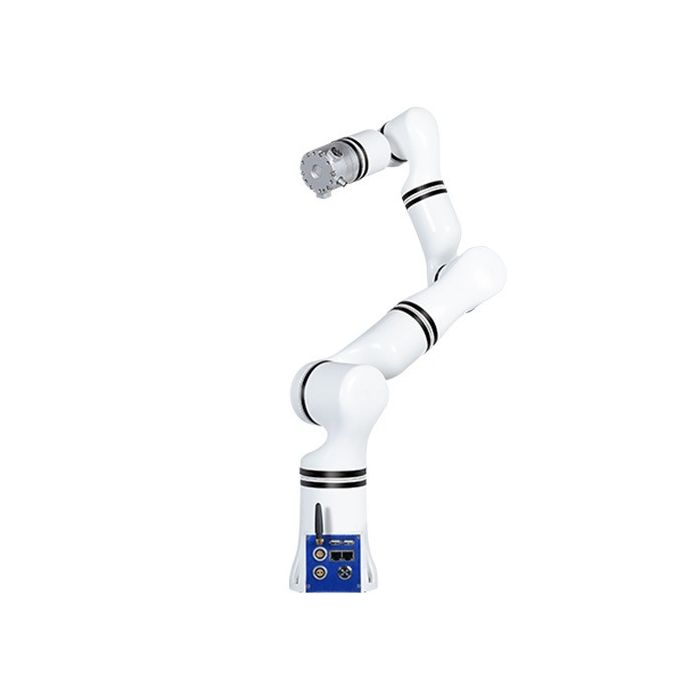
Realman Robotics Ultra-Lightweight Robotic Arm (RM65-6F)
In stock
- BRAND:
- REALMAN
- MODEL:
- RM65-6F
- PART #:
- RM65-6F
- ORIGIN:
- China
- AVAILABILITY:
- SUBJECT TO AVAILABILITY
- SKU:
- Realman Robotics-RM65-6F
Realman Robotics Ultra-Lightweight Robotic Arm (RM65-6F)
Weight is usually what a robotic arm gives up in exchange for strength and precision: the more an arm must carry and the more accurately it must place it, the heavier its links, base and control cabinet tend to become. The Realman Robotics Ultra-Lightweight Robotic Arm (RM65-6F) challenges that trade. Its aluminium alloy structure weighs 7.3 kg with the controller built in, and RealMan has run it continuously under a 5 kg load for over 30,000 hours without failure. It also carries a six-axis force/torque sensor at the wrist, so the arm measures the forces it applies as well as the positions it reaches.
Robots Middle East supplies the RM65-6F to universities, research laboratories, system integrators and industrial teams across the Middle East. Robots Middle East prepares each quotation, coordinates delivery to the customer's site and provides support after installation, so that an arm chosen for a laboratory bench or a production cell arrives with a clear plan for commissioning.
Background
RealMan and the RM series
The RM series ultra-lightweight humanoid robotic arm is a 6-DOF and 7-DOF robotic arm independently developed and produced by RealMan. The series is built around two configurations: the RM65/75-B basic versions and the RM65/75-6F six-axis force versions. The RM65 designation refers to the six-degree-of-freedom arm, while the RM75 adds a seventh joint. The RM65-6F is therefore the six-joint arm in its force-sensing configuration, sharing its mechanical design with the basic RM65-B while adding the sensor that sets the 6F versions apart.
RealMan's wider range includes further arms for different requirements, which Robots Middle East lists in its Robot Arms category, including long arm span models and entry-level options.
Integrated control and force sensing
Two design choices define the RM65-6F. The first is the integrated controller: the control electronics sit within the arm rather than in a separate cabinet, which suits installations where floor space, mobility or a tidy workcell matters. The second is the six-axis force/torque sensor, rated at 200N / 7N·m with an accuracy of ±0.5%FS, intended for precision contact tasks. Alongside the sensor, a built-in safety module stops the arm on contact, enabling safe human-machine collaboration and streamlining drag-and-drop teaching, in which an operator guides the arm by hand to record a motion.
Technical Specifications
| Specification | Value |
|---|---|
| Degrees of freedom | 6 (RM65) |
| Working radius | 627 mm |
| Net weight | 7.3 kg |
| Positioning repeatability | ±0.05 mm |
| Maximum TCP speed | 1.8 m/s |
| Six-axis force/torque sensor | 200N / 7N·m, ±0.5%FS |
| Joint motion range | J1 ±178°, J2 ±130°, J3 ±135°, J4 ±178°, J5 ±128°, J6 ±360° |
| Joint maximum speed | J1-J2 180°/s, J3-J6 225°/s |
| Material | Aluminium alloy |
| Controller | Integrated |
| Safety | Built-in safety module that stops operation upon contact |
| Reliability test | Continuous operation under a 5 kg load for over 30,000 hours without failure |
Specifications as published by the manufacturer; confirmed against the datasheet at quotation. The manufacturer has not published the arm's dimensions, certifications, cable length, controller interface ports, software package, mounting bolt pattern or noise level; Robots Middle East confirms these at quotation.
What does the RM65-6F add over the basic RM65-B?
The basic and force versions of the RM65 share the same six-joint kinematics, the same aluminium alloy construction and the same integrated controller. The difference lies in what the arm can perceive. A basic arm knows where its joints are; the RM65-6F also knows how hard its tool is pressing and in which direction, through a six-axis force/torque sensor rated at 200N / 7N·m with ±0.5%FS accuracy.
That distinction matters whenever the task involves contact. Inserting a part into a tight fit, pressing a button on laboratory equipment, following a surface with consistent pressure or handing an object to a person all depend on reacting to force rather than simply reaching a coordinate. Position control alone can achieve these tasks only when parts and fixtures are perfectly repeatable; force feedback lets the program respond to the small variations found in real work. Combined with ±0.05 mm positioning repeatability, the RM65-6F is designed for work in which both accuracy and touch count.
For applications that are purely about moving between known positions, such as simple transfer or demonstration routines, the basic RM65-B provides the same arm without the sensor. Robots Middle East can advise which configuration a project needs when preparing the quotation.
Why does the arm's low weight matter?
At 7.3 kg with its controller integrated, the RM65-6F can be mounted where heavier industrial arms cannot: on a mobile base, a laboratory bench, a compact frame or a humanoid or dual-arm research platform. Lower mass also means lower inertia in motion, which supports the joint speeds of up to 225°/s on the wrist joints and a TCP speed of up to 1.8 m/s.
Light weight is only useful if it does not come at the expense of durability. RealMan's endurance test, in which the arm operated continuously under a 5 kg load for over 30,000 hours without failure, addresses that concern directly. For a buyer, this combination means an arm that is easy to relocate and integrate, yet tested for sustained operation.
Who is the Realman Robotics Ultra-Lightweight Robotic Arm (RM65-6F) for?
Research groups in robotics, manipulation and human-robot interaction form a natural audience. Force sensing, drag-and-drop teaching and a compact build make the RM65-6F a practical platform for experiments in compliant control, learning from demonstration and mobile manipulation.
Laboratory automation teams will value an arm that fits on a bench, works close to people thanks to its contact-stop safety module, and can operate instruments that require a measured touch. Robots Middle East also lists the arm among its Cobots for teams planning shared workspaces.
System integrators and manufacturers building light assembly, testing or inspection cells will find the integrated controller simplifies cabinet design and wiring, while the force sensor supports insertion and contact-based quality checks.
Where a project needs greater reach than the RM65-6F's 627 mm working radius, the long arm span Realman Robotics RML63-6F Long Arm Span Robotic Arm 6-Axis-Force Version (RML63-6F) is the force-sensing alternative to compare, and the Realman Robotics RML63-B Long Arm Span Robotic Arm Basic Version (RML63-B) covers the same need without force sensing.
What is the Realman Robotics Ultra-Lightweight Robotic Arm (RM65-6F) used for?
- Precision assembly: inserting and fitting components where force feedback guides the final motion.
- Laboratory automation: handling samples and operating instruments on a bench alongside staff.
- Human-robot collaboration: shared tasks in which the contact-stop safety module protects the operator.
- Teaching by demonstration: recording motions through drag-and-drop teaching instead of offline programming.
- Mobile manipulation: mounting on mobile or humanoid platforms where every kilogram of arm weight counts.
- Research and education: studying force control, compliance and manipulation in university laboratories.
Pricing and Availability
Robots Middle East supplies the RM65-6F on quotation, so that each offer reflects the configuration, accessories and integration support a project requires. Delivery, customs clearance and technical support are arranged together with the quotation. To receive an offer tailored to your application, request a quotation for the Realman Robotics Ultra-Lightweight Robotic Arm (RM65-6F), available on this page.
Frequently Asked Questions
Does the RM65-6F need a separate control cabinet?
No. The controller is integrated into the arm, which reduces the external hardware needed in the workcell.
What is the rating of the force/torque sensor?
The six-axis force/torque sensor is rated at 200N / 7N·m with an accuracy of ±0.5%FS. It is designed for precision contact tasks.
What is the working radius and weight of the arm?
The RM65 six-axis force version has a working radius of 627 mm and a net weight of 7.3 kg.
How accurate and fast is the RM65-6F?
It offers ±0.05 mm positioning repeatability and a TCP speed of up to 1.8 m/s. Joints J1-J2 reach 180°/s and J3-J6 reach 225°/s.
Can the arm work safely alongside people?
The arm has a built-in safety module that stops operation upon contact, enabling safe human-machine collaboration and drag-and-drop teaching. A risk assessment for the specific installation remains the responsibility of the integrator.
What is the RM65-6F made of?
The arm is built from aluminium alloy, with its controller integrated into the structure. This construction keeps the net weight of the arm at 7.3 kg.
Where can I buy the Realman Robotics Ultra-Lightweight Robotic Arm (RM65-6F) and what does it cost?
Robots Middle East supplies the RM65-6F across the Middle East. The cost depends on configuration and project scope, so please request a quotation on this page.
Summary
The RM65-6F answers a familiar dilemma in robotics: how to keep an arm light without giving up the precision and endurance that serious work demands. RealMan's answer is an aluminium alloy arm of 7.3 kg with its controller inside, ±0.05 mm repeatability, a 627 mm working radius and a six-axis force/torque sensor that lets it respond to contact, backed by more than 30,000 hours of continuous operation under a 5 kg load in testing. For research groups, laboratory teams and integrators who need an arm that is easy to place and able to feel its work, Robots Middle East quotes, delivers and supports the arm across the region, and this page is the starting point.