
Realman Robotics Ultra-Lightweight Robotic Arm (RM75-6F)
In stock
- BRAND:
- REALMAN
- PART #:
- RM75-6F
- ORIGIN:
- China
- AVAILABILITY:
- SUBJECT TO AVAILABILITY
- SKU:
- Realman Robotics-RM75-6F
Realman Robotics Ultra-Lightweight Robotic Arm (RM75-6F)
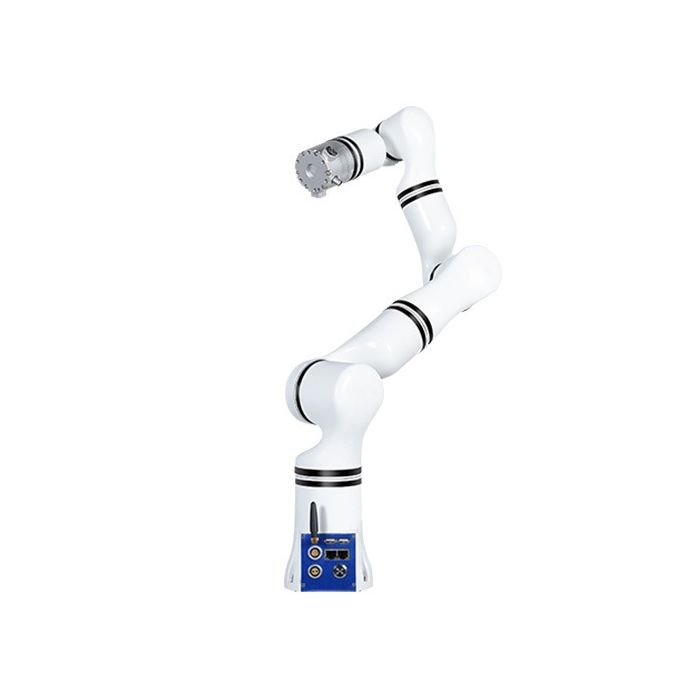
In most robot cells the control cabinet is the silent partner: a steel box on the floor, a heavy umbilical cable and a fixed position that the arm can never stray far from. The Realman Robotics Ultra-Lightweight Robotic Arm (RM75-6F) does away with that partner. Its controller is built into the arm, its seven joints give it room to work around obstacles, and a six-axis force/torque sensor allows it to register the forces it meets at the tool. The result is a manipulator that can be carried to the task rather than having the task brought to it, with a body weight of 7.9kg and a DC24V power supply that suits mobile platforms and benchtop installations alike.
Robots Middle East supplies the RM75-6F to universities, research laboratories, system integrators and industrial users throughout the Middle East. Our team prepares each quotation, coordinates delivery to your site and remains your point of contact for technical support once the arm is in service.
Background
Realman and the RM series
Realman Robotics designs lightweight robotic arms intended to be built into larger systems: mobile robots, humanoid upper bodies, laboratory benches and compact production cells. The RM series is organised around two arm geometries and two sensing options. The RM65 models have six degrees of freedom and the RM75 models have seven; each geometry is offered as a basic version, identified by the suffix -B, and as a six-axis force version, identified by -6F. The RM75-6F therefore combines the more flexible seven-joint geometry with integrated force sensing, which places it at the most capable end of the series.
Integrated control and force sensing
Two design decisions define this arm. The first is the integrated controller, which removes the separate cabinet found in many industrial installations and simplifies mounting on a moving base. Communication is available over WIFI, network port, Bluetooth, USB serial port and RS485, and the arm can be programmed by drag and drop teaching, by teaching pendant, or through an API and JSON commands. The second decision is the six-axis force/torque sensor, rated at 200N/7Nm, which measures forces and torques at the end of the arm and makes force-controlled motion possible. Alongside it, a built-in safety module stops operation upon contact, which supports safe human-machine collaboration and makes hand-guided teaching more straightforward. Realman reports that the arm has operated continuously under a 5 kg load for over 30,000 hours without failure.
Technical Specifications
| Specification | Value |
|---|---|
| Degrees of freedom | 7 |
| Payload | 5kg |
| Peak payload | 9kg |
| Body weight | 7.9kg |
| Repeatability | ±0.05mm |
| Working radius | 638.5mm |
| TCP linear speed | ≤1.8 m/s |
| Six-axis force range | 200N/7Nm |
| Six-axis force accuracy | <0.1% FS |
| Joint motion range | J1 ±178°, J2 ±130°, J3 ±178°, J4 ±135°, J5 ±178°, J6 ±128°, J7 ±360° |
| Joint maximum speed | J1-J2 180°/s, J3-J7 225°/s |
| Power supply voltage | DC24V |
| Power consumption | Maximum 200W, comprehensive 100W |
| Protection level | IP54 (robotic arm body) |
| Material | Aluminium alloy |
| Controller | Integrated |
| Communication mode | WIFI / network port / Bluetooth / USB serial port / RS485 |
| Control mode | Drag and drop teaching / teaching pendant / API / JSON |
Specifications are as published by the manufacturer and are confirmed against the datasheet at quotation. The manufacturer has not published the dimensions of the arm, the package contents, independent certifications or the details of the tool flange interface; these are confirmed at quotation.
What does the RM75-6F add over the RM75-B?
Both arms share the seven-joint geometry, the integrated controller, the 5kg payload and the ±0.05mm repeatability. The difference lies at the wrist. The RM75-B is the basic version and carries no six-axis force sensor, whereas the RM75-6F measures forces up to 200N and torques up to 7Nm at the end of the arm. Realman publishes the RM75-B with a working radius of 610mm and a body weight of 7.8kg, against 638.5mm and 7.9kg for the RM75-6F, so the force version also offers slightly more reach.
What the sensor changes is the kind of task the arm can be trusted with. A position-controlled arm follows its programmed path regardless of what it encounters; a force-sensing arm can regulate how firmly it presses, detect when a part has seated, or yield when a surface is not quite where the program expected. For insertion, polishing, surface following and any work involving delicate or variable components, that feedback is often what separates a dependable process from a fragile one.
Why choose a seven-axis arm over a six-axis one?
Six joints are enough to place a tool at any reachable position and orientation. A seventh joint adds redundancy: the arm can reach the same tool pose with different elbow positions, which allows it to work around fixtures, avoid obstacles or keep clear of a person sharing the workspace. This is why seven-joint arms are widely chosen for humanoid upper bodies, for manipulation in cluttered environments and for research into motion planning. On the RM75-6F, the final joint rotates through ±360°, which suits tasks involving continuous wrist rotation. Where the workspace is open and the motions are simple, the six-axis RM65 models in the same series may be the more economical engineering choice.
Who is the RM75-6F for?
The RM75-6F is aimed principally at research laboratories and universities working on force control, dexterous manipulation and human-robot interaction, where the combination of seven joints and force sensing in one integrated unit saves considerable integration effort. Developers of mobile manipulators and humanoid platforms form a second group: the integrated controller, the DC24V supply and a body weight of 7.9kg make the arm well suited to mounting on a moving base. System integrators building contact-rich applications, such as assembly or finishing cells that require consistent pressure, form a third.
Buyers who need the seven-joint geometry but not force feedback, for example for pick-and-place research or demonstration work, may find that the Realman Robotics Ultra-Lightweight Robotic Arm (RM75-B) meets their requirements. The wider choice of manipulators is available in our Robot Arms category, and complete platforms can be found under Humanoids.
What is the RM75-6F used for?
- Force-controlled assembly: inserting pins, connectors and fitted parts while monitoring contact forces at the tool.
- Surface finishing: polishing, sanding or wiping with regulated pressure across curved surfaces.
- Research and education: teaching and studying force control, redundant kinematics and motion planning.
- Mobile manipulation: mounting on wheeled bases or humanoid torsos thanks to the integrated controller and DC24V supply.
- Collaborative workstations: sharing a bench with people, supported by the safety module that stops operation upon contact.
- Laboratory automation: handling samples, instruments and containers where gentle, repeatable contact is required.
Pricing and Availability
Robots Middle East prepares a quotation for each RM75-6F order according to the configuration and the project it serves, so please contact our team with your application, your intended mounting and any accessories you require. Delivery, customs clearance and technical support are arranged together with your quotation. A quotation for the Realman Robotics Ultra-Lightweight Robotic Arm (RM75-6F) can be requested directly from Robots Middle East, available on this page.
Frequently Asked Questions
How much can the RM75-6F carry?
The arm has a payload of 5kg and a peak payload of 9kg. Realman reports continuous operation under a 5 kg load for over 30,000 hours without failure.
How many degrees of freedom does the RM75-6F have?
It has seven degrees of freedom. The additional joint allows the arm to reach the same tool pose with different elbow positions.
What does the six-axis force sensor measure?
It measures forces and torques at the end of the arm, with a range of 200N/7Nm. This allows force-controlled tasks such as insertion, polishing and surface following.
How is the arm programmed?
The RM75-6F supports drag and drop teaching, a teaching pendant, and programming through an API and JSON. It communicates over WIFI, network port, Bluetooth, USB serial port and RS485.
Can the RM75-6F work alongside people?
Yes, it has a built-in safety module that stops operation upon contact, which supports safe human-machine collaboration. A risk assessment of the complete installation remains advisable for every application.
Does the arm need a separate control cabinet?
No, the controller is integrated into the arm. It operates from a DC24V power supply, with a maximum power consumption of 200W.
Where can I buy the Realman Robotics Ultra-Lightweight Robotic Arm (RM75-6F) and what does it cost?
You can buy the RM75-6F from Robots Middle East, which supplies customers across the Middle East. The cost depends on your configuration and project, and our team will prepare a quotation on request.
Summary
Removing the control cabinet changes where a robotic arm can go, and the RM75-6F takes full advantage of that freedom. With its controller built in, seven joints for working around obstacles and a six-axis force sensor for managing contact, it brings to a mobile base, a laboratory bench or a humanoid torso the capabilities that would otherwise require a fixed cell. Its 5kg payload, ±0.05mm repeatability and 638.5mm working radius suit precise, contact-sensitive work, and the RM75-B and RM65 models remain available for projects that need less. For a quotation from Robots Middle East, delivered and supported across the region, this page is the starting point.