
RobotEra L7 Bipedal Humanoid Robot W
In stock
- BRAND:
- ROBOTERA
- PART #:
- L7
- ORIGIN:
- China
- Warranty:
- 12 MONTHS
- AVAILABILITY:
- SUBJECT TO AVAILABILITY
- SKU:
- RobotEra-L7
RobotEra L7 Bipedal Humanoid Robot W
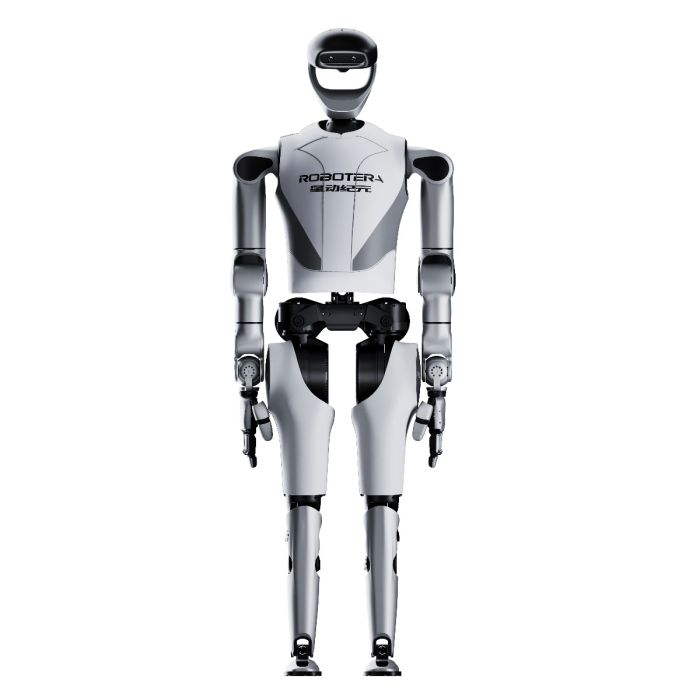
Inside most robot joints, a gearbox sits between the motor and the limb. It multiplies force, but it also muffles the limb's sense of what it has just touched, and it costs energy every time it turns. The RobotEra L7 Bipedal Humanoid Robot w is built around joints that do without the conventional gear reducer, and a great deal of what the machine can do follows from that one engineering decision. The result is a full-size humanoid that can sprint, spin in the air and land, then step up to a workbench to drive screws and scan barcodes. The body is human in scale, yet the real story is told at the joint.
Robots Middle East supplies the L7 to universities, research laboratories, industrial integrators and exhibition organisers across the Middle East. Robots Middle East prepares each quotation around the configuration you require, whether full-body or upper-body only, and arranges delivery and after-sales support for customers throughout the region, so that a single partner remains responsible from the first enquiry to the robot in service.
Background
ROBOTERA and its humanoid line
ROBOTERA develops humanoid robots and the dexterous hands that equip them. Its range spans bipedal machines such as the L7, wheeled humanoids built for service and manipulation, and standalone robotic hands. Within that family the L7 occupies the most demanding position: a full-size, high-performance bipedal humanoid intended for multi-scenario deployment, meaning that the same platform is expected to serve in logistics, in industrial settings and in commercial services rather than in a single narrow role.
That ambition shapes the engineering choices. A robot that must both perform athletic movements and carry out careful manual tasks needs joints that are powerful, quick and sensitive at once, and a structure light enough for the legs to move it with authority. ROBOTERA addressed both requirements in-house rather than assembling the robot from off-the-shelf components.
Quasi-direct drive joints and a modular skeleton
The L7 uses a quasi-direct drive joint system combined with a self-developed modular skeletal structure. By eliminating conventional gear reducers, the design reduces power loss and achieves a more compact structure with improved force feedback accuracy, which allows the robot to adjust to impacts in real time. The self-developed semi-direct drive joints reach 400N·m peak torque and 25rad/s peak speed, and the frame houses built-in efficient heat dissipation for these high-power joints.
The skeleton itself is made of aerospace-grade aluminium alloy and carbon fibre. For a humanoid, mass is the enemy of agility: every kilogram in the limbs must be accelerated and stopped with each stride. Pairing a light composite structure with responsive, high-torque joints is what makes running and rotating jumps achievable on a machine of adult height.
Technical Specifications
| Specification | Value |
|---|---|
| Product type | Full-size high-performance bipedal humanoid robot for multi-scenario deployment |
| Height | 171 cm |
| Total weight | 65kg (excl. dexterous hands) |
| Full-body degrees of freedom | 55 DOF |
| Dual-arm max payload | 20kg |
| Upper limb configuration | 7DOF humanoid robotic arms + 3DOF waist |
| Operation space | 2.1m diameter |
| Locomotion | Walking, running (4m/s), 360° rotating jumps |
| Joint peak torque | 400N·m |
| Joint peak speed | 25rad/s |
| Joint drive | Quasi-direct drive joint system, self-developed modular skeletal structure, no conventional gear reducers |
| Dexterous hand degrees of freedom | 12 independently actuated degrees of freedom |
| Dexterous hand response rate | 10 Hz |
| Perception system | Binocular vision + 3D LiDAR + microphone array |
| Communication and control | Ethernet/USB communication, full-body teleoperation, 2.4G wireless control |
| Interfaces | 1×HDMI, 1×Ethernet, 2×USB, 1×emergency stop, external power interface |
| Power | High-performance lithium battery with BMS |
| Frame material | Aerospace-grade aluminium alloy + carbon fibre |
| Thermal management | Built-in efficient heat dissipation for high-power joints |
| Configurations | Full-body; upper-body only (interchangeable) |
Specifications are as published by the manufacturer and are confirmed against the datasheet at quotation.
The manufacturer has not published the battery capacity, the charging time, the IP rating, the operating system, the onboard compute, any dimensions other than height or the contents of the box; these details are confirmed at quotation.
What makes the RobotEra L7 different from a conventional geared humanoid?
The difference begins with the joint. In a geared design, the reducer allows a small motor to deliver large torque, but friction and backlash sit between the motor and the outside world. When the limb meets an unexpected obstacle, the motor learns of it late and imprecisely. The L7's quasi-direct drive arrangement removes the conventional reducer, cutting power loss and sharpening force feedback, so the controller can react to an impact as it happens rather than after the fact.
That responsiveness matters at both ends of the robot's repertoire. For dynamic movement, landing a 360° rotating jump or running at 4m/s demands joints that can absorb and redirect sudden loads. For manipulation, the same sensitivity helps the robot handle a soft package without crushing it or seat a screw without forcing the thread. The joints deliver 400N·m peak torque and 25rad/s peak speed, so the gain in sensitivity does not come at the expense of power.
Perception completes the picture. Binocular vision, 3D LiDAR and a microphone array are fused to give the robot dead-angle-free awareness, supporting obstacle avoidance in complex environments such as warehouses stacked with irregular goods, and recognition of QR codes that are tilted or wrinkled. The hands add 12 independently actuated degrees of freedom, with each finger controlled on its own, and adjust finger posture 10 times per second, so the robot can move quickly between screwing, scanning and labelling.
What does the upper-body configuration change?
The L7 is offered in interchangeable full-body and upper-body configurations. ROBOTERA directs the full-body version towards commercial services and dynamic displays such as 360° spinning jumps and street dance performances, where the legs are the point of the exercise. The upper-body arrangement keeps the manipulation side of the robot, namely the 7DOF arms, the 3DOF waist and the dexterous hands, for buyers whose interest lies chiefly in what the robot does with its arms and hands. Because the figures for each configuration should be read from the datasheet, Robots Middle East confirms the specification of the chosen configuration in the quotation.
Who is the RobotEra L7 for?
Research institutions working on humanoid locomotion, whole-body control and dexterous manipulation are natural buyers. Fifty-five full-body degrees of freedom, full-body teleoperation and open Ethernet and USB connections give researchers a platform on which to study balance, gait and grasping on a single machine, and to collect demonstration data through teleoperation.
Industrial and logistics teams evaluating humanoids for real tasks form a second group. The manufacturer cites sorting, barcode scanning and screw fastening as functional tasks in logistics and industrial settings, and the perception system is described with exactly such environments in mind. For pilot projects in warehouses and factories in the region, the L7 lets a team test humanoid work in spaces that were designed for people.
Commercial services, exhibition organisers and science centres make up the third segment. Here the full-body version is the one to choose, since its running, spin jumps and dance routines are what draw an audience. Universities building advanced robotics programmes complete the list. Buyers comparing alternatives can browse our Bipedal Humanoids category, or the wider range of Humanoids from ROBOTERA.
What is the RobotEra L7 used for?
- Logistics sorting — picking and sorting goods while avoiding obstacles among irregular items in a warehouse.
- Barcode and QR code scanning — reading codes even when labels are tilted or wrinkled.
- Screw fastening and assembly — operating tools such as screw guns with independently controlled fingers.
- Dynamic displays and performances — running, 360° spinning jumps and street dance in the full-body version.
- Teleoperation and data collection — full-body teleoperation for remote tasks and for gathering demonstration data.
- Humanoid research and teaching — a platform for locomotion, whole-body control and manipulation studies.
Pricing and Availability
Robots Middle East supplies the L7 on quotation, so that the offer reflects the configuration, accessories and project requirements of each customer. Delivery, customs clearance and after-sales support are arranged together with the quotation. To begin, please share your intended application and preferred configuration with our team, and Robots Middle East will return a tailored proposal; the quotation request form is available on this page.
Frequently Asked Questions
How tall is the RobotEra L7 and how much does it weigh?
The L7 stands 171 cm tall. Its total weight is 65kg, excluding the dexterous hands.
How fast can the L7 move?
The robot can walk, run at 4m/s and perform 360° rotating jumps.
How many degrees of freedom does the L7 have?
The robot has 55 full-body DOF. Each arm offers 7DOF, the waist adds 3DOF, and the dexterous hands provide 12 independently actuated degrees of freedom.
What can the L7 carry?
The dual-arm maximum payload is 20kg. Single-arm use is intended for dexterous tasks.
How is the L7 controlled?
It supports Ethernet and USB communication, full-body teleoperation and 2.4G wireless control. The robot also provides HDMI, Ethernet and USB ports, an emergency stop and an external power interface.
Is there more than one configuration?
Yes, the L7 comes in interchangeable full-body and upper-body configurations. The full-body version suits dynamic displays and performances.
Where can I buy the RobotEra L7 and what does it cost?
You can buy the L7 from Robots Middle East, which supplies customers across the Middle East. The cost depends on the configuration and project scope, so please request a quotation and our team will prepare an offer for you.
Summary
The L7 is easiest to understand from the inside out. Joints that dispense with the conventional gear reducer give it fast, accurate force feedback; a light skeleton of aluminium alloy and carbon fibre lets those joints move a full-size body with agility; and fused vision, LiDAR and sound give it the awareness to work among people and goods. From that foundation come both the athletic repertoire of running and spin jumps and the patient work of sorting, scanning and fastening. For research teams, industrial pilots and exhibition organisers in the Middle East considering a humanoid of this calibre, with Robots Middle East handling quotation, delivery and support, this page is the starting point.
Specifications
General
Physical
Mobility
Performance
What's included
Downloads
Related Products
Out of stock