
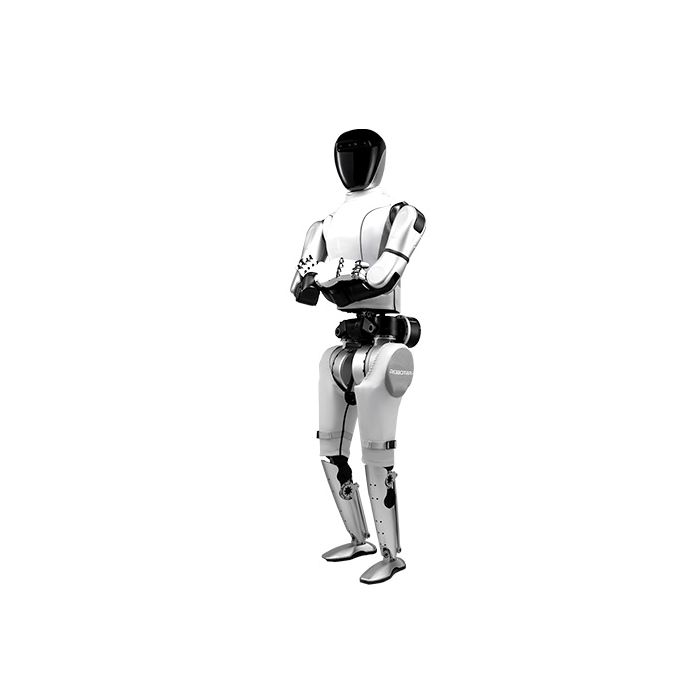
RobotEra Star1 Humanoid Robot
Out of stock
- BRAND:
- ROBOTERA
- PART #:
- Star1
- ORIGIN:
- China
- Warranty:
- 12 MONTHS
- AVAILABILITY:
- SUBJECT TO AVAILABILITY
- SKU:
- RobotEra-Star1
RobotEra Star1 Humanoid Robot
Most humanoid robots are built to excel at one thing: some are sprinters that cannot do much with their hands, others are skilled manipulators that shuffle carefully across a flat floor. The RobotEra Star1 Humanoid Robot is ROBOTERA's attempt to remove that trade-off. Its legs are built for running and jumping over uneven ground, while its arms end in direct-drive, five-fingered hands that can take on fine assembly work. The result is a single machine that can cross a workshop at pace and then do something useful with its hands when it arrives.
Robots Middle East supplies the RobotEra Star1 Humanoid Robot to research institutions, universities, system integrators and industrial users across the Middle East. We prepare each quotation for the specific configuration and project, coordinate delivery to the customer's site and provide technical support once the robot is in service.
Background
ROBOTERA: a young company with full-stack ambitions
ROBOTERA was founded in August 2023, which makes it one of the newer names in a field where several competitors have been working for a decade or more. What sets the company apart is its decision to own both halves of the problem. It develops its software and its hardware in house, combining its own native embodied foundation model, ERA-42, with what it calls an AI-defined hardware platform. Rather than buying in a control stack or a set of actuators and then integrating them, ROBOTERA designs the intelligence and the body together, and the Star1 is the most visible product of that approach.
ERA-42 and the Star1's place in the range
The Star1 runs ERA-42, ROBOTERA's proprietary end-to-end AI model, which enables it to walk, run and jump stably on a variety of challenging terrains. End-to-end models of this kind aim to map what a robot perceives directly onto how it moves, rather than relying on a long chain of hand-tuned rules for every situation. Within ROBOTERA's line-up, the Star1 is the full-size bipedal model: a robot of human height with legs, a flexible waist, an articulated neck and two dexterous arms. It sits alongside the company's wheeled humanoids and its standalone dexterous hands, all of which appear among the Humanoids offered by Robots Middle East.
Technical Specifications
| Specification | Value |
|---|---|
| Height | 171 cm |
| Weight | 63 kg |
| Degrees of freedom (overall) | 55 |
| Leg degrees of freedom | 12 DOF |
| Waist degrees of freedom | 3 DOF |
| Neck degrees of freedom | 2 DOF |
| Arms | Dual bionic arms, 7 DOF each |
| Arm lifting capacity | 20 kg in total (both arms) |
| Hands | ROBOTERA XHAND1, five-fingered, 12 active DOF, full direct drive |
| Joint torque | Up to 400 Nm |
| Peak joint rotational speed | 25 rad/s |
| Top running speed (outdoors) | 3.6 m/s |
| Runtime per charge | 4 hours |
| AI model | ERA-42 (proprietary, end-to-end) |
Specifications are as published by the manufacturer and are confirmed against the datasheet at quotation.
ROBOTERA has not published a rated payload, the IP rating, the battery capacity, the charging time, the connectivity, the sensors and cameras, the operating system, the onboard compute platform, the operating temperature range or the contents of the box; all of these are confirmed with your quotation.
What makes the Star1 different from a wheeled humanoid?
The clearest difference is in how the robot gets around. A wheeled humanoid places a human-like upper body on a mobile base, which is efficient and stable on smooth, level floors. The Star1 instead walks on legs with 12 degrees of freedom, supported by a waist with 3 degrees of freedom that helps it stay flexible and balanced. Combined with the ERA-42 model, which allows it to walk, run and jump on challenging terrain, this gives the Star1 access to places that a wheeled base would find difficult: steps, thresholds, cluttered aisles and outdoor ground.
Legs also bring speed. Outdoors, the Star1 reaches a top running speed of 3.6 m/s, and its joints deliver up to 400 Nm of torque with peak rotational speeds of 25 rad/s. These are figures that matter to anyone studying dynamic locomotion, balance recovery or agile movement, and they are the reason many research groups specifically seek out a biped rather than a wheeled platform.
That said, legs are not always the right answer. Where the work takes place on a flat factory floor and the priority is the upper body, a wheeled design such as the RobotEra M7 Upper Body Wheeled Humanoid Robot or the RobotEra Q5 Wheeled Humanoid Service Robot may be the more practical choice. Robots Middle East is happy to compare the options for a given site.
How capable are the Star1's hands and arms?
Many bipedal robots are developed first as walking machines, with manipulation added later. The Star1 treats its upper body as seriously as its legs. Each arm offers 7 degrees of freedom, the same number as a human arm from shoulder to wrist, which gives it the redundancy needed to reach around obstacles and approach a part from different angles. The two arms together can lift 20 kg in total.
At the end of each arm is the ROBOTERA XHAND1, a five-fingered dexterous hand with 12 active degrees of freedom and full direct drive. Direct drive means the fingers are driven without the long gear trains or tendon systems found in many robotic hands, an approach generally associated with responsive, back-drivable motion. For tasks such as precision assembly, inserting connectors or handling small components, that dexterity is what turns a mobile robot into a productive one. A neck with 2 degrees of freedom allows natural, human-like head movement, which supports tasks that require precise head positioning. Laboratories that want to work on manipulation alone can also obtain the hand separately, for example the Robotera XHAND1 Dexterous Right Hand.
Who is the RobotEra Star1 Humanoid Robot for?
The first group is research. University laboratories and research centres working on embodied AI, bipedal locomotion, whole-body control or dexterous manipulation will find in the Star1 a platform that covers all of these areas in one body. Its 55 degrees of freedom give researchers a great deal to work with, and the pairing of a running-capable biped with direct-drive hands is unusual.
The second group is industry, particularly automotive assembly and 3C manufacturing (computers, communications and consumer electronics). ROBOTERA positions the Star1 for precision assembly, quality checks, packaging and material transport in these sectors. Manufacturers exploring how humanoids could fit into existing production lines, and the system integrators who support them, are natural buyers.
The third group comprises innovation teams, technology showcases and pilot programmes, which are common across the region as organisations evaluate automation and AI. A full-size humanoid that can move dynamically and handle objects is a strong platform for such projects. Buyers who do not need legged mobility should look at the wheeled models mentioned above, while those comparing several walking robots can browse our range of Bipedal Humanoids.
What is the RobotEra Star1 Humanoid Robot used for?
- Precision assembly: fitting and joining components in automotive and electronics production with dexterous hands.
- Quality checks: inspecting parts and assemblies at points along a production line.
- Packaging: picking, placing and packing finished goods for dispatch.
- Material transport: carrying parts and materials between workstations across the floor.
- Locomotion research: studying walking, running, jumping and balance on varied terrain.
- Embodied AI development: testing and training models that link perception to whole-body action.
Pricing and Availability
The RobotEra Star1 Humanoid Robot is supplied on quotation, because configuration, intended use and project scope all affect what each customer needs. Robots Middle East prepares every quotation individually and confirms the outstanding specifications against the manufacturer's datasheet as part of that process. Delivery, customs clearance and technical support are arranged together with the quotation. To begin, simply use the quotation request available on this page.
Frequently Asked Questions
How tall is the RobotEra Star1 Humanoid Robot and how much does it weigh?
The Star1 stands 171 cm tall and weighs 63 kg. That places it close to the size of an adult person.
How fast can the Star1 run?
In outdoor conditions the Star1 reaches a top running speed of 3.6 m/s. Its joints deliver up to 400 Nm of torque and peak rotational speeds of 25 rad/s.
What AI does the Star1 use?
It runs ERA-42, ROBOTERA's proprietary end-to-end AI model. ERA-42 enables the robot to walk, run and jump stably on a variety of challenging terrains.
Which hands does the Star1 have?
The Star1 is fitted with the ROBOTERA XHAND1, a five-fingered dexterous hand with 12 active degrees of freedom and full direct drive. Each hand is mounted on an arm with 7 degrees of freedom.
How long does the Star1 run on one charge?
ROBOTERA states a runtime of 4 hours per charge. The battery capacity and charging time are confirmed at quotation.
Which industries is the Star1 intended for?
ROBOTERA highlights automotive assembly and 3C manufacturing, where the Star1 can handle precision assembly, quality checks, packaging and material transport. It is also well suited to research in locomotion and embodied AI.
Where can I buy the RobotEra Star1 Humanoid Robot and what does it cost?
You can buy the Star1 from Robots Middle East, which supplies it across the Middle East. Pricing depends on configuration and project scope, so it is provided in a personal quotation that you can request on this page.
Summary
The RobotEra Star1 Humanoid Robot sets out to be both athlete and craftsman. Its legs, waist and ERA-42 model give it the ability to run at 3.6 m/s outdoors and to stay stable on challenging terrain, while its 7-DOF arms and direct-drive XHAND1 hands give it the dexterity for assembly, inspection and handling. Behind it stands ROBOTERA, a company that has, since 2023, developed its own AI and hardware side by side. For laboratories studying embodied intelligence and for manufacturers testing humanoids on real production tasks, the Star1 offers a rare combination in one full-size body. Robots Middle East will quote, deliver and support it across the region, and for any organisation considering it, this page is the starting point.