
RobotEra M7 Upper Body Wheeled Humanoid Robot
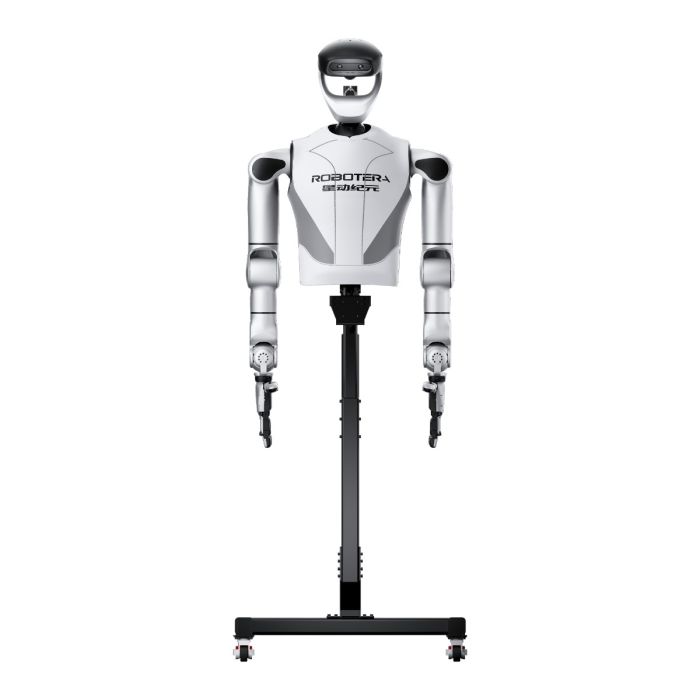
In stock
- BRAND:
- ROBOTERA
- MODEL:
- M7
- ORIGIN:
- China
- Warranty:
- 12 MONTHS
- AVAILABILITY:
- SUBJECT TO AVAILABILITY
- SKU:
- RobotEra-M7
RobotEra M7 Upper Body Wheeled Humanoid Robot
Every vision-language-action model is shaped by the demonstrations it receives, and those demonstrations can only be as rich as the hands that perform them. A robot that grips with a simple claw teaches a model to grip like a claw. The RobotEra M7 Upper Body Wheeled Humanoid Robot begins from the opposite premise: give a research team or a production engineer a humanlike upper body with ten fingers, stereo vision and a software environment built on ROS, and the distance between what a person does and what a machine can learn starts to narrow. The M7 is designed for embodied AI research, teleoperation and dexterous manipulation in laboratory and industrial settings, and it places its engineering where that work is decided: in the arms, the hands and the eyes.
Robots Middle East sells the RobotEra M7 and supplies it to universities, research institutes and industrial teams across the Middle East. Our team prepares each quotation, coordinates delivery to your site and supports the robot once it is in service, so that your laboratory or plant works with a single partner from the first enquiry to the first experiment. The M7 belongs to our Upper Body Humanoids range, which forms part of the wider Humanoids category.
Background
ROBOTERA and its humanoid family
ROBOTERA builds humanoid platforms intended for embodied intelligence, the field in which AI models learn by perceiving and acting in the physical world rather than from text and images alone. Within that family the M7 has a clearly defined role. It is the upper-body member, and its full-body sibling is the RobotEra L7 Bipedal Humanoid Robot. The two are related closely enough that the M7 can be easily upgraded to the full-body L7 model, which means an institution can begin with manipulation research and extend its programme later without abandoning the platform it has learned to work with.
An upper body engineered for manipulation
The structure of the M7 combines aluminium alloy with engineering composites, a pairing commonly chosen in robotics to keep moving mass low while retaining stiffness in the frame. Actuation combines electric servo drives with harmonic reducers and precision robotic joints. Harmonic reducers are widely used in collaborative and humanoid robots because they deliver high reduction in a compact housing with very little backlash, which matters when a fingertip must arrive at the same point repeatedly. Perception relies on stereo RGB vision, giving the robot depth cues for locating objects in front of it, while Ethernet, USB and WiFi connect it to workstations, data-logging systems and teleoperation equipment. The software environment is built on Linux and ROS and is compatible with RobotEra embodied AI and VLA models.
Technical Specifications
| Specification | Value |
|---|---|
| Product type | Upper body humanoid robot for embodied AI research, teleoperation and dexterous manipulation |
| Height | 119 cm |
| Weight | 43 kg |
| Degrees of freedom (total) | 43 |
| Degrees of freedom (hands) | 24 |
| Fingers | 10, for two-handed work |
| Structure | Aluminium alloy and engineering composites |
| Actuation | Electric servo drives with harmonic reducers and precision robotic joints |
| Vision | Stereo RGB |
| Connectivity | Ethernet, USB, WiFi |
| Software environment | Linux and ROS |
| AI model compatibility | RobotEra embodied AI and VLA models |
| Upgrade path | Upgradeable to the full-body L7 model |
Specifications are as published by the manufacturer and are confirmed against the datasheet at quotation.
The manufacturer has not published the payload, battery capacity, battery runtime, power supply, IP rating, arm reach, arm degrees of freedom, compute platform, package contents, base or stand dimensions or details of the mobility base; Robots Middle East confirms these with you at quotation.
Why do 24 degrees of freedom in the hands matter?
Of the 43 degrees of freedom across the body of the M7, 24 sit in the hands. That proportion tells you what the robot is for. Many manipulators spend almost all of their articulation on positioning an end effector and very little on what the end effector does once it arrives. The M7 reverses that priority: a substantial share of its joints is devoted to the fingers themselves, spread across ten fingers intended for two-handed work.
For embodied AI teams this has a direct consequence for data. When an operator teleoperates the robot to fold, insert, twist or hand an object from one side to the other, the recorded trajectories capture finger-level behaviour rather than a single open-or-close command. Models trained on such data can learn grasps that adapt to the shape of an object, regrasping and in-hand adjustment, which are precisely the skills that simple grippers cannot demonstrate. For industrial engineers, the same dexterity means tools and parts designed for human hands can be handled without bespoke fixtures for every task.
The hands do not work alone. Stereo RGB vision supplies the depth information needed to place fingers accurately, and the ROS-based software environment allows researchers to bring their own perception and control pipelines alongside RobotEra embodied AI and VLA models. Dexterity, sight and an open software stack are designed to be used together, and that combination is the substance of the M7.
What changes when the M7 is upgraded to the L7?
The M7 is the upper-body configuration; the L7 is the full-body model. Choosing the M7 first is a decision to concentrate on manipulation, with the option to add the rest of the body later, since the M7 can be easily upgraded to the L7. For a research group this is a practical way to stage a programme: build competence in teleoperation, data collection and dexterous control, then extend into full-body work once the manipulation results are established.
The specific figures of the L7 are not part of this page, and the M7 figures above should not be read as applying to it. If your project needs full-body capability from the outset, Robots Middle East will quote the L7 separately and explain how the two configurations compare for your intended tasks.
Who is the RobotEra M7 Upper Body Wheeled Humanoid Robot for?
The first audience is embodied AI research: university laboratories and corporate research groups that train or evaluate vision-language-action models and need a humanlike platform for collecting demonstrations. Compatibility with RobotEra embodied AI and VLA models, together with Linux and ROS, shortens the path from unpacking to the first recorded dataset.
The second audience is teleoperation. Teams studying remote manipulation, operator interfaces or shared autonomy benefit from hands that can reproduce a human operator's intent at finger level, with Ethernet, USB and WiFi available for linking the control station.
The third audience is industrial. The M7 is best aligned with manipulation-focused workflows such as sorting goods and assembling products, which makes it relevant to integrators and manufacturers exploring whether humanoid manipulation can take over tasks currently performed at a workstation.
Teaching institutions form a fourth group: engineering faculties that want students to work with a modern humanoid control stack in a form focused on manipulation.
Where the research question concerns the whole body rather than the hands, the RobotEra L7 Bipedal Humanoid Robot is the better fit, and the upgrade path means an M7 purchase need not close that door.
What is the RobotEra M7 Upper Body Wheeled Humanoid Robot used for?
- Embodied AI research: a physical platform on which models learn from perception and action rather than from static data alone.
- VLA model training and evaluation: collecting demonstrations and testing RobotEra embodied AI and VLA models on real objects.
- Teleoperation studies: remote control of two dexterous hands for research into operator interfaces and shared autonomy.
- Dexterous manipulation: in-hand adjustment, two-handed handling and grasping of irregular objects.
- Sorting goods: picking and separating items in manipulation-focused workflows.
- Assembling products: handling parts and performing assembly steps at a workstation.
Pricing and Availability
The RobotEra M7 is supplied on quotation, prepared for your configuration, your site and the work you intend it to do. Delivery, customs clearance and after-sales support are arranged with the quotation. To begin, tell us about your application and the specifications you need confirmed, and request a quotation for the RobotEra M7 Upper Body Wheeled Humanoid Robot through the enquiry option available on this page.
Frequently Asked Questions
What kind of robot is the RobotEra M7?
It is an upper body humanoid robot designed for embodied AI research, teleoperation and dexterous manipulation in laboratory and industrial settings.
How many degrees of freedom does the M7 have?
The M7 has 43 degrees of freedom across its body, of which 24 are in the hands, with ten fingers for two-handed work.
What software does the M7 run?
Its software environment is built on Linux and ROS. It is compatible with RobotEra embodied AI and VLA models.
How does the M7 perceive and connect?
Perception relies on stereo RGB vision. For connectivity the robot offers Ethernet, USB and WiFi.
Can the M7 be upgraded later?
Yes. The M7 can be easily upgraded to the full-body L7 model, which allows a programme to begin with manipulation and expand afterwards.
Which industrial tasks suit the M7 best?
The M7 is best aligned with manipulation-focused workflows such as sorting goods and assembling products. Robots Middle East can discuss how these tasks map to your own process when preparing the quotation.
Where can I buy the RobotEra M7 Upper Body Wheeled Humanoid Robot and what does it cost?
Robots Middle East sells and supplies the RobotEra M7 across the Middle East. The cost depends on your configuration and project requirements, so it is given in a personal quotation that you can request on this page.
Summary
A learning machine inherits the limits of the body that teaches it, and the RobotEra M7 Upper Body Wheeled Humanoid Robot is designed to raise those limits where they matter most for manipulation. With 43 degrees of freedom, 24 of them in its hands, ten fingers for two-handed work, stereo RGB vision and a Linux and ROS software environment compatible with RobotEra embodied AI and VLA models, it gives research teams and industrial engineers a platform whose demonstrations are worth learning from. Its upgrade path to the full-body L7 lets a programme grow without starting again. For a quotation from Robots Middle East, including delivery, customs and support, this page is the starting point.