
Robotera XHAND1 Dexterous Right Hand W
In stock
- BRAND:
- ROBOTERA
- MODEL:
- RIGHT XHAND1
- ORIGIN:
- China
- Warranty:
- 12 MONTHS
- AVAILABILITY:
- SUBJECT TO AVAILABILITY
- SKU:
- RobotEra-XHAND1
Robotera XHAND1 Dexterous Right Hand W
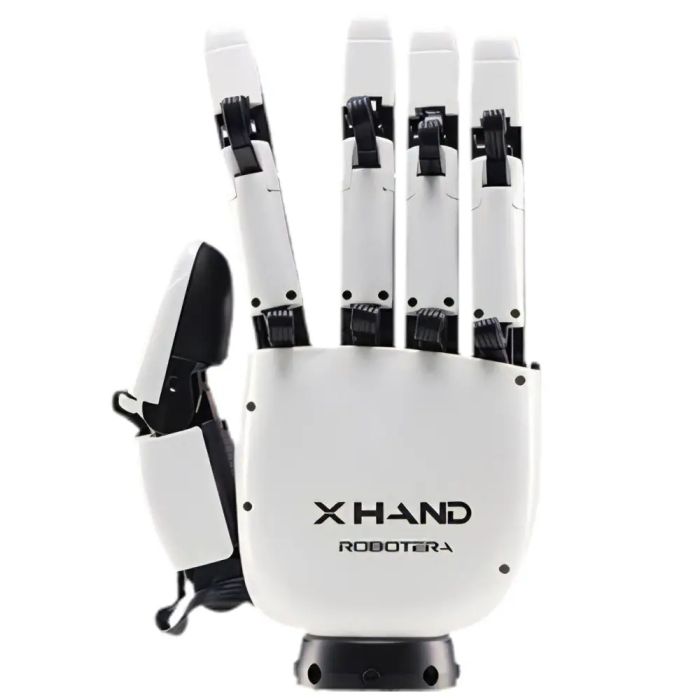
Most industrial grippers are specialists: two jaws, one closing motion and a fixture designed around a single family of parts. The difficulty begins when the object changes from one cycle to the next, such as a cable, a cup, or a tool with a trigger that has to be pressed rather than merely held. The Robotera XHAND1 Dexterous Right Hand w meets that difficulty with an anthropomorphic right hand whose thumb and fingers are driven by gear-driven, force-controlled joint modules. The hand can therefore regulate how firmly it presses as well as where its fingers go. It is built for researchers and integrators who want a robot to work with objects shaped for people, rather than objects reshaped for the robot.
Robots Middle East supplies the XHAND1 right hand to universities, research centres, robotics start-ups and industrial integrators across the Middle East. Our team prepares a formal quotation for each enquiry and coordinates delivery and import documentation to your country. We also remain your point of contact for technical questions once the hand is on your bench.
Background
ROBOTERA and its humanoid range
ROBOTERA develops humanoid robots and the hands that complete them. Alongside the XHAND1 family, the brand's line-up includes full-body and upper-body platforms such as the Star1, the L7 bipedal humanoid, the M7 upper-body wheeled humanoid and the Q5 wheeled service robot. A hand designed by a company that also builds complete humanoids has to meet three demands. It must be light enough to sit at the end of an arm, it must be controllable through a software stack that researchers already use, and it must be dependable enough for long series of experiments.
The XHAND1 is used well beyond the brand's own robots. It has been adopted by robotics companies including Skild AI, Humanoid AI and Extend Robotics, and by research institutions including UC Berkeley, MIT and ByteDance Seed. That spread of users matters to a buyer. A hand already in use in respected laboratories tends to have a body of practical experience behind it, and research groups can more easily compare their results with published work.
Force-controlled joints throughout
The defining design choice in the XHAND1 is its actuation. The thumb uses three gear-driven, force-controlled joint modules, and the four fingers share nine more of the same kind. Many simpler robotic hands are under-actuated, with fewer motors than joints and linkages that couple finger movements together. The XHAND1 instead distributes dedicated force-controlled modules through the thumb and fingers, which gives the controller far more say over the posture and pressure of each digit.
That hardware is matched by three control modes: position control, current-loop force control and force-position control. Position control suits repeatable motions where the finger path matters most. Current-loop force control regulates the effort a joint applies, which is valuable when handling fragile or deformable items. Force-position control combines the two, so a finger can travel to a target and then hold a defined contact force once it arrives. Being able to choose among these modes in software is what turns a set of motors into a usable manipulation tool.
Technical Specifications
| Specification | Value |
|---|---|
| Weight | 1100 g |
| Thumb actuation | 3 gear-driven, force-controlled joint modules |
| Four-finger actuation | 9 gear-driven, force-controlled joint modules |
| Maximum grip force (whole hand) | 80 N |
| Working voltage | 24 V to 72 V |
| Control modes | Position control, current-loop force control, force-position control |
| Software support | Linux compatibility, SDK (C++/Python), ROS support |
Specifications are as published by the manufacturer and are confirmed against the datasheet at quotation.
The manufacturer has not published the contents of the box, the IP rating, the operating temperature range, the fingertip material, the mounting interface or the communication interface for the right hand (the left-hand version lists RS485 (USB) and EtherCAT); Robots Middle East confirms each of these at quotation.
What makes the XHAND1 different from a parallel gripper?
A parallel gripper is an excellent answer to a narrow question. If every part on a line is the same shape, two jaws closing on it will do the job quickly and cheaply. Laboratories and humanoid developers rarely face that situation. Their robots are expected to open drawers, turn handles, pass objects between hands and use tools designed for human fingers. A gripper either fails at such tasks or needs a custom fixture for each one.
The XHAND1 approaches the problem from the other side. Its thumb and four fingers are actuated by force-controlled joint modules, so it can shape a grasp around an object rather than requiring the object to suit the grasp. The maximum whole-hand grip force of 80 N gives it a useful working range, while current-loop force control lets it apply far less when the object is delicate. A gripper usually knows only open and closed. A hand that controls force at the joint can hold a paper cup without crushing it and then grip a tool handle firmly a moment later.
The trade-off is complexity. A dexterous hand asks more of the controller, the software team and the integration work than a simple gripper does. For teams whose research or product depends on human-like manipulation, that complexity is the point of the purchase, not an obstacle to it.
How does the XHAND1 fit into a research software stack?
A capable hand is of little use if it takes months to connect. ROBOTERA lists Linux compatibility, an SDK for C++ and Python, and ROS support for the XHAND1. These are the tools most robotics laboratories already work with. A team can drive the hand from existing ROS nodes, prototype grasping behaviour in Python and move performance-critical loops to C++ without changing platform.
On the electrical side, the working voltage of 24 V to 72 V covers a broad band. This is helpful when the hand has to share a supply with an arm or a mobile base, and it gives integrators room to fit the hand into an existing power architecture rather than designing a dedicated supply around it. Robots Middle East is glad to discuss your platform in detail, so that your integration plan is settled before the hand arrives.
Who is the Robotera XHAND1 Dexterous Right Hand w for?
The clearest fit is university and institutional research groups working on manipulation, grasp planning, tactile reasoning or learning from demonstration. For them, a force-controlled hand with Python and ROS support shortens the distance between an idea and an experiment. Humanoid developers are a second group. They need an end effector that can be mounted on an arm, controlled alongside the rest of the robot and trusted across long data-collection sessions.
AI teams training manipulation policies form a third segment. Their models are only as good as the physical interactions they learn from, and a hand that can regulate contact force produces richer data than a gripper that merely closes. Industrial innovation departments and system integrators running pilot projects, for example in assembly, inspection or laboratory automation, may also find the XHAND1 a practical way to test whether dexterous handling solves a problem before committing to a larger programme.
This page covers the right hand. Projects that need a left-side mount, or bimanual work with a matched pair, should look at the Robotera XHAND1 Dexterous Left Hand w. Teams comparing configurations across the family can also review the Robotera XHAND1 - Lite Elfin Hand (XHAND1-Lite), and our team will gladly explain the differences between them.
What is the Robotera XHAND1 Dexterous Right Hand w used for?
- Manipulation research: studying grasp synthesis, in-hand repositioning and contact-rich tasks on physical hardware.
- Humanoid robot development: serving as the right-hand end effector on humanoid and upper-body robot platforms.
- Robot learning and data collection: gathering force-aware demonstration data to train manipulation policies.
- Teleoperation studies: letting an operator control a human-like hand remotely for tasks that need fine handling.
- Tool use experiments: operating handles, triggers and instruments designed for human hands.
- Industrial pilot projects: testing dexterous handling of varied or delicate parts before scaling an automation programme.
Pricing and Availability
Robots Middle East supplies the Robotera XHAND1 Dexterous Right Hand w on a quotation basis, so that each offer reflects your configuration, destination and support requirements. Delivery, customs clearance and after-sales support are arranged together with your quotation. When you contact us, a short description of your intended platform and application helps us prepare your offer quickly. To begin, use the quotation request form available on this page.
Frequently Asked Questions
Is this a right or a left hand?
This product is the right hand. ROBOTERA also offers a left-hand version, the Robotera XHAND1 Dexterous Left Hand w, for left-side mounting or bimanual set-ups.
How much does the XHAND1 right hand weigh?
The right hand weighs 1100 g.
What grip force can the XHAND1 deliver?
The maximum whole-hand grip force is 80 N. With current-loop force control the hand can also apply much lower forces when handling delicate objects.
What power supply does it need?
The working voltage is 24 V to 72 V, a range that suits many arm and mobile-base power systems.
Which software does the XHAND1 support?
The hand offers Linux compatibility, an SDK for C++ and Python, and ROS support. Teams can therefore integrate it with the tools most robotics laboratories already use.
Who already uses the XHAND1?
The XHAND1 has been adopted by robotics companies including Skild AI, Humanoid AI and Extend Robotics. Research institutions including UC Berkeley, MIT and ByteDance Seed use it as well.
Where can I buy the Robotera XHAND1 Dexterous Right Hand w and what does it cost?
You can buy it from Robots Middle East, which supplies it across the Middle East. The cost depends on your configuration, destination and support needs, so request a quotation and we will prepare a tailored offer.
Summary
A gripper asks the world to fit its two jaws. The Robotera XHAND1 Dexterous Right Hand w turns that around and gives a robot a hand that fits the world. Its thumb and fingers are driven by gear-driven, force-controlled joint modules, and it offers position, force and combined control modes. Its software support covers Linux, C++, Python and ROS. Adoption by companies such as Skild AI and Extend Robotics and by institutions including UC Berkeley and MIT shows how seriously the research community takes it. For laboratories, humanoid developers and integrators who need a robot to handle objects made for people, Robots Middle East supplies, delivers and supports the hand throughout the region, and this page is the starting point.