
Robotera XHAND1 Dexterous Left Hand W
In stock
- BRAND:
- ROBOTERA
- MODEL:
- LEFT XHAND1
- ORIGIN:
- China
- Warranty:
- 12 MONTHS
- AVAILABILITY:
- SUBJECT TO AVAILABILITY
- SKU:
- RobotEra-Left-XHAND1
Robotera XHAND1 Dexterous Left Hand W
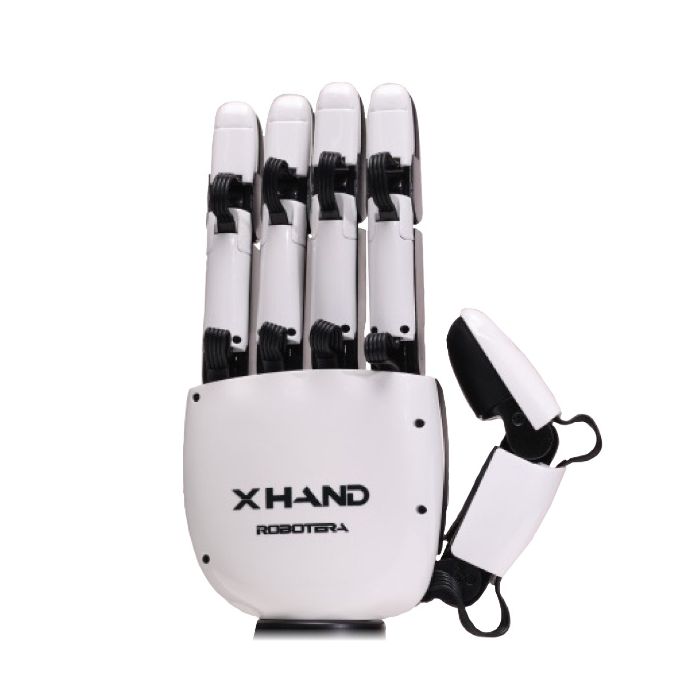
A pair of human hands is not two copies of one design but a design and its reflection, and any robot meant to work as a person does eventually needs both. The Robotera XHAND1 Dexterous Left Hand w is the left half of that pair: a fully direct-drive, five-fingered hand with 12 active degrees of freedom, built for the side of the bench that single-hand demonstrations tend to overlook. Where a laboratory has spent years teaching one arm to grasp, this hand allows the second arm to hold, steady, pass and assist. Bimanual tasks then stop being a simulation exercise and become something that can be recorded and repeated on real hardware.
Robots Middle East sells the Robotera XHAND1 Dexterous Left Hand w and supplies it to universities, research institutes and robotics companies across the Middle East. Our team prepares each quotation, arranges delivery to your site and remains your point of contact for technical questions and support once the hand has arrived, whether you order it on its own or together with its right-hand counterpart.
Background
ROBOTERA and the XHAND1 line
ROBOTERA develops humanoid robots and the end effectors that make them useful, and the XHAND1 is its family of dexterous hands. The family is offered in mirrored versions: the left hand, model XHAND1-2L32, and the right hand, model XHAND1-2R32, which is sold as the Robotera XHAND1 Dexterous Right Hand w. Both sit within the brand's wider range of Hands.
The XHAND1 has already found its way into serious work. It has been adopted by robotics companies including Skild AI, Humanoid AI and Extend Robotics, and by universities and research institutions including UC Berkeley, MIT and ByteDance Seed. For a buyer, that adoption matters less as a badge than as a practical signal: when research groups and companies work on the same hardware, methods and results become easier to compare, and the distance between reading about a technique and reproducing it in your own laboratory becomes shorter.
Direct drive and fingertip touch
Two design choices define this hand. The first is its drive. The XHAND1 is fully direct-drive, and its 12 active degrees of freedom are independently actuated joints. Many hands in this class are underactuated, meaning that one motor moves several joints through linkages or tendons; that keeps them simple, but it couples the movement of the fingers together. Independent actuation lets a controller place each joint where the task requires it, which is what fine in-hand manipulation demands.
The second is touch. The fingertips carry 270-degree (10x12x5) tactile sensors that detect 3D force and temperature, and the sensing comes with a simulated plug-in. In general, tactile data of this kind tells a control policy not only that contact has occurred but how it is distributed across the fingertip, and a simulation counterpart allows the same signals to be represented during virtual training before a policy is moved onto the physical hand.
Technical Specifications
| Specification | Value |
|---|---|
| Hand type | Fully direct-drive, five-fingered dexterous hand |
| Active degrees of freedom | 12, with independently actuated joints |
| Fingertip tactile sensors | 270-degree (10x12x5), detecting 3D force and temperature, with a simulated plug-in |
| Size (XHAND1 series) | 191 × 94 × 47 mm |
| Weight (XHAND1 series) | 1.1 kg |
| Maximum single-hand grip force (XHAND1 series) | 80 N |
| Maximum liftable object weight (XHAND1 series) | 25 kg |
Specifications are as published by the manufacturer and are confirmed against the datasheet at quotation. ROBOTERA has not published dimensions, weight or electrical ratings specific to the left hand, nor an IP rating or a list of what is in the box; our team provides these details with your quotation.
What does the left-hand version change compared with the right?
The XHAND1 is offered as one series with two model codes, XHAND1-2L32 for the left hand and XHAND1-2R32 for the right. The size, weight, grip force and lifting figures in the table are given for the XHAND1 series rather than for either hand individually. What the left version changes, therefore, is chirality: it is the hand that mounts on the left side of a robot or a bimanual rig.
That distinction is more consequential than it first appears. A great deal of manipulation research has been carried out with a single hand, usually on the right. Tasks that people perform without thinking, such as holding a jar while turning its lid, steadying a part while fastening it or passing an object from one hand to the other, all require a second hand with comparable dexterity. A team that already owns the right-hand XHAND1 completes a matched pair with this version, and a team starting afresh can plan both sides at once, so that the control software, tactile data format and mechanical behaviour are consistent across the two arms.
Why do direct drive and tactile sensing matter for manipulation research?
Dexterous manipulation is ultimately a question of control: a policy can only be as precise as the hand allows it to be. With 12 active degrees of freedom driven through independently actuated joints, the XHAND1 gives a controller direct command over each joint rather than over groups of joints moving together. For researchers training policies from demonstration or by reinforcement learning, this means that the actions a model produces correspond closely to what the hand actually does.
Tactile sensing closes the other half of the loop. Vision alone struggles at the moment of contact, when the fingers themselves hide the object from the camera. Fingertip sensors that report 3D force and temperature provide information at exactly that moment, which supports work on slip detection, grasp stability and the handling of delicate or deformable items. The simulated plug-in for the sensors is relevant to teams that train in simulation, since tactile signals can be included in the virtual environment rather than added only after transfer to hardware.
Strength completes the picture. The XHAND1 series offers a maximum single-hand grip force of 80 N and can lift objects weighing up to 25 kg, so the hand is suited to experiments that move beyond light laboratory props towards everyday objects and tools.
Who is the Robotera XHAND1 Dexterous Left Hand w for?
The first group is university laboratories and research institutes working on bimanual manipulation, embodied intelligence and tactile perception. For them, the left hand is most valuable alongside its right-hand partner, and many will order the two together. Teams that need only a single hand for an existing right-sided setup are better served by the Robotera XHAND1 Dexterous Right Hand w.
The second group is robotics companies developing general-purpose manipulation and foundation models for robots. Such organisations collect large volumes of demonstration data and need hardware that is consistent from unit to unit and comparable with what other developers use; the adoption of the XHAND1 by companies such as Skild AI and Extend Robotics is relevant here.
The third group is developers of teleoperation and remote-handling systems, for whom a dexterous left hand allows an operator to use both hands naturally. Integrators planning a robot arm or humanoid installation also belong in this group, and our team can discuss the mechanical and electrical interface of a specific platform when preparing the offer.
Teams still comparing approaches may also wish to review the Robotera XHAND1 - Lite Elfin Hand (XHAND1-Lite) and the wider Robot Hands category; Robots Middle East can set out the differences between the options when preparing your quotation.
What is the Robotera XHAND1 Dexterous Left Hand w used for?
- Bimanual manipulation research: paired with a right hand, it enables two-handed tasks such as holding, passing and assembling.
- Embodied AI data collection: independently actuated joints and tactile feedback produce rich demonstration data for training manipulation policies.
- Tactile perception studies: fingertip sensing of 3D force and temperature supports work on contact, slip and grasp stability.
- Simulation-to-reality transfer: the simulated plug-in for the tactile sensors helps align virtual training with the physical hand.
- Teleoperation: a dexterous left hand lets remote operators use both hands in the way they would in person.
- Handling of everyday objects and tools: grip force and lifting capacity allow experiments with real objects rather than lightweight props.
Pricing and Availability
Robots Middle East supplies the Robotera XHAND1 Dexterous Left Hand w on a quotation basis, so that the offer reflects your configuration, whether you require the left hand alone or a matched pair with the right hand. Delivery, customs and support are arranged with the quotation, and our team will answer any open technical questions before you commit. To begin, please send us your project details and the number of units required; the request form is available on this page.
Frequently Asked Questions
Is the left hand a mirror image of the right hand?
The XHAND1 is offered as a left version, XHAND1-2L32, and a right version, XHAND1-2R32. The size, weight and force figures in the table apply to the XHAND1 series as a whole.
How many degrees of freedom does the hand have?
The hand has 12 active degrees of freedom with independently actuated joints, and it is fully direct-drive.
What do the fingertip sensors detect?
The 270-degree (10x12x5) fingertip tactile sensors detect 3D force and temperature. They come with a simulated plug-in for use in simulation.
How strong is the XHAND1?
The XHAND1 series offers a maximum single-hand grip force of 80 N and can lift objects weighing up to 25 kg.
Can I order the left and right hands together?
Yes. Robots Middle East can quote the left hand on its own or as a matched pair with the right hand, so that both sides of a bimanual setup use the same design.
Who already uses the XHAND1?
The XHAND1 has been adopted by Skild AI, Humanoid AI and Extend Robotics, and by UC Berkeley, MIT and ByteDance Seed.
Where can I buy the Robotera XHAND1 Dexterous Left Hand w and what does it cost?
You can buy it from Robots Middle East, which supplies it across the Middle East. The cost depends on your configuration and is set out in a quotation; please submit a request through this page.
Summary
A robot that works as people do needs a reflection of its right hand, and the Robotera XHAND1 Dexterous Left Hand w provides it. It brings the same fully direct-drive design, 12 independently actuated degrees of freedom and fingertip sensing of 3D force and temperature to the left side of the workspace, turning single-hand experiments into two-handed ones. Adopted by leading companies and universities, it is a practical foundation for bimanual research, embodied AI and teleoperation. Robots Middle East quotes, delivers and supports it across the region; for a matched pair or a single left hand, this page is the starting point.
Specifications
General
Physical
Mobility
Shipping
What's included
Downloads
Related Products
Out of stock