
SIASUN Collaborative Robot Arm (GCR10-1300)
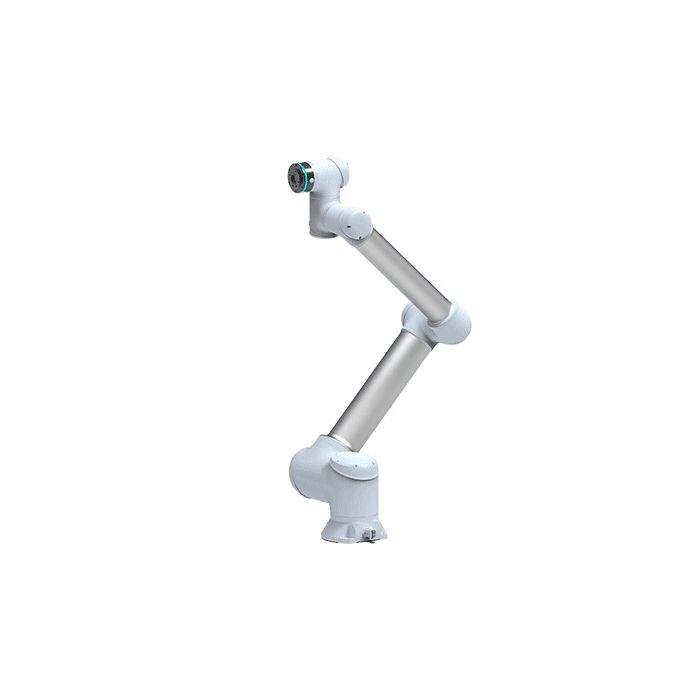
In stock
- BRAND:
- SIASUN
- PART #:
- GCR10-1300
- ORIGIN:
- China
- AVAILABILITY:
- FOR OPPORTUNITIES OVER 1 MILLION USD
- SKU:
- SIASUN-GCR10-1300
SIASUN Collaborative Robot Arm (GCR10-1300)
A production line that builds the same part for ten years can justify a fenced robot cell designed around one motion. Most plants are not that line. Their products change with the order book, their benches are shared with people, and the arm that suits them has to be useful on Monday's task and on Thursday's very different one. The SIASUN Collaborative Robot Arm (GCR10-1300) is built for that second kind of factory: a high-end, general-purpose cobot that combines a long reach with vision, force sensing and hand-guided teaching, so that changing its job is closer to a briefing than a re-engineering project.
Robots Middle East sells the SIASUN Collaborative Robot Arm (GCR10-1300) and supplies it to manufacturers, integrators, laboratories and training centres across the Middle East. Our team prepares each quotation around your application and arranges delivery and after-sales support for your site.
Background
SIASUN and the GCR series
SIASUN builds automation across a wide span, from heavy industrial and palletising arms to large mobile robots for factory logistics. The GCR series is its line of collaborative robots, the arms intended to work in shared spaces rather than behind guarding. Within that series, the GCR10-1300 is positioned as a high-end, general-purpose model. SIASUN's range also includes two further versions, the GCR10-1300-Ex and the GCR10-1300-W. The figures on this page refer to the standard GCR10-1300, and our team will advise which version best suits your project.
Vision, force and hand-guided teaching
What sets this arm apart from a simple pick-and-place manipulator is the combination of sensing and control that SIASUN builds into it. The GCR10-1300 integrates 2D/3D vision depth fusion with high-sensitivity force perception and control, allowing the robot to locate parts and to feel contact while it works. Programming is by drag-and-drop teaching: an operator guides the arm through a motion by hand, which lowers the threshold for staff who have never written robot code. Scenario-specific software packages, support for multiple external interfaces, cloud-based robot data monitoring and remote OTA upgrades complete the picture, so that the arm can be adapted to a task, watched in operation and kept current without a technician standing beside it.
Technical Specifications
| Specification | Value |
|---|---|
| Product type | High-end, general-purpose collaborative robot (GCR series) |
| Max payload | 10kg |
| Reach | 1300mm |
| Repeatability | ±0.03mm |
| Max TCP speed | 3.8m/s |
| Max straight-line speed | 1.5m/s |
| Degrees of freedom | 6 |
| IP class | IP54/IP65 |
| Weight | 38 kg |
| Safety | 16 TUV-certified safety features for human-machine collaboration |
| Sensing | 2D/3D vision depth fusion, high-sensitivity force perception and control |
| Programming | Drag-and-drop teach programming |
| Software and connectivity | Scenario-specific software packages, multiple external interfaces, cloud-based robot data monitoring, remote OTA upgrades |
Specifications are as published by the manufacturer and are confirmed against the datasheet at quotation.
The manufacturer has not published the dimensions, power supply voltage, joint ranges, communication protocols, operating temperature or noise level, nor does it state whether a controller is included or what is in the box; these details are confirmed at quotation.
What makes the GCR10-1300 different from a conventional industrial robot?
A conventional industrial robot is usually specified for speed and load, then surrounded by fencing, light curtains and interlocks so that nobody is near it while it moves. That arrangement works, but it fixes the robot to one place and one process. The GCR10-1300 starts from the opposite assumption. Its 16 TUV-certified safety features are designed for human-machine collaboration, which is what allows it to be considered for a shared workstation rather than a sealed cell. As with any cobot, the final layout still depends on a risk assessment of the complete application, including the tool, the workpiece and the speeds chosen.
The second difference is perception. A traditional robot repeats taught positions and relies on fixtures to present parts precisely. With 2D/3D vision depth fusion and force perception built into its control, the GCR10-1300 can find parts whose position varies and can respond to contact forces during tasks such as assembly, screw fastening or polishing. That reduces the amount of precision tooling a project needs and makes the arm more tolerant of the variation found in real production.
Performance is not sacrificed for this. A 10kg payload and 1300mm reach give the arm room to serve a machine, a conveyor and a bench from one mounting point, and a repeatability of ±0.03mm suits work where position matters. A maximum TCP speed of 3.8m/s and a maximum straight-line speed of 1.5m/s describe the envelope available where the application and its safety assessment permit it.
How easy is the GCR10-1300 to programme and maintain?
For many plants, the true cost of a robot is not the arm but the expertise needed to keep it productive. SIASUN addresses this in three ways. Drag-and-drop teach programming lets an operator show the arm a path by moving it, so a new task can be set up by the people who know the process best. Scenario-specific software packages give a starting point for common applications instead of a blank screen. And cloud-based data monitoring, together with remote OTA upgrades, means the robot's condition can be followed and its software updated without waiting for a site visit, which is of particular value for facilities spread across several cities or countries.
Multiple external interfaces allow the arm to work with grippers, vision systems and the equipment around it. Robots Middle East checks compatibility with your PLCs and line equipment when preparing your offer.
Who is the SIASUN Collaborative Robot Arm (GCR10-1300) for?
The arm suits manufacturers running high-mix production, where frequent changeovers make fixed automation hard to justify and where a robot taught by hand can move between jobs. Electronics, automotive component and metalworking suppliers will find its combination of reach, payload and force sensing relevant to assembly, fastening and finishing. System integrators can use the scenario-specific software packages and external interfaces as a base for tailored cells, while research institutions, universities and technical training centres will value an arm that new users can programme without extensive code. Operations managers responsible for several sites may also appreciate cloud monitoring and remote upgrades.
Where the parts are lighter and the workspace more compact, SIASUN's smaller SIASUN Collaborative Robot Arm with 917mm Reach, 5kg Max Payload, 6 DOFs (GCR5-910) may be the more economical fit. Buyers comparing other options can browse our full range of Robot Arms. Where your application calls for the GCR10-1300-Ex or GCR10-1300-W rather than the standard version, our team will advise which is appropriate.
What is the SIASUN Collaborative Robot Arm (GCR10-1300) used for?
- Intelligent picking — locating and collecting parts with vision, even where their position varies from cycle to cycle.
- Welding — guiding a torch along seams in fabrication work that changes from batch to batch.
- Loading and unloading — tending machine tools and conveyors from a single mounting point thanks to its long reach.
- Assembly and screw fastening — using force perception to seat components and drive fasteners with controlled contact.
- Polishing and grinding — maintaining consistent contact pressure across surfaces during finishing operations.
- Quality inspection, gluing and oiling — checking parts with vision and applying adhesives or lubricants along taught paths.
Pricing and Availability
Robots Middle East supplies the SIASUN Collaborative Robot Arm (GCR10-1300) on a quotation basis, so that the offer reflects the version, tooling, software and integration your application actually requires. Delivery, customs clearance and after-sales support are arranged together with your quotation. To begin, tell us about your parts, cycle times and workspace, and our team will respond with a configuration and offer; a quotation can be requested directly through the form available on this page.
Frequently Asked Questions
What payload and reach does the GCR10-1300 offer?
The GCR10-1300 has a maximum payload of 10kg and a reach of 1300mm. It is a six-degree-of-freedom arm with a repeatability of ±0.03mm.
Can the GCR10-1300 work alongside operators?
Yes, it is designed for human-machine collaboration and carries 16 TUV-certified safety features. As with any cobot, the final layout should follow a risk assessment of the complete application.
Do I need programming experience to use it?
No specialist coding is required for basic tasks, because the arm supports drag-and-drop teach programming. Scenario-specific software packages provide further support for common applications.
What IP class does the arm have?
The IP class is IP54/IP65. Our team can advise which rating applies to the version you choose.
What are the GCR10-1300-Ex and GCR10-1300-W versions?
They are further versions of the GCR10-1300 within SIASUN's GCR series. Our team can advise which of them suits your project.
Can the robot be monitored and updated remotely?
Yes, the GCR10-1300 supports cloud-based robot data monitoring and remote OTA upgrades. This allows its condition to be followed and its software kept current without a site visit.
Where can I buy the SIASUN Collaborative Robot Arm (GCR10-1300) and what does it cost?
You can buy it from Robots Middle East, which supplies the arm across the Middle East. The cost depends on the version, tooling and integration you need, so please request a quotation through this page.
Summary
Factories whose work changes with every order need a robot that changes with it, and the SIASUN Collaborative Robot Arm (GCR10-1300) is designed for exactly that. A 10kg payload, 1300mm reach and ±0.03mm repeatability give it the capability for real production; vision depth fusion and force perception let it cope with variation; drag-and-drop teaching, scenario-specific software and remote upgrades keep it adaptable long after installation; and its TUV-certified safety features are aimed at shared workspaces. Robots Middle East quotes, delivers and supports it throughout the region. For a cobot that can be briefed rather than rebuilt for each new task, this page is the starting point.