
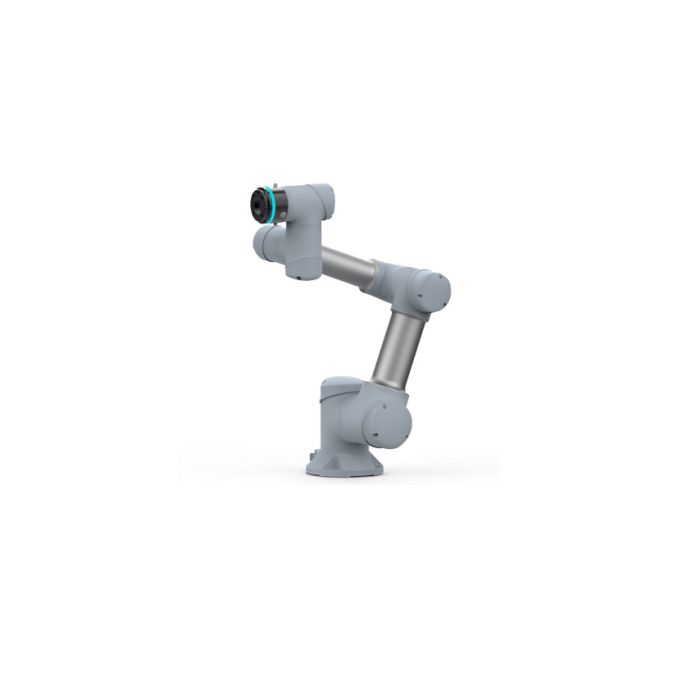
SIASUN Collaborative Robot Arm With 917mm Reach, 5kg Max Payload, 6 DOFs (GCR5-910)
In stock
- BRAND:
- SIASUN
- PART #:
- GCR5-910
- ORIGIN:
- China
- AVAILABILITY:
- FOR OPPORTUNITIES OVER 1 MILLION USD
- SKU:
- SIASUN-GCR5-910
SIASUN Collaborative Robot Arm With 917mm Reach, 5kg Max Payload, 6 DOFs (GCR5-910)
On many production floors, the most expensive part of a new robot is not the hardware but the weeks spent teaching it a task that an experienced operator could demonstrate in a minute. The SIASUN Collaborative Robot Arm with 917mm Reach, 5kg Max Payload, 6 DOFs (GCR5-910) approaches that problem from the other end. The operator takes hold of the arm, guides it through the motion, and the robot records the path. Behind that simple gesture sit a six-axis arm with ±0.02mm repeatability, 16 TUV-certified safety features for human-machine collaboration, and a sensing package that fuses 2D and 3D vision with high-sensitivity force perception. The aim is a cobot that is quick to set up and exact once it is running.
Robots Middle East supplies the GCR5-910 to manufacturers, system integrators, research institutions and training centres across the Middle East. Our team prepares each quotation around your application, arranges delivery to your site and remains your point of contact for support once the arm has been commissioned.
Background
SIASUN and the GCR series
SIASUN is a Chinese robotics manufacturer with roots in the country's academic automation research. Its portfolio runs from heavy industrial arms for palletising and material handling to mobile robots and collaborative arms. The GCR series is its collaborative line, and the sources name several members of it: the GCR5-910 and GCR5-910-W, alongside the GCR3-618 and GCR3-618-W. SIASUN describes the GCR5-910 as a high-end, general-purpose collaborative robot in that series. In other words, it is not built for one niche task but intended as a versatile arm that can be redeployed as production needs change.
That general-purpose positioning matters to buyers who do not yet know exactly where automation will pay off first. A single arm that can pick parts in one quarter and drive screws or apply glue in the next protects the investment better than a dedicated machine does, provided the arm is easy to re-teach. That is where the rest of SIASUN's design choices come in.
Vision, force sensing and software
SIASUN builds the GCR5-910 around the integration of 2D/3D vision depth fusion, high-sensitivity force perception and control. Vision lets the arm locate parts that are not presented in a fixed position, while force perception lets it sense contact. This matters in tasks such as fitting components, finishing surfaces or detecting an unexpected obstacle. Programming is by drag-and-drop teaching, which SIASUN presents as a way to lower the threshold for use and make operation easier.
On the software side, the arm is supported by a range of scenario-specific software packages and multiple external interfaces. Cloud-based monitoring of robot data and remote over-the-air (OTA) upgrades complete the picture. For a plant manager, this means the arm's condition can be followed without walking to the cell, and software improvements can reach the robot without a site visit.
Technical Specifications
| Specification | Value |
|---|---|
| Max payload | 5kg |
| Reach | 917mm |
| Repeatability | ±0.02mm |
| Max TCP speed | 3.6m/s |
| Max straight-line speed | 1.5m/s |
| IP class | IP54/IP65 |
| Degrees of freedom | 6 |
| Safety | 16 TUV-certified safety features for human-machine collaboration |
Specifications are as published by the manufacturer and are confirmed against the datasheet at quotation.
SIASUN has not published the communication interfaces, the contents of the box, the operating noise, the robot cable length or a joint-by-joint speed table; these details are confirmed at quotation.
What makes the GCR5-910 different from a conventional industrial robot arm?
A conventional industrial arm is normally installed inside guarding. It is programmed by specialists, and it is kept apart from people while it runs. That model suits high-volume lines that rarely change, but it fits poorly in workshops where batches are small, floor space is shared and the same station may handle several products in a week. Collaborative arms were developed for that second situation, and the GCR5-910 follows the pattern closely.
Three elements set it apart. The first is safety designed for proximity. The arm carries 16 TUV-certified safety features for human-machine collaboration, so it is intended to operate in a workspace that people also use. A risk assessment of the complete application, including the tool and the workpiece, remains the integrator's responsibility, as with any collaborative installation. The second is the teaching method. Drag-and-drop teaching replaces much of the line-by-line programming that conventional arms demand, so production staff can adjust a path themselves. The third is perception. The combination of 2D/3D vision and force sensing lets the arm adapt to parts and contact conditions rather than relying entirely on fixtures that hold every part in exactly the same place.
None of this makes a cobot a replacement for every industrial robot. Heavier loads and longer reaches remain the territory of SIASUN's industrial arms, which you will find among our Robot Arms. The GCR5-910 is aimed at the many stations where a light payload, close cooperation with people and frequent changeovers matter more than raw throughput.
How do the speed and repeatability figures translate into practice?
SIASUN publishes two speed figures for the GCR5-910, and they describe different things. The maximum TCP speed of 3.6m/s refers to the tool centre point, the working end of the arm, at its fastest. The maximum straight-line speed of 1.5m/s applies to linear moves. These are the motions a robot follows when it traces a weld seam, lays a bead of adhesive or approaches a part along a defined axis. In a collaborative installation, the speeds actually used are set by the risk assessment for the task, so the published maxima indicate the arm's capability rather than the speed of every cycle.
Repeatability of ±0.02mm describes how closely the arm returns to a taught position, time after time. For screw fastening, assembly of small components and placement of parts into fixtures, this consistency counts for more than top speed. A station that places parts reliably avoids the rework and inspection loops that can quietly erase the gains of automation. With a reach of 917mm and a maximum payload of 5kg, the arm covers a typical workbench-sized area while carrying grippers, screwdrivers, dispensers or light finishing tools, together with the part being handled.
Who is the GCR5-910 for?
The first group is manufacturers taking their first step into automation. Drag-and-drop teaching and a collaborative safety concept mean a small engineering team can bring a station into service without building a guarded cell around it. For workshops across the Middle East that are moving manual tasks towards automation, this lowers both the technical and the organisational barrier.
The second group is system integrators who build cells for clients in electronics, metalworking, consumer goods and component manufacturing. The scenario-specific software packages, external interfaces and cloud-based monitoring give integrators a base they can adapt to each project. Remote OTA upgrades simplify long-term support for installed systems.
The third group is research laboratories, universities and technical training centres. An arm that combines vision, force perception and an approachable programming method gives students and researchers a platform for experiments in perception-guided manipulation and human-robot interaction.
Buyers whose tasks call for a different size class should compare the wider SIASUN collaborative range before deciding. The sources also name the GCR5-910-W, GCR3-618 and GCR3-618-W, and our catalogue includes the SIASUN Collaborative Robot Arm (GCR10-1300). Robots Middle East can set the published figures of each model side by side when preparing your quotation. For applications that point towards conventional automation instead, our Factory Robots category gives a broader overview.
What is the GCR5-910 used for?
- Intelligent picking – vision-guided picking of parts that arrive in varying positions, without rigid fixtures for every item.
- Welding – steady straight-line motion along seams in light fabrication work.
- Loading and unloading – tending machines and moving parts between conveyors, fixtures and trays beside operators.
- Assembly and screw fastening – repeatable placement and fastening, where force perception helps to detect correct seating.
- Polishing and grinding – surface finishing tasks in which contact force must be sensed and controlled.
- Quality inspection – presenting parts to cameras or carrying sensors across a workpiece, alongside related tasks such as gluing and oiling.
Pricing and Availability
Robots Middle East supplies the GCR5-910 on a quotation basis, so that the configuration, tooling and documentation match your application. Tell us about the task, the parts involved and the environment of the station, and we will prepare an offer that reflects your project. Delivery, customs clearance and after-sales support are arranged with the quotation. To begin, the quotation request for the SIASUN GCR5-910 is available on this page.
Frequently Asked Questions
What payload and reach does the GCR5-910 offer?
The GCR5-910 has a maximum payload of 5kg and a reach of 917mm. The payload includes the end-of-arm tool, so the tool weight should be taken into account when the application is planned.
Can the GCR5-910 work safely alongside people?
The arm carries 16 TUV-certified safety features for human-machine collaboration. As with every collaborative installation, a risk assessment of the complete application is carried out before operation.
Does the GCR5-910 require programming expertise?
SIASUN equips the arm with drag-and-drop teaching, so operators can guide it through a motion by hand to record a path. This lowers the threshold for staff who have not programmed robots before.
Is the GCR5-910 suitable for dusty or damp environments?
SIASUN publishes the IP class as IP54/IP65. Robots Middle East will match the protection level to the conditions of your station when preparing the quotation.
Does the GCR5-910 support vision and force sensing?
Yes. The arm integrates 2D/3D vision depth fusion with high-sensitivity force perception and control, which supports picking, assembly and finishing tasks.
Can the robot be monitored and updated remotely?
The GCR5-910 supports cloud-based monitoring of robot data and remote OTA upgrades. This allows its condition to be followed and its software to be updated without a site visit.
Where can I buy the GCR5-910 and what does it cost?
You can buy the GCR5-910 from Robots Middle East, which supplies it across the Middle East. Pricing depends on configuration and project scope, so it is provided in a tailored quotation that you can request through this page.
Summary
The GCR5-910 rests on the idea that automation should begin with a demonstration rather than a programming course. An operator shows the arm what to do, and the arm repeats it to ±0.02mm. Around that core, SIASUN adds 16 TUV-certified safety features for shared workspaces, 2D/3D vision and force perception for parts that do not sit perfectly still, and cloud monitoring with OTA upgrades to keep the installation current. With a 5kg payload and 917mm reach, it suits the many workbench-scale tasks, from picking and screw fastening to polishing and inspection, where flexibility and closeness to people matter most. For manufacturers, integrators and institutions in the Middle East who want to put that approach to work with Robots Middle East, this page is the starting point.