
Unitree Go2 Edu Plus Mid 360 Quadruped Robot
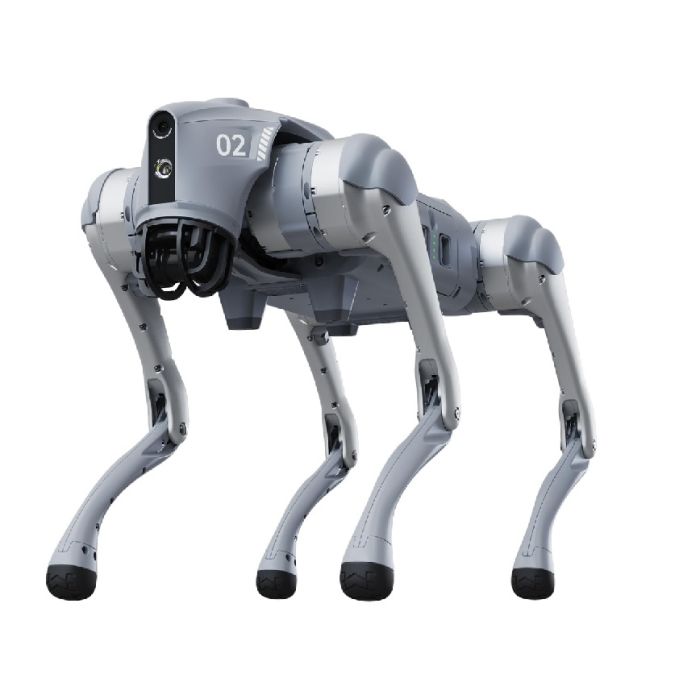
In stock
- BRAND:
- UNITREE ROBOTICS
- MODEL:
- GO2 EDU PLUS MID 360
- ORIGIN:
- China
- Warranty:
- 12 MONTHS
- AVAILABILITY:
- SUBJECT TO AVAILABILITY
- SKU:
- Unitree-Go2-Edu-Plus-Mid-360
Unitree Go2 Edu Plus Mid 360 Quadruped Robot
A LiDAR sensor sees in every direction, yet it cannot take a single step. Mounted on a tripod, it maps one room. Bolted to a trolley, it maps whatever the floor allows. The Unitree Go2 Edu Plus Mid 360 Quadruped Robot overcomes that limitation with four legs. It is a development quadruped from the Go2 EDU line, configured around the Mid-360 sensor, that carries perception hardware up slopes, over thresholds and across ground a wheeled base would never attempt. For a laboratory or an integration team, the question changes. It is no longer where the sensor can be placed, but where the robot can walk.
Robots Middle East sells the Unitree Go2 Edu Plus Mid 360 Quadruped Robot to universities, research centres, system integrators and industrial organisations throughout the Middle East. Robots Middle East prepares each quotation for the exact configuration requested, arranges delivery to the customer's site and provides support after handover. A project team therefore deals with one accountable supplier from the first enquiry to the first deployment.
Background
Unitree Robotics and the Go2 family
Unitree Robotics is one of the best-known makers of legged robots. Its quadrupeds have helped move four-legged locomotion from specialist research projects into teaching laboratories, demonstration halls and field trials. The Go2 is the company's compact quadruped family, and it is offered in several versions with different purposes. The Go2 Air, Go2 Pro and Go2 X serve consumer and general users. The Go2 EDU line is aimed at development and research. Within EDU there are further distinctions. The Unitree Go2 Edu Standard Quadruped Robot is the entry development configuration, while the Edu Plus is offered both on its own and in two sensor-equipped variants. The full family is presented in the Unitree Go2 category.
A development platform with the sensor already chosen
The Mid 360 version sits at the configured end of the line-up. A buyer of the base Unitree Go2 Edu Plus AI Quadruped Robot Dog selects, sources and mounts a perception sensor separately. This version arrives as a package built around the Mid-360. The practical value lies in time. A team that needs three-dimensional perception from the outset can concentrate on mapping, localisation and autonomy software, rather than on mechanical integration. The EDU platform beneath it brings the long-endurance battery and the foot-end force sensors that the manufacturer lists for this line.
Technical Specifications
| Specification | Value |
|---|---|
| Dimensions (standing) | 70cm x 31cm x 40cm |
| Dimensions (crouching) | 76cm x 31cm x 20cm |
| Weight (with battery) | About 15kg |
| Payload | ≈8kg (MAX ~ 12kg) |
| Speed | 0 ~ 3.7m/s (MAX ~ 5m/s) |
| Max climb angle | 40° |
| Voltage | 28V~33.6V |
| Smart battery | Long endurance (15000mAh) |
| Battery life | About 2-4h |
| Peak joint torque | Approx. 45N·m |
| Foot-end force sensor | Included |
| Wireless module | Wi-Fi6/Bluetooth/4G |
The specifications are given as the manufacturer publishes them, and they are confirmed against the datasheet at quotation.
The manufacturer has not published the IP rating, the operating temperature range, the package dimensions or the shipping weight, and Robots Middle East confirms these with the quotation.
What does the EDU configuration offer that the consumer Go2 versions do not?
The difference shows most clearly in endurance. The EDU platform carries a long-endurance 15000mAh smart battery with a battery life of about 2-4h. That is the margin a research session needs when calibration, repeated runs and data logging all compete for the same charge. A sensor-equipped robot gains little if it must return to the bench just as the interesting part of an experiment begins.
The second difference is touch. The EDU line includes foot-end force sensors, which give the controller and the researcher information about each contact with the ground. For work on gait, terrain classification or contact-aware control, that data is the raw material of the research rather than a convenience.
The third is load and mobility. A payload of ≈8kg, with a maximum of ~12kg, leaves room for computing modules, additional sensors or task equipment above the robot's own perception package. A speed range of 0 ~ 3.7m/s, reaching ~5m/s at maximum, and a maximum climb angle of 40° mean the platform is not confined to level corridors. Peak joint torque of approx. 45N·m supports these figures. The Wi-Fi6/Bluetooth/4G wireless module keeps the robot reachable for teleoperation and data transfer across a campus or a site.
How does the Mid 360 version compare with the Hesai XT16 version?
Both versions are configurations of the Go2 Edu Plus, and both are defined by the LiDAR sensor they carry. The choice between them is therefore a choice of perception hardware, not of chassis philosophy. A team should base it on the sensor its software stack and research method expect, the field of view the task demands and the point clouds its existing tools already handle well. Robots Middle East sets out the sensor-level details of the Unitree Go2 Edu Plus Hesai XT16 Quadruped Robot and of the Mid 360 version side by side at quotation. This allows the decision to rest on confirmed documentation for the exact package rather than on a version name.
Who is the Unitree Go2 Edu Plus Mid 360 Quadruped Robot for?
The first group is university departments and research institutes working on legged locomotion, simultaneous localisation and mapping, and autonomous navigation. For them, a pre-configured LiDAR platform shortens the path from delivery to the first published experiment. Teaching laboratories form a second group. They gain a robot that students can programme at a level well beyond scripted demonstrations, and it sits naturally alongside the wider range of Research Robots.
System integrators are the third group. They use the platform to prototype inspection, patrol or survey solutions for clients in energy, construction and facilities management, and to test autonomy software on real terrain before committing to larger hardware. Industrial innovation teams evaluating legged robots for site monitoring form a fourth.
Not every buyer needs a sensor already fitted. Programmes focused on locomotion and control may find the Edu Standard a better starting point. Teams that prefer to choose and mount their own perception hardware may opt for the base Edu Plus. Those committed to a different LiDAR can consider the Hesai XT16 version.
What is the Unitree Go2 Edu Plus Mid 360 Quadruped Robot used for?
- Mapping and localisation research: building and testing SLAM pipelines on a platform that walks where survey trolleys cannot.
- Autonomous navigation: developing path planning and obstacle avoidance on slopes, steps and uneven ground.
- Facility inspection pilots: trialling routine walk-throughs of plant rooms, tunnels and industrial sites before scaling up.
- Construction site monitoring: capturing repeated scans of work in progress for comparison over time.
- Locomotion and contact studies: using the foot-end force sensors to study gait, balance and terrain response.
- Teaching and demonstration: giving students hands-on experience with perception, control and robot software in one platform.
Pricing and Availability
The cost of this robot depends on the exact package, any additional equipment and the project's requirements, so Robots Middle East provides it by individual quotation. Delivery, customs clearance and after-sales support are arranged together with the quotation, so the agreed terms cover the robot's entire journey to the customer's site. Organisations that wish to plan a purchase, a pilot or a laboratory installation are invited to request a quotation, available on this page.
Frequently Asked Questions
How long does the battery last?
The EDU platform uses a long-endurance 15000mAh smart battery, and the manufacturer gives a battery life of about 2-4h. Actual runtime depends on the task, the terrain and the equipment carried.
How much can the robot carry?
The payload is ≈8kg, with a maximum of ~12kg. This leaves capacity for additional computing or sensor equipment.
Can it handle slopes?
The maximum climb angle is 40°. This allows the robot to work on ramps and inclined ground as well as level floors.
Which wireless connections does it support?
The wireless module provides Wi-Fi6, Bluetooth and 4G connectivity.
Is the robot rated against dust and water?
The manufacturer has not published an IP rating for this robot. Robots Middle East confirms the environmental details at quotation.
What separates this version from the Hesai XT16 version?
Both are Go2 Edu Plus configurations, and the difference lies in the LiDAR sensor each carries. Robots Middle East compares the two packages on request.
Where can I buy the Unitree Go2 Edu Plus Mid 360 Quadruped Robot and what does it cost?
Robots Middle East supplies this robot across the Middle East and provides the cost by quotation for the exact configuration you need. Delivery and support terms are included in the same quotation.
Summary
A LiDAR sensor is only as useful as the places it can reach. The Unitree Go2 Edu Plus Mid 360 Quadruped Robot gives the Mid-360 a pair of legs on each side, a long-endurance battery, foot-end force sensing and the payload margin to carry more. Mapping, autonomy and inspection work can then leave the bench and continue across real terrain. For universities, integrators and industrial teams in the Middle East, Robots Middle East supplies, delivers and supports the platform under one quotation. For anyone ready to take perception off the tripod, this page is the starting point.