
Unitree Aliengo Quadruped Robot
In stock
- BRAND:
- UNITREE ROBOTICS
- MODEL:
- ALIENGO
- ORIGIN:
- China
- AVAILABILITY:
- SUBJECT TO AVAILABILITY
- SKU:
- Unitree-Aliengo
Unitree Aliengo Quadruped Robot
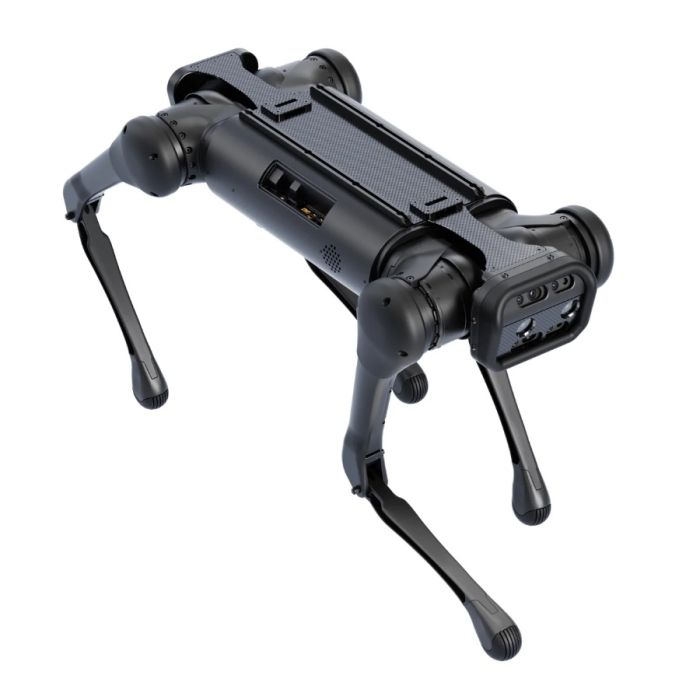
A wheeled robot asks the ground to be kind; a legged robot asks only that it be walkable. That single difference decides where a mobile platform can take a camera, a sensor or an experiment, and it explains why the Unitree Aliengo Quadruped Robot keeps finding work in laboratories and with field teams. Twelve motors drive its four legs, two depth cameras and a visual odometry camera give it a view of its surroundings, and its body folds flat for the journey between sites. What truly distinguishes it, however, is what it leaves open: power outputs, data ports and a programming interface for whatever its owner intends to mount and develop.
Robots Middle East supplies the Unitree Aliengo Quadruped Robot to universities, research institutes, system integrators and industrial users across the Middle East. Our team prepares each quotation around the buyer's intended configuration, coordinates delivery to the destination and remains the point of contact for technical support once the robot is in service.
Background
Unitree Robotics and its legged lineage
Unitree Robotics has built its reputation on legged machines, with a range of quadrupeds that runs from compact platforms for teaching to heavier systems for industrial duty. Across that range, the company has favoured robots that developers can open up and extend rather than closed appliances. The Aliengo belongs firmly to that philosophy. It is offered as a Developer version, with external interfaces exposed for the user's own hardware, and Unitree explicitly allows owners to carry their own modules, such as vision cameras, lidar, robotic arms and GPS systems. For a research group, that openness matters as much as any locomotion figure, because it determines how quickly a project moves from unpacking to experimentation.
Perception and control on board
The Aliengo's sense of where it is comes from a highly optimised V-SLAM visual odometer, with a closed-loop offset of less than 1% and a delay of less than 6 milliseconds between attitude action and action reflection. Two depth cameras and one visual odometer camera feed that system, and a single-line or multi-line lidar can be added as an option. Software is divided across two layers: movement control runs on Ubuntu, while environment sensing runs on Ubuntu-ROS. Developers reach the robot through a high-level interface and an underlying interface, with support for C/C++, ROS and other environments. This split allows a team to issue simple motion commands for application work, or to go deeper when the research concerns locomotion itself.
Technical Specifications
| Specification | Value |
|---|---|
| Weight (without battery) | 21.5kg ±1kg |
| Dimensions, standing (L*W*H) | 0.65*0.31*0.6m |
| Dimensions, folded (L*W*H) | 0.60*0.31*0.15m |
| Load | 13kg |
| Maximum walking speed | >1.5m/s |
| Climbing angle | ≤25° |
| Endurance | 2.5-4.6h |
| Battery capacity | 12600mAh |
| Degrees of freedom (number of motors) | 12 |
| Foot-end sensors | 4 |
| Output power | 5V, 12V, 19V, BAT(24V~30V) |
| Sensing function | Depth Camera (2), Visual Odometer Camera (1), Lidar: Single or Multi-line (optional) |
| Visual odometer | V-SLAM, closed-loop offset of less than 1%, delay of less than 6 milliseconds |
| External interfaces (Developer version) | Ethernet port x2, USB 3.0x2, USB 2.0x1, 485 port x1 |
| Real-time operating system | Movement Control: Ubuntu; Environment Sensing: Ubuntu-ROS |
| Software control interface | High-level and underlying interfaces; supports C/C++, ROS, etc. |
| Protection | Wireless Emergency Stop Protection, Fall Protection |
| In the box | 1 x Unitree AlienGo, 1 x Battery, 1 x Charger, 1 x Remote Controller |
Specifications are as published by the manufacturer and are confirmed against the datasheet at quotation.
The manufacturer has not published the IP rating, the operating temperature range, the charging time, the maximum joint torque, the wireless connectivity or the battery voltage; Robots Middle East confirms these details at quotation.
What makes the Aliengo different from a wheeled research robot?
Wheeled and tracked platforms remain excellent choices on flat floors and paved surfaces, but they depend on continuous contact with a reasonably even path. A quadruped places its feet individually, which lets it negotiate uneven ground, small obstacles and gradients that would stall many wheeled bases. The Aliengo handles climbing angles of up to 25°, and each of its four feet carries a sensor, giving the control system direct information about contact with the ground.
The second difference is practical. A legged robot that cannot be transported easily spends more time in the store room than in the field. Standing, the Aliengo measures 0.65*0.31*0.6m; folded, its height drops to 0.15m, so it travels in the boot of a vehicle or a flight case alongside the rest of a team's equipment. With a weight of 21.5kg ±1kg without its battery, it remains a machine that two people can handle comfortably during setup.
Finally, legged locomotion is itself a research subject. Where a wheeled base is usually a means to an end, the Aliengo's twelve motors and underlying control interface make the gait, balance and recovery behaviour available for study, which is why it appears in locomotion laboratories as well as in applied projects.
Can the Aliengo carry my own sensors and equipment?
It was designed to. The robot carries a load of 13kg, enough for a meaningful payload of instruments, compute or a lightweight manipulator. Power is available at 5V, 12V and 19V, as well as directly from the battery at 24V to 30V, so most cameras, single-board computers and sensor heads can be supplied without an additional power system. On the Developer version, two Ethernet ports, two USB 3.0 ports, one USB 2.0 port and one 485 port connect that equipment to the robot's own computers.
Because environment sensing runs on Ubuntu-ROS, sensors with existing ROS drivers integrate into a familiar workflow. The optional single-line or multi-line lidar extends the on-board perception for mapping work, and Unitree's own guidance names vision cameras, lidar, robotic arms and GPS systems as modules that users may fit. Robots Middle East can discuss your intended payload during quotation, so that mounting, power and data requirements are agreed before the robot is ordered.
Who is the Unitree Aliengo Quadruped Robot for?
The first group is academic: university departments and research institutes working on legged locomotion, control theory, perception or autonomous navigation. For them, the underlying interface and the ROS environment turn the Aliengo into a shared testbed on which several students or projects can work in turn.
The second group is applied: integrators and engineering teams building prototypes for inspection, surveying or monitoring, who need a mobile base that accepts their own sensors and reaches places beyond the reach of wheels. The 13kg load and the range of power outputs speak directly to this audience.
The third group consists of organisations evaluating legged robotics before a wider programme, such as innovation units, technology centres and companies exploring automation for their sites. An endurance of 2.5 to 4.6 hours supports full sessions of demonstration and trial work. Buyers comparing the related options can browse the Unitree AlienGo category, and our team will help match a configuration to the intended use.
What is the Unitree Aliengo Quadruped Robot used for?
- Locomotion research: studying gait, balance and fall recovery through the underlying control interface.
- Autonomous navigation: developing SLAM and path-planning methods on the V-SLAM visual odometer and depth cameras.
- Sensor-carrying prototypes: mounting cameras, lidar or GPS systems to build application-specific inspection platforms.
- Mobile manipulation: pairing the quadruped with a robotic arm to explore tasks that combine walking and handling.
- Robotics teaching: giving students hands-on experience with ROS, C/C++ and a real legged machine.
- Field trials: transporting the folded robot to outdoor sites to test perception and mobility on real terrain.
Pricing and Availability
Robots Middle East supplies the Unitree Aliengo Quadruped Robot on quotation, which allows us to reflect the configuration, optional lidar and any accessories you require, together with the conditions for your destination. Delivery, customs clearance and after-sales support are arranged with the quotation. To begin, please share your intended application and location through the quotation request available on this page.
Frequently Asked Questions
How much can the Unitree Aliengo Quadruped Robot carry?
The Aliengo carries a load of 13kg. This capacity is intended for user-fitted modules such as cameras, lidar, robotic arms or GPS systems.
How long does the Aliengo run on one battery?
Endurance is 2.5 to 4.6 hours, from a battery with a capacity of 12600mAh. One battery and one charger are included in the kit.
Does the Aliengo support ROS?
Yes. Environment sensing runs on Ubuntu-ROS, and the software control interface supports C/C++, ROS and other environments through both a high-level and an underlying interface.
What is included in the box?
The kit contains one Unitree AlienGo, one battery, one charger and one remote controller.
Can the robot be folded for transport?
Yes. Folded, it measures 0.60*0.31*0.15m, compared with 0.65*0.31*0.6m when standing, which makes it practical to carry in a vehicle or case.
What safety protection does the Aliengo provide?
The Aliengo provides wireless emergency stop protection and fall protection. A remote controller is included in the kit for direct operation.
Where can I buy the Unitree Aliengo Quadruped Robot and what does it cost?
You can buy the Unitree Aliengo Quadruped Robot from Robots Middle East, which supplies it across the Middle East. The cost depends on configuration and destination, so please request a quotation and our team will reply with a complete offer.
Summary
The Unitree Aliengo Quadruped Robot asks little of the ground and a great deal of its owner's imagination. Its legs, foot-end sensors and climbing ability take it where wheels hesitate; its depth cameras, V-SLAM odometry and Ubuntu-ROS environment give it a sense of place; and its load capacity, power outputs and Developer version interfaces give researchers and integrators room to build. It folds away for transport and unfolds into a working platform for locomotion research, navigation, teaching and field prototypes. Robots Middle East quotes, delivers and supports it across the region, and for any team ready to put a legged robot to work, this page is the starting point.
Specifications
General
Physical
Performance
Battery + Power
What's included
Related Products
Out of stock