
Unitree R1-A7-D Ultimate A Humanoid Robot
In stock
- BRAND:
- UNITREE ROBOTICS
- MODEL:
- R1-A7-D-Ultimate-A
- PART #:
- R1-A7-D-Ultimate-A
- ORIGIN:
- China
- Warranty:
- 12 MONTHS
- AVAILABILITY:
- SUBJECT TO AVAILABILITY
- SKU:
- Unitree-R1-A7-D-Ultimate-A
Unitree R1-A7-D Ultimate A Humanoid Robot
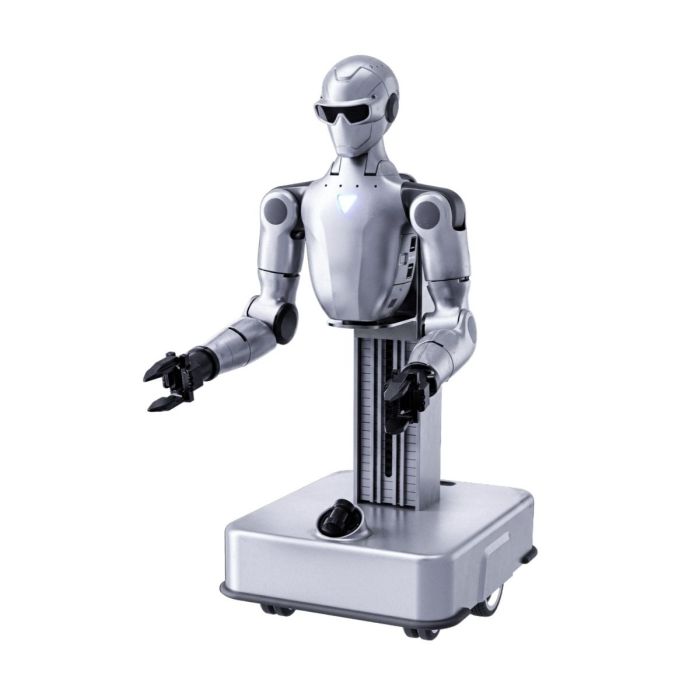
Every robot-learning laboratory knows the cable. A policy is trained on a workstation, the robot streams its camera feed across the network, and the arm waits for instructions computed somewhere else in the room. The Unitree R1-A7-D Ultimate A Humanoid Robot is designed to shorten that loop. An Orin NX module rated at 100 TOPS sits on board, so vision-language-action models and learned policies can run inside the robot while its wheeled base carries it from one workstation to the next. It is a torso rather than a walking humanoid, raised and lowered on a powered lifting column, and in the Ultimate A version it is fitted with the Dex1-1 V2 end effector.
Robots Middle East sells the R1-A7-D Ultimate A to universities, research institutes, system integrators and corporate innovation teams across the Middle East. We prepare each quotation for the exact configuration requested, arrange delivery to the customer's site and provide support once the robot has arrived, from first power-up to the questions that arise when development work begins in earnest.
Background
Unitree Robotics and the R1 family
Unitree Robotics is a Chinese manufacturer best known for its legged robots, with a range that has grown from quadrupeds into humanoid platforms for research and development. The R1 family takes a deliberately different route from the company's walking machines. Rather than investing its engineering in balance and gait, it concentrates on the upper body: two articulated arms, a sensing head and a body that can either be fixed to a bench or carried on wheels. The sources name several versions: the desk-mount R1-A7, the R1-A7-D on a mobile base, the Smart and Ultimate packages of the R1-A7-D, and the R1-A5 and R1-A5-D. The suffix D marks the mobile base, which adds the wheeled chassis, the powered lifting column and a chassis LiDAR.
The Ultimate tier and onboard inference
As standard, the R1 carries an 8-core CPU in the body and an 8-core CPU with 10 TOPS in the head. The Ultimate tier, offered on the R1-A7-D only, adds Orin NX compute rated at 100 TOPS for onboard VLA and policy inference. The Ultimate packages are lettered from A to H and share this compute, differing in the hand option fitted. The Ultimate A combines the 100 TOPS compute with the Dex1-1 V2 end effector, making it the configuration for teams who want the mobile platform, the full onboard inference capacity and this particular end effector in a single robot.
Technical Specifications
| Specification | Value |
|---|---|
| Form factor | Torso mounted on a wheeled mobile base with a powered lifting column and a chassis LiDAR |
| Locomotion | Wheeled base; the robot does not walk |
| Dimensions (collapsed) | 683 x 520 x 440 mm (26.9 x 20.5 x 17.3 in) |
| Height (raised) | 1,600 mm (63 in) |
| Weight | About 32 kg (71 lb) |
| Total degrees of freedom | 22 |
| Arms | Two arms, 7 degrees of freedom per arm, low-inertia inner-rotor joint motors |
| Arm reach (forearm plus upper arm) | 555 mm (21.9 in) |
| Arm payload | 2 to 4 kg (4.4 to 8.8 lb) per arm, varying considerably with arm extension |
| Maximum shoulder torque | 60 Nm (44 lb-ft) |
| End-clamp repeatability | ±0.1 mm (±0.004 in) |
| Waist yaw | ±35° |
| Head range | Yaw ±115°, pitch ±36° |
| Joint design | Crossed-roller and deep-groove ball bearings, hollow internal wiring, dual encoders on the arm joints, local air cooling |
| Head camera | Binocular; RGB 1280 x 720 at 30 Hz, depth 544 x 448 at 10 Hz |
| Standard compute | 8-core CPU in the body; 8-core CPU with 10 TOPS in the head |
| Ultimate compute | Orin NX, 100 TOPS, for onboard VLA and policy inference |
| End effector | Dex1-1 V2 |
| Additional sensing | Chassis LiDAR; optional wrist cameras |
| Audio | 4-array microphone, dual 3 W speakers |
| Wireless | Wi-Fi 6, Bluetooth 5.2 |
| Runtime and power | About 1.5 hours on battery; also runs on external power |
| Software | Open interfaces for the underlying system, arms, audio, lighting and vision; full secondary development support |
Specifications are as published by the manufacturer and are confirmed against the datasheet at quotation.
The manufacturer has not published the IP rating, the operating temperature range, the top speed, the charging time, the battery capacity or the contents of the box; these are confirmed at quotation.
What does the Ultimate tier add to the R1-A7-D?
The mechanical platform is shared: the same wheeled base, lifting column, arms and head. What changes is where the thinking happens. The standard compute, an 8-core CPU in the body and an 8-core CPU with 10 TOPS in the head, is sufficient for control, sensor handling and lighter perception tasks. Larger learned models, however, are usually run on an external machine, which ties the robot to a network link and a workstation.
The Orin NX module of the Ultimate tier, rated at 100 TOPS, is intended precisely for onboard VLA and policy inference. For a mobile robot this matters more than it would for a fixed one. Once the R1-A7-D leaves the bench and moves along a corridor, into a demonstration space or towards a shelf, an inference workload carried on board keeps the robot self-contained. The binocular head camera supplies the RGB and depth streams, the arms act on the result, and the decision loop remains inside the machine. For teams evaluating whether a policy trained in the laboratory will hold up in a less controlled room, that self-sufficiency is the central reason to choose Ultimate over Smart.
Why choose the mobile R1-A7-D over the desk-mount R1-A7?
The desk-mount R1-A7 has 19 degrees of freedom and a waist that yaws ±150°, which suits fixed benchtop work where the task comes to the robot. The R1-A7-D reverses that arrangement and takes the robot to the task. Its wheeled chassis brings the total to 22 degrees of freedom, the lifting column raises it from a collapsed 683 mm package to 1,600 mm, and the chassis LiDAR gives the base awareness of its surroundings. The waist range on the mobile base is ±35°, so wider turns of the body are made with the base itself.
The lifting column is the quiet advantage here. A pair of arms with a reach of 555 mm can address a low table or a higher worktop simply by changing the height of the torso, which widens the range of tasks a single robot can attempt without being moved by hand. Because the Ultimate tier exists only on the R1-A7-D, teams that want 100 TOPS of onboard inference are choosing the mobile base in any case.
Who is the Unitree R1-A7-D Ultimate A Humanoid Robot for?
The first group is embodied-AI and robot-learning researchers who collect demonstrations, train manipulation policies and need to test them on hardware that can run them without an external computer. The open interfaces for the system, arms, audio, lighting and vision, together with full secondary development support, allow such groups to work at the level of the underlying system rather than through a closed application.
The second group is universities and training centres teaching mobile manipulation, perception and human-robot interaction. The microphone array and speakers support voice interaction projects, and the folding form factor makes the robot practical to move between rooms.
The third group is system integrators and corporate innovation teams assessing how a dual-arm mobile platform might handle light handling, service or demonstration tasks. Here the payload of 2 to 4 kg per arm, which varies with extension, sets a clear boundary: this is a platform for light, careful work rather than heavy lifting.
Buyers whose projects call for a different hand should compare the other lettered packages that pair the same 100 TOPS compute with alternative hand options, such as the Unitree R1-A7-D Ultimate B Humanoid Robot, or review the complete R1-A7-D Ultimate range. Those who do not require onboard VLA inference will find the wider Unitree R1-A7-D family a useful place to compare configurations.
What is the Unitree R1-A7-D Ultimate A Humanoid Robot used for?
- Onboard policy deployment – running trained manipulation policies on the Orin NX module without streaming to a workstation.
- Vision-language-action research – linking spoken or written instructions, camera input and arm motion within one self-contained robot.
- Mobile manipulation studies – combining base movement, LiDAR sensing and torso height adjustment to reach tasks at different locations.
- Teleoperation and data collection – gathering demonstration data with dual arms and a binocular head camera for later training.
- Human-robot interaction – exploring voice-led interaction through the microphone array and speakers in reception or exhibition settings.
- Teaching and curriculum work – giving students an open platform for perception, control and secondary development projects.
Pricing and Availability
The R1-A7-D Ultimate A is supplied on quotation, which allows Robots Middle East to confirm the exact package, optional wrist cameras and any accessories your project requires. Delivery, customs clearance and after-sales support are arranged together with the quotation. To begin, please submit your requirements through the request for quotation available on this page.
Frequently Asked Questions
Does the R1-A7-D Ultimate A walk?
No. It is a torso mounted on a wheeled mobile base with a powered lifting column; it moves on wheels and does not walk.
How much can each arm carry?
Each arm is rated at 2 to 4 kg (4.4 to 8.8 lb), and Unitree states that the figure varies considerably with arm extension. Loads held close to the body sit at the upper end of that range.
What does the 100 TOPS Orin NX compute make possible?
It is intended for onboard VLA and policy inference, so larger learned models can run inside the robot instead of on an external workstation. This keeps the mobile platform self-contained when it works away from the bench.
How long does it run on battery?
The R1 runs for about 1.5 hours on battery. It also runs on external power, which is how most benchtop work is carried out.
Can we develop our own software for it?
Yes. Unitree provides open interfaces for the underlying system, the arms, audio, lighting and vision, with full secondary development support.
Which end effector does the Ultimate A use?
The Ultimate A is fitted with the Dex1-1 V2 end effector. Other lettered Ultimate packages, such as the Unitree R1-A7-D Ultimate C Humanoid Robot, pair the same compute with different hand options.
Where can I buy the Unitree R1-A7-D Ultimate A Humanoid Robot and what does it cost?
You can buy it from Robots Middle East, which supplies it across the Middle East. The cost depends on the confirmed configuration and is set out in a written quotation prepared on request.
Summary
The R1-A7-D Ultimate A addresses the problem of the cable. Its mechanical platform, with a wheeled base, lifting column, two 7-degree-of-freedom arms and a binocular head, takes the robot to the task, while the 100 TOPS Orin NX compute allows learned policies and VLA models to travel with it. The Dex1-1 V2 end effector completes a configuration aimed at teams that want to test manipulation intelligence beyond the laboratory bench. For a quotation tailored to your project, with delivery and support arranged by Robots Middle East, this page is the starting point.