
Unitree R1-A7-D Ultimate E Humanoid Robot
In stock
- BRAND:
- UNITREE ROBOTICS
- MODEL:
- R1-A7-D-Ultimate-E
- PART #:
- R1-A7-D-Ultimate-E
- ORIGIN:
- China
- Warranty:
- 12 MONTHS
- AVAILABILITY:
- SUBJECT TO AVAILABILITY
- SKU:
- Unitree-R1-A7-D-Ultimate-E
Unitree R1-A7-D Ultimate E Humanoid Robot
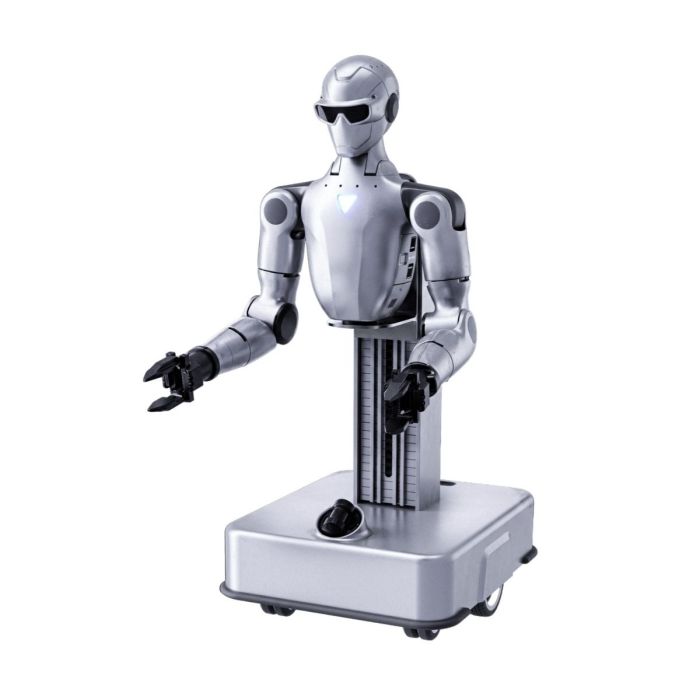
A humanoid has to make sense of the room it stands in before it can be useful: the bench in front of it, the doorway behind it, the person approaching from one side. The Unitree R1-A7-D Ultimate E Humanoid Robot meets that problem with a layered view of its surroundings. A LiDAR sits in the chassis, a binocular camera with a wide field of view sits in the head, and a camera can be added at the wrist. Around that perception are a body that folds down for transport and rises to working height, a head module with its own computing power, and a development environment that is open from top to bottom. It is built for teams who want to study and shape how a robot perceives and acts, not merely to watch it perform.
Robots Middle East supplies the Unitree R1-A7-D Ultimate E Humanoid Robot to universities, research centres, system integrators and corporate innovation teams across the Middle East. Robots Middle East prepares each quotation for the exact configuration requested, arranges delivery to the customer's site and remains the point of contact for technical support once the robot is in service.
Background
Unitree Robotics and the R1 family
Unitree Robotics has built its reputation on legged and humanoid machines that bring advanced motion and perception research within reach of laboratories, developers and educators. The R1 line continues that approach. The sources name several versions of it: the R1-A5, R1-A7, R1-A5-D and R1-A7-D, with the R1-A7-D also offered in lettered Ultimate packages, among them Ultimate D, Ultimate E, Ultimate F and Ultimate G. The Ultimate E is one of those packages. Buyers who wish to see the wider platform can browse the Unitree R1-A7-D range or the R1-A7-D Ultimate category, where the lettered configurations are listed side by side.
The published technical figures describe the R1-A7-D platform on which the Ultimate E is built. The contents that distinguish one lettered package from another are not set out in the published material, so Robots Middle East confirms the package detail with each quotation.
Perception and computing at the core
The R1-A7-D platform combines three sources of visual information. The chassis LiDAR builds a picture of the space around the robot, while the binocular camera in the head provides stereo vision with a horizontal field of view of 146° and a vertical field of view of 124°, and an eye spacing of 60mm. An optional wrist camera can bring the view closer to the point where a hand meets an object. The head module carries 10 TOPS of computing power, and the platform accepts a high-computing module such as Orin (40-100TOPS) for heavier perception and learning workloads. The joints are driven by low-inertia, high-speed inner-rotor permanent magnet synchronous motors, which the manufacturer describes as offering superior responsiveness and heat dissipation.
Technical Specifications
| Specification | Value (R1-A7-D platform) |
|---|---|
| Weight | Approx. 32kg |
| Shrunk size | 683x520x440mm |
| Raised size | 1600x520x440mm |
| Joint motor | Low-Inertia High-Speed Inner Rotor PMSM (Superior Responsiveness & Heat Dissipation) |
| Waist movement range | Yaw±35° |
| Camera module | Chassis LiDAR + Binocular Camera + Optional Wrist Camera |
| Binocular field of view | Horizontal 146°, Vertical 124° |
| Eye spacing | 60mm |
| Head module computing power | 10 TOPS |
| High-computing module | Such as Orin(40-100TOPS), etc. |
| Speakers | Dual Speakers (3W×2) |
| Power supply | External Power or Li-ion Battery |
| Battery life | Approx. 1.5h |
| Charger | Included |
| Secondary development | Full-stack open secondary development |
Specifications are as published by the manufacturer and are confirmed against the datasheet at quotation.
The manufacturer has not published the IP rating, the operating temperature range, the chassis travel speed, the chassis battery capacity or the hand specifications of the Ultimate E; Robots Middle East confirms these at quotation.
How does the R1-A7-D Ultimate E see its surroundings?
Most of what a humanoid does well depends on what it perceives first. On this platform, perception is divided between levels of the body. The LiDAR in the chassis is positioned to map the floor area and nearby obstacles, which is the information a mobile robot needs to orient itself in a room. The binocular camera in the head works at the level where people and work surfaces are found, and its wide field of view lets it take in a broad scene without constantly turning. Stereo vision with a fixed eye spacing of 60mm gives developers a consistent geometry from which to estimate depth.
The optional wrist camera addresses a different question: not where things are in the room, but what is happening at the point of contact. For research into grasping and manipulation, a close view from the wrist is often what separates a reliable pick from a near miss. Because the platform pairs these sensors with 10 TOPS in the head and room for a high-computing module such as Orin (40-100TOPS), a team can run perception locally and decide how much additional computing it needs for its own models.
Why does full-stack open development matter on a humanoid?
A humanoid that only runs its maker's routines is a demonstration piece. The R1-A7-D platform is described as offering full-stack open secondary development, which means a laboratory or integrator can work across the layers of the system rather than being confined to a single application interface. That openness is what allows a research group to test its own perception pipeline, a university to teach control from first principles, or an integrator to build an application tailored to one customer's workflow.
The practical design supports that work. The robot can run from external power or its Li-ion battery, so long programming sessions at the bench need not be interrupted by battery life of approx. 1.5h on a single charge, and the charger is included. The waist yaw range of ±35° adds a turning motion at the torso that developers can use in reaching and interaction tasks, and the dual 3W speakers give the robot a voice for spoken interaction experiments.
Who is the Unitree R1-A7-D Ultimate E Humanoid Robot for?
The first group is academic: universities and research institutes working on embodied intelligence, robot perception, manipulation and human-robot interaction. For them, the open development stack and the layered sensor arrangement are the main attractions. The second group is applied: system integrators and innovation departments that want a humanoid platform on which to prototype services for retail, hospitality, logistics or public-facing settings before committing to a larger deployment.
Education forms a third group. Technical colleges and STEM programmes can use a full-size humanoid to show students how sensing, computing and actuation fit together, while the shrunk size makes it easier to move the robot between classrooms. Finally, exhibition and demonstration teams value a robot that can travel compactly and rise to meet visitors at a natural height.
The published material does not set out how the lettered packages differ, so buyers deciding between configurations are welcome to compare the Unitree R1-A7-D Ultimate D Humanoid Robot and the Unitree R1-A7-D Ultimate F Humanoid Robot; Robots Middle East will set out the contents of each package side by side in the quotation.
What is the Unitree R1-A7-D Ultimate E Humanoid Robot used for?
- Perception research — developing and testing stereo vision, LiDAR mapping and sensor fusion on a full-size humanoid.
- Manipulation studies — investigating grasping and object handling, with the optional wrist camera providing a close view of the task.
- Human-robot interaction — studying speech, gesture and social behaviour with a robot that meets people at working height.
- Teaching and training — giving students hands-on experience of robot software, control and integration.
- Application prototyping — building and validating custom services on an open platform before a wider rollout.
- Demonstrations and exhibitions — presenting embodied AI at events, showrooms and innovation centres.
Pricing and Availability
The Unitree R1-A7-D Ultimate E Humanoid Robot is supplied on quotation, so that the configuration, optional components such as the wrist camera or a high-computing module, and the support required are matched to each project. Delivery, customs clearance and technical support are arranged together with the quotation from Robots Middle East. To begin, please submit your requirements through the quotation request available on this page.
Frequently Asked Questions
What size is the robot when folded and when raised?
The R1-A7-D platform has a shrunk size of 683x520x440mm and a raised size of 1600x520x440mm. Its weight is approx. 32kg.
Which sensors does the robot use?
The camera module comprises a chassis LiDAR and a binocular camera, with an optional wrist camera. The binocular camera has a horizontal field of view of 146° and a vertical field of view of 124°.
How much computing power does it have?
The head module provides 10 TOPS of computing power. The platform also accepts a high-computing module such as Orin (40-100TOPS).
How long does it run on battery?
Battery life is approx. 1.5h. The robot can also run from external power, and the charger is included.
Can we develop our own software for it?
Yes. The platform offers full-stack open secondary development, so your team can work across the software layers of the system.
How does the Ultimate E differ from the other Ultimate packages?
The published material does not detail the contents of each lettered package, including the hand specifications of the Ultimate E. Robots Middle East confirms the exact package contents and compares them with other configurations at quotation.
Where can I buy the Unitree R1-A7-D Ultimate E Humanoid Robot and what does it cost?
You can buy it from Robots Middle East, which supplies customers across the Middle East. The cost depends on the configuration and support required, and is set out in a quotation that you can request from this page.
Summary
Usefulness in a humanoid begins with understanding its surroundings, and the Unitree R1-A7-D Ultimate E Humanoid Robot is arranged around that principle. LiDAR in the chassis, wide-angle stereo vision in the head and an optional camera at the wrist give it several ways of reading a room, while 10 TOPS in the head and room for a high-computing module let teams decide how much intelligence to run on board. A body that folds for transport and rises to working height, a choice of battery or external power, and full-stack open development make it a platform to build upon. For research groups, educators and integrators in the Middle East who want to shape how a robot sees and acts, this page is the starting point.