
Unitree R1-A7-D Ultimate D Humanoid Robot
In stock
- BRAND:
- UNITREE ROBOTICS
- MODEL:
- R1-A7-D-Ultimate-D
- PART #:
- R1-A7-D-Ultimate-D
- ORIGIN:
- China
- Warranty:
- 12 MONTHS
- AVAILABILITY:
- SUBJECT TO AVAILABILITY
- SKU:
- Unitree-R1-A7-D-Ultimate-D
Unitree R1-A7-D Ultimate D Humanoid Robot
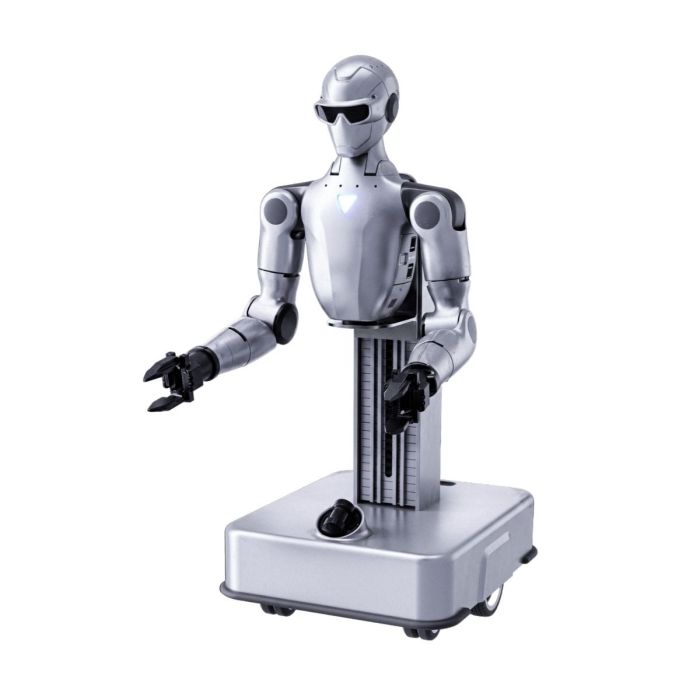
A fixed robot arm waits for the work to come to it: the part arrives on a conveyor, the sample is placed inside the cell and the bench is built around the machine. The Unitree R1-A7-D Ultimate D Humanoid Robot reverses that arrangement. Two 7-DoF arms, a rotating waist and a 2-DoF sensor head ride on a wheeled chassis with its own LiDAR, so the robot can be driven to a shelf, a workstation or a demonstration floor and begin working where it stops. In the Ultimate D configuration, BrainCo Revo 2 Basic is paired with a 100 TOPS Orin NX, which gives the platform considerable onboard compute for perception-heavy and learning-based manipulation work.
Robots Middle East sells the Unitree R1-A7-D Ultimate D Humanoid Robot and supplies it to universities, research centres, system integrators and corporate innovation teams across the Middle East. Each quotation from Robots Middle East is prepared against the exact configuration requested, and Robots Middle East arranges delivery, commissioning guidance and after-sales support for every installation.
Background
Unitree Robotics and the R1 platform
Unitree Robotics is widely known for legged robots, from quadrupeds used in inspection and research to humanoid platforms aimed at embodied AI laboratories. The R1 dual-arm manipulation platform extends that work into upper-body tasks. The sources name four base versions: the R1-A5, the R1-A7, the R1-A5-D and the R1-A7-D. The R1-A7 is the 7-DoF-per-arm version, with two 7-DoF arms offering 555 mm of reach, a rotating waist and a 2-DoF sensor head. The D suffix places the robot on a mobile base: the R1-A7-D adds a 3-DoF wheeled chassis and a chassis LiDAR to the same head camera, turning a workbench manipulator into a machine that can move between tasks.
The Ultimate D configuration
On top of the base versions sit lettered configurations. The Smart A–H configurations carry 40 TOPS of compute, while the Ultimate A–H configurations, offered on the R1-A7-D only, add a 100 TOPS Orin NX. Within that Ultimate series, the letter D identifies the combination of BrainCo Revo 2 Basic with 100 TOPS. The rest of the robot follows the R1-A7-D design: crossed-roller and deep-groove ball bearings in the joints, hollow internal wiring, dual encoders on the arm joints and local air cooling. For developers, Unitree provides open interfaces for the underlying system, robotic arm, audio, lighting and visual control, so the Ultimate D is intended to be programmed rather than simply operated.
Technical Specifications
| Specification | Value |
|---|---|
| Configuration | R1-A7-D Ultimate D – BrainCo Revo 2 Basic, 100 TOPS |
| Additional compute (Ultimate) | 100 TOPS Orin NX |
| Collapsed dimensions (mobile base) | 683 x 520 x 440 mm |
| Raised size | 1600x520x440mm |
| Weight | About 32 kg |
| Degrees of freedom | 22 counting the grippers, including a 3-DoF wheeled chassis |
| Arms | Two 7-DoF arms |
| Arm reach (forearm + upper arm) | 555 mm |
| Head | 2-DoF sensor head |
| Binocular camera field of view | Horizontal 146°, Vertical 124° |
| Binocular eye spacing | 60mm |
| Chassis sensing | LiDAR |
| Audio | 4-array microphone and dual 3 W speakers |
| Wireless | Wi-Fi 6 and Bluetooth 5.2 |
| Power | Removable chassis battery (about 1.5 h) plus external supply |
| Joint design | Crossed-roller and deep-groove ball bearings, hollow internal wiring, dual encoders on the arm joints, local air cooling |
| End effector options | Two-finger gripper / three-finger dexterous hand / five-finger dexterous hand |
| Secondary development | Open interfaces for the underlying system, robotic arm, audio, lighting, visual control, etc. |
| Charger | Included |
Specifications are as published by the manufacturer and are confirmed against the datasheet at quotation.
The manufacturer has not published the IP rating, the operating temperature range, the top speed, the charging time or the chassis payload capacity; Robots Middle East confirms these at quotation.
What does the Ultimate configuration add over the Smart versions?
The difference is computational. Smart configurations of the R1 carry 40 TOPS, whereas every Ultimate configuration adds a 100 TOPS Orin NX, and that option exists only on the R1-A7-D. For a team running vision models on the binocular head, fusing LiDAR data from the chassis and executing manipulation policies at the same time, the extra onboard capacity reduces the need to offload inference to an external workstation over Wi-Fi 6. That matters most for mobile work: a robot that drives away from its desk is easier to manage when the intelligence travels with it.
The mechanical platform does not change between Smart and Ultimate on the R1-A7-D. The arms, waist, sensor head and wheeled base are shared, which means research results gained on one configuration remain relevant to the other. Choosing Ultimate D is therefore a decision about how much processing should sit on the robot itself, combined with the BrainCo Revo 2 Basic element that the letter D specifies.
How does the R1-A7-D differ from the R1-A7 without the mobile base?
The R1-A7 and the R1-A7-D share the same pair of 7-DoF arms with 555 mm of reach, the same rotating waist and the same 2-DoF sensor head. The R1-A7-D places this upper body on a 3-DoF wheeled chassis, bringing the count to 22 degrees of freedom when the grippers are included, and adds a chassis LiDAR for spatial awareness. On the mobile base it measures 683 x 520 x 440 mm collapsed and rises to 1,600 mm, at about 32 kg.
Power follows the same logic. A removable chassis battery provides about 1.5 h of operation, and the robot also runs on external supply, so a laboratory can work tethered at the bench and switch to battery when the task requires movement. Because the battery is removable, a spare can keep sessions running while another is charged.
Who is the Unitree R1-A7-D Ultimate D Humanoid Robot for?
The first audience is embodied AI and robotics research groups that study manipulation in realistic settings rather than in a fixed cell. The combination of a mobile base, a wide-angle binocular head and 100 TOPS of onboard compute suits experiments in which perception, navigation and grasping have to work together. University departments form a second audience: the open interfaces for the arm, audio, lighting and vision allow students to build and test their own software on a platform that resembles the machines now entering industry.
System integrators and corporate innovation teams are a third group. They use a platform of this kind to prototype service, logistics or laboratory automation concepts before committing to a dedicated solution, and the voice interaction hardware supports public-facing demonstrations. Because the robot has a complex structure and considerable power, Unitree advises that users maintain a sufficient safety distance between people and the robot, and buyers should plan supervised operation accordingly.
Buyers who do not need the full onboard compute may find a 40 TOPS Smart configuration sufficient, and those who require a different end-effector arrangement can compare the alternatives listed in the R1-A7-D Ultimate category. The wider family, including other configurations on the same mobile base, is gathered under Unitree R1-A7-D.
What is the Unitree R1-A7-D Ultimate D Humanoid Robot used for?
- Mobile manipulation research: testing how a robot plans grasps after driving itself to a new workspace.
- Learning from demonstration: collecting manipulation data for imitation and reinforcement learning with onboard processing.
- Stereo perception studies: using the wide-angle binocular head to develop depth estimation and object recognition.
- Human–robot interaction: building voice-driven behaviours with the microphone array and speakers.
- Robotics education: teaching students to program arms, vision and audio through the open interfaces.
- Automation prototyping: trialling service, retail or laboratory tasks before investing in dedicated equipment.
Pricing and Availability
The cost of the Unitree R1-A7-D Ultimate D Humanoid Robot depends on the exact configuration, the accessories selected and the support package required, so Robots Middle East prices it by quotation rather than through a fixed listing. Delivery, customs and support are arranged with the quotation. Our team can also advise on configuration choices and integration planning before you commit. A quotation request for the Unitree R1-A7-D Ultimate D Humanoid Robot is available on this page.
Frequently Asked Questions
What compute does the Ultimate D configuration carry?
The Ultimate D combines BrainCo Revo 2 Basic with 100 TOPS of compute, provided by the Orin NX that all Ultimate configurations add. Smart configurations carry 40 TOPS instead.
How large is the robot when collapsed and when raised?
On the mobile base it measures 683 x 520 x 440 mm collapsed and rises to 1,600 mm when raised. It weighs about 32 kg.
How long does it run on its battery?
The removable chassis battery provides about 1.5 h of operation, and the robot can also run on external supply. Because the battery is removable, a spare can extend working sessions.
Can we develop our own software for it?
Yes. Unitree provides open interfaces for the underlying system, robotic arm, audio, lighting and visual control, among others.
How much can the arms lift?
The maximum load of the arm varies greatly with the extension posture, so no single figure describes it. Robots Middle East can review your intended tasks with you before you order.
Which end effectors can be fitted to the R1 platform?
The R1 platform offers a two-finger gripper, a three-finger dexterous hand and a five-finger dexterous hand as options. The Ultimate D configuration is specified with BrainCo Revo 2 Basic.
Where can I buy the Unitree R1-A7-D Ultimate D Humanoid Robot and what does it cost?
You can buy it from Robots Middle East, which supplies customers across the Middle East. The cost depends on configuration and support requirements, so please request a quotation through this page.
Summary
The appeal of the Unitree R1-A7-D Ultimate D Humanoid Robot lies in bringing the robot to the work rather than the work to the robot. Two 7-DoF arms, a wide-angle binocular head and a LiDAR-equipped wheeled chassis give it the reach and awareness to operate wherever it is driven, while the 100 TOPS Orin NX keeps demanding perception and control on board. Open interfaces make it a platform for building, not merely for watching, and the removable battery with external supply suits both bench and mobile sessions. For research groups, educators and integrators in the region who want to evaluate this configuration with Robots Middle East, this page is the starting point.