
Unitree R1-A7-D Ultimate B Humanoid Robot
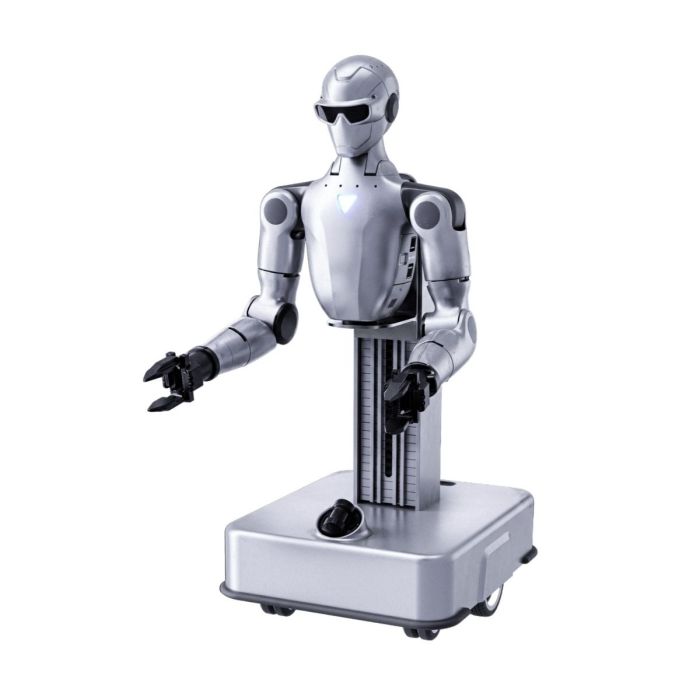
In stock
- BRAND:
- UNITREE ROBOTICS
- MODEL:
- R1-A7-D-Ultimate-B
- PART #:
- R1-A7-D-Ultimate-B
- ORIGIN:
- China
- Warranty:
- 12 MONTHS
- AVAILABILITY:
- SUBJECT TO AVAILABILITY
- SKU:
- Unitree-R1-A7-D-Ultimate-B
Unitree R1-A7-D Ultimate B Humanoid Robot
A vision-language-action model is only as convincing as the loop between what a robot sees and what its hands do next, and every round trip to an external workstation stretches that loop. The Unitree R1-A7-D Ultimate B Humanoid Robot keeps the loop on board. Orin NX compute rated at 100 TOPS sits inside a wheeled torso that rises on a powered column, with two 7-DoF arms and Dex3-1 force-controlled hands, so perception, policy and grasp share one machine. For teams moving from recorded demonstrations to manipulation at a real bench, that consolidation matters more than any single headline figure.
Robots Middle East sells the Unitree R1-A7-D Ultimate B and supplies it to universities, research institutes, corporate innovation teams and system integrators across the Middle East. Robots Middle East prepares the quotation for the exact configuration you require, arranges delivery to your site and supports the robot once it is in service.
Background
Unitree Robotics and the R1 platform
Unitree Robotics is widely known for its legged and humanoid robots, and the R1 range applies the company's actuator and control experience to dual-arm manipulation. The platform comes in several versions: the desk-mount R1-A7, the R1-A7-D on a mobile base, the R1-A7-D Smart configurations A to H with 40 TOPS, the R1-A7-D Ultimate configurations A to H with 100 TOPS, and the R1-A5 and R1-A5-D. The R1-A7 is the version with seven degrees of freedom per arm. The R1-A7-D mounts that torso on a wheeled mobile base with a powered lifting column and a chassis LiDAR, turning a stationary manipulator into a mobile one. It does not walk; the platform is designed around the arms, the hands and the sensor head rather than around legged locomotion.
Where the Ultimate B configuration sits
Within the R1-A7-D family, the Ultimate tier is defined by its compute. It carries Orin NX compute for onboard VLA and policy inference, offered with the same hand options as the rest of the range. The letter B identifies the hand fitment: the R1-A7-D Ultimate B combines Dex3-1 three-finger force-controlled hands with 100 TOPS of compute. Alongside this, the platform carries an 8-core CPU in the body and an 8-core CPU with 10 TOPS in the head as standard. The result is a configuration aimed squarely at groups that want to train, deploy and iterate on manipulation policies on the robot itself.
Technical Specifications
| Specification | Value |
|---|---|
| Configuration | R1-A7-D Ultimate B – Dex3-1, 100 TOPS |
| Arms | Two 7-DoF arms with 555 mm (21.9 in) of reach |
| Arm payload | 2 to 4 kg (4.4 to 8.8 lb) per arm, varying considerably with arm extension |
| Maximum shoulder torque | 60 Nm (44 lb-ft) |
| End-clamp repeatability | ±0.1 mm (±0.004 in) |
| Degrees of freedom (R1-A7-D) | 20 (adds a 3-DoF wheeled chassis), or 22 counting the grippers |
| Waist yaw (mobile base) | ±35° |
| Head range | 2-DoF sensor head; yaw ±115°, pitch ±36° |
| Mobile base | Wheeled base with powered lifting column and chassis LiDAR |
| Dimensions (R1-A7-D, collapsed) | 683 x 520 x 440 mm (26.9 x 20.5 x 17.3 in) |
| Maximum height (R1-A7-D) | 1,600 mm (63 in) |
| Weight (R1-A7-D) | About 32 kg (71 lb) |
| Head camera | Binocular; RGB at 1280 x 720 at 30 Hz, depth at 544 x 448 at 10 Hz |
| Binocular field of view | 146° horizontal by 124° vertical; eye spacing 60 mm (2.4 in) |
| Standard compute | 8-core CPU in the body; 8-core CPU with 10 TOPS in the head |
| Ultimate compute | Orin NX, 100 TOPS, for onboard VLA and policy inference |
| Hands | Dex3-1 three-finger force-controlled hands |
| Audio | 4-array microphone and dual 3 W speakers |
| Wireless | Wi-Fi 6 and Bluetooth 5.2 |
| Optional sensors | Wrist cameras |
| Battery runtime | About 1.5 hours |
| Joint design | Crossed-roller and deep-groove ball bearings, hollow internal wiring, dual encoders on the arm joints, local air cooling |
| Software | Open interfaces for the underlying system, arms, audio, lighting and vision, with full secondary development support |
| Locomotion | Wheeled; does not walk |
Specifications are as published by the manufacturer and are confirmed against the datasheet at quotation.
The manufacturer has not published the IP rating, the operating temperature range, the top speed, the battery capacity, the charging time or the contents of the box; each of these is confirmed at quotation.
What does onboard Orin NX compute change for the R1-A7-D Ultimate B?
In much embodied AI work, the robot is little more than a sensor and actuator package tethered to a powerful computer elsewhere in the room. That arrangement is workable for teleoperation, yet it complicates the moment a learned policy has to run on its own: network conditions, cabling and the location of the workstation all become part of the experiment. The Ultimate configuration places Orin NX compute rated at 100 TOPS inside the robot, for onboard VLA and policy inference. Models can therefore be evaluated where they will eventually have to operate, on the moving platform itself.
This sits on top of a sensor suite built for close work. The binocular head camera delivers RGB at 1280 x 720 at 30 Hz and depth at 544 x 448 at 10 Hz, across a field of view of 146° horizontal by 124° vertical, and optional wrist cameras can add a view from the hands. The arms are built for repeatable motion, with end-clamp repeatability of ±0.1 mm and dual encoders on the arm joints. Wi-Fi 6 and Bluetooth 5.2 remain available for logging, monitoring and fleet tools, but the inference loop no longer depends on them. Compared with the Smart configurations of the R1-A7-D, which carry 40 TOPS, the Ultimate tier gives development teams considerably more headroom for the models they intend to deploy.
How does the R1-A7-D Ultimate B compare with the desk-mount R1-A7?
The desk-mount R1-A7 and the R1-A7-D share the same pair of 7-DoF arms, the rotating waist and the 2-DoF sensor head. The difference lies beneath the torso. The R1-A7-D adds a wheeled base with a 3-DoF chassis, a powered lifting column and a chassis LiDAR, bringing the degree-of-freedom count to 20, or 22 counting the grippers. Collapsed, it measures 683 x 520 x 440 mm and rises to 1,600 mm, at about 32 kg. That lifting column allows the same arms to address a low bin, a bench and a high shelf without re-fixturing the robot.
There is a trade-off. Waist yaw is ±150° on the desk-mount version but ±35° on the mobile base, so the R1-A7-D relies more on repositioning its chassis than on twisting at the waist. For a fixed cell where the work surrounds the robot, the desk-mount R1-A7 may be the more direct choice; for tasks spread across a room, the mobile base is the point of the exercise.
Who is the Unitree R1-A7-D Ultimate B Humanoid Robot for?
The clearest fit is a research group in embodied AI or robot learning that needs force-controlled hands and onboard inference in a single platform, and that wants to move between data collection and autonomous evaluation without changing hardware. University departments running postgraduate programmes in manipulation, perception or human-robot interaction will value the open interfaces for the arms, audio, lighting and vision, and the full secondary development support. System integrators and corporate innovation teams evaluating mobile manipulation for laboratories, light logistics or service settings form a third group, particularly where a robot must work at several heights across a room.
Buyers whose work depends on a different end effector should compare the other Ultimate configurations, such as the Unitree R1-A7-D Ultimate A Humanoid Robot or the Unitree R1-A7-D Ultimate D Humanoid Robot; the Unitree R1-A7-D Ultimate C Humanoid Robot also uses Dex3-1 hands and is worth reviewing alongside the B. The full tier is gathered in the R1-A7-D Ultimate category, and the wider family, including the Smart configurations, in the Unitree R1-A7-D category. Teams that do not need mobility at all may find the desk-mount R1-A7 sufficient.
What is the Unitree R1-A7-D Ultimate B Humanoid Robot used for?
- Embodied AI research: running vision-language-action models and learned policies directly on the robot's onboard compute.
- Demonstration data collection: recording manipulation episodes from the binocular head camera and optional wrist cameras for imitation learning.
- Dexterous grasping studies: exploring force-controlled grasps and in-hand handling with the Dex3-1 hands.
- Mobile manipulation trials: moving between workstations and adjusting working height with the lifting column in laboratory or mock-up environments.
- Human-robot interaction: voice-driven experiments using the 4-array microphone and dual speakers.
- Teaching and curricula: giving students an open, fully programmable dual-arm platform for coursework and projects.
Pricing and Availability
The cost of the R1-A7-D Ultimate B depends on the configuration, optional items such as wrist cameras, and the support package you require, so Robots Middle East provides it by individual quotation. Delivery, customs clearance and after-sales support are arranged together with the quotation. To begin, please submit your requirements through the quotation request available on this page.
Frequently Asked Questions
Does the R1-A7-D Ultimate B walk?
No. It moves on a wheeled mobile base with a 3-DoF chassis and raises its torso on a powered lifting column.
Which hands are fitted to the Ultimate B configuration?
The Ultimate B is fitted with Dex3-1 three-finger force-controlled hands.
How much can each arm carry?
Each arm carries 2 to 4 kg (4.4 to 8.8 lb), and the figure varies considerably with arm extension, so the payload for your task is best reviewed with Robots Middle East.
How long does it run on battery?
The robot runs for about 1.5 hours on battery.
Can we develop our own software for it?
Yes. Unitree provides open interfaces for the underlying system, the arms, audio, lighting and vision, with full secondary development support.
What cameras does the robot use?
A binocular head camera provides RGB at 1280 x 720 at 30 Hz and depth at 544 x 448 at 10 Hz. Wrist cameras are available as an option.
Where can I buy the Unitree R1-A7-D Ultimate B Humanoid Robot and what does it cost?
You can buy it from Robots Middle East, which supplies it across the Middle East. The cost depends on configuration and support, and is provided in a written quotation on request.
Summary
The R1-A7-D Ultimate B is defined by where its intelligence lives. Orin NX compute at 100 TOPS, Dex3-1 force-controlled hands, a binocular head camera and two 7-DoF arms on a wheeled, height-adjustable base place perception, decision and grasp inside the same machine, shortening the loop that every learned policy depends on. It does not walk, and it is not meant to; it is meant to reach, grip and learn at the bench, the shelf and the bin. For research groups, universities and integrators in the region who want that loop closed on board, this page is the starting point.