
Unitree G1-D Standard C U3 Fixed Base Dual-Arm Humanoid Robot
متوفر
- ماركة:
- UNITREE ROBOTICS
- نموذج:
- U3
- الجزء #:
- G1-D-U3
- ORIGIN:
- الصين
- Warranty:
- 12 MONTHS
- AVAILABILITY:
- SUBJECT TO AVAILABILITY
- SKU:
- Unitree-G1-D-U3
Unitree G1-D Standard C U3 Fixed Base Dual-Arm Humanoid Robot
Force control tells the hand how hard it is squeezing. Tactile sensing tells it what is happening at the fingertips. If your research involves contact rather than simply gripping known objects, that second thing is the whole point.
What it is
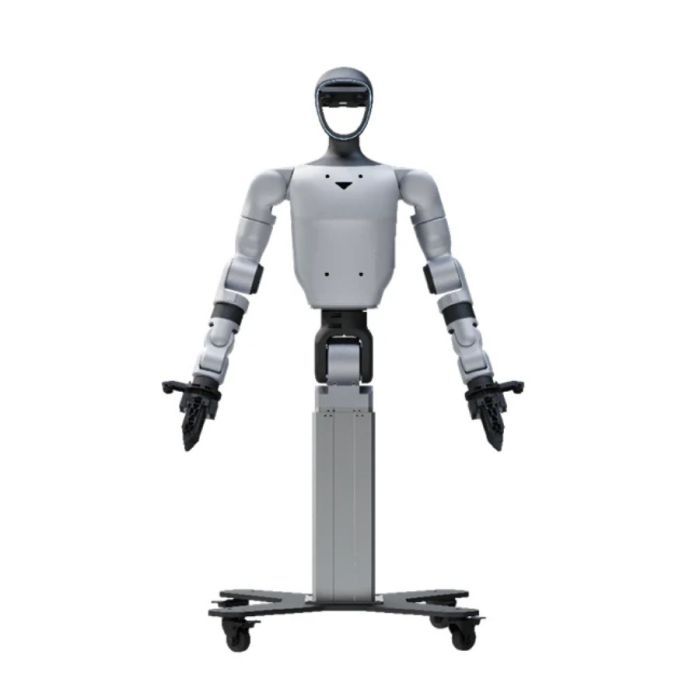
The Unitree G1-D Standard C U3 is a dual-arm manipulation platform: two 7-DOF arms and a waist on a telescoping column, mounted on a fixed base, fitted with two Dex3-1 force-controlled three-finger dexterous hands with tactile sensing. Total freedom reaches 31 degrees. It is sold as a development platform with documented interfaces rather than as a closed product.
This is not a legged humanoid
The naming invites confusion, so it is worth being blunt. The Unitree G1 is a bipedal robot that walks. The G1-D is a dual-arm manipulation platform: two 7-DOF arms and a waist mounted on a telescoping column, which either stands on a fixed base or rides on a wheeled one. It does not walk, and it is not trying to. What it does instead is hold a stable, repeatable working posture at any height between roughly 1.26 and 1.68 metres, which is precisely what bimanual manipulation research needs and precisely what a walking robot struggles to give you.
If your work is locomotion, balance or whole-body control, buy a G1. If your work is grasping, bimanual coordination, teleoperation or collecting demonstration data for robot learning, the G1-D is the better platform and usually the cheaper one.
Two decisions: the base and the hands
Every G1-D is one of two bases crossed with one of five hand options. Ten SKUs, two decisions. Get the axes straight and the range stops being confusing.
| Tier | Base | Core DOF (excluding hands) | Mobility | Codes |
|---|---|---|---|---|
| Standard | Fixed base | 17 | Stationary — column lifts, base does not move | U1–U5 |
| Ultimate | Wheel base | 19 | Dual-wheel differential drive, up to 1.5 m/s, with navigation sensors | U6–U10 |
The core 17 degrees of freedom are the same in both: 7 per arm, 2 in the waist and 1 in the lifting column. The Ultimate tier adds 2 for the drive wheels. Hands are then added on top.
| Letter | Hands | DOF per hand | Tactile sensing | Fixed base | Wheel base |
|---|---|---|---|---|---|
| A | Dex1-1 two-finger gripper | 1 | No | U1 | U6 |
| B | Dex3-1 three-finger, force controlled | 7 | No | U2 | U7 |
| C | Dex3-1 three-finger, force controlled | 7 | Yes | U3 | U8 |
| D | BrainCo Revo 2, five fingers | 6 | No | U4 | U9 |
| E | BrainCo Revo 2 Tactile, five fingers | 6 | Yes | U5 | U10 |
The wheel base carries a consistent premium over the fixed base across every hand option, so the two decisions price independently. Choose the base from whether the robot needs to travel, and the hands from what it needs to hold.
Where this configuration sits
The U3 is the Standard tier — fixed base — with the C hand option. Its direct counterpart is the U8 Ultimate C, which is the identical robot on the other base. If the robot needs to move between workstations or follow a person, that wheeled version is the one to specify. Within this tier the other hand options are the U1 Standard A, U2 Standard B and the rest of the G1-D range.
Unitree G1-D Standard C U3 specifications
| Specification | Value |
|---|---|
| Tier | Standard — fixed base |
| Total degrees of freedom | 31 (17 core + 7 per hand) |
| Hands | Dex3-1 force-controlled three-finger hands with tactile sensing |
| Tactile sensing | Yes — pressure, friction, direction and proximity |
| Mobility | Stationary fixed base |
| Arms | Two arms, 7 DOF each |
| Payload | 3 kg per arm |
| Arm reach | 0.45 m |
| Height range | 1,260 – 1,680 mm (telescoping column) |
| Maximum working height | About 2 m |
| Lifting stroke | 500 mm |
| Lifting speed | 60 mm/s |
| Battery life | Up to about 6 hours |
Figures follow published specifications for this configuration and vary by production batch. Confirm the exact build on your quotation before ordering.
Who buys it
- Contact-rich manipulation and slip-detection research
- Compliant grasping of fragile or deformable objects
- Tactile learning and multimodal perception work
- Groups publishing on force and touch sensing
How to choose
Buy the U3 if you need two Dex3-1 force-controlled three-finger dexterous hands with tactile sensing and the robot can stay where it is put. Switch base with the U8 and nothing else changes. Save money by dropping tactile sensing with the B option, or move to five fingers with the E option. Compare the whole field in our humanoid robots category.
Safety and standards
The G1-D is research and development equipment. The industrial robot safety standards — ISO 10218 and the ANSI/RIA R15.06 family — and the mobile robot standard R15.08 do not cover it, so the duty of care sits with the operator. Define and mark a working area, keep untrained people outside it, keep a trained operator with the emergency stop within reach, and complete a written risk assessment before any public demonstration. Two arms moving 3 kg each at head height deserve the same respect you would give any industrial manipulator.
Lithium batteries are regulated dangerous goods in transit, which affects how spares ship and how quickly.
Deployment and running costs
A fixed-base platform needs a dedicated bench or floor position and the working area around it. Battery endurance of around six hours means most labs run a full day without a swap, which is a real advantage over legged humanoids. Budget for mounting or siting, the working-area arrangements above, and any end-effector spares — hands are the most frequently damaged part of any manipulation platform. Related parts are listed under robot accessories. International buyers should add duty and import charges. Current pricing is shown on the listing above; for quantities, grant purchases or bundles, request a written quotation.
Import and delivery
Units ship from the manufacturer and lead times follow production batches rather than a fixed schedule. Lithium batteries restrict some routes and add documentation, and this is a heavy, bulky crate. Tell us the destination country when you enquire and we will confirm delivered cost, a realistic lead time and the paperwork required before you commit.
Support before and after the sale
Before you buy, our team will confirm that your work genuinely reads tactile data. If it does not, the B option is the same robot for less. We will also check the base decision with you, because moving between fixed and wheeled after delivery is not a cheap correction. After delivery, we help with training, set up and ongoing support. The specifics for your order are confirmed on your quotation.
Where to buy
This configuration is listed above with current price and availability, alongside the rest of the G1-D range so you can compare before committing. Order directly, or contact our team for a formal quotation including delivery to your country. Universities and institutions buying against a purchase order should request a written quotation first.
Frequently asked questions
How much does a Unitree G1-D Standard C U3 cost?
Current pricing is shown on the listing above. Request a quotation for delivered pricing or quantities.
What is the difference between the U3 and the U8?
The hands are identical. The U3 has the fixed base; the U8 has the wheel base.
What is the difference between Standard and Ultimate?
Standard is a fixed base; Ultimate adds a dual-wheel differential drive base reaching 1.5 m/s, with navigation sensors, and 2 extra degrees of freedom.
What hands does the U3 have?
Dex3-1 force-controlled three-finger hands with tactile sensing, 7 degrees of freedom per hand, with tactile sensing covering pressure, friction, direction and proximity.
Can I change the hands later?
Yes. End effectors are sold separately and can be changed, though specifying correctly at order saves cost and downtime.
How many degrees of freedom does it have?
31 in total: 17 in the core body — 7 per arm, 2 in the waist, 1 in the column — plus 7 per hand.
Does the G1-D walk?
No. It is a dual-arm manipulation platform on a telescoping column, with either a fixed base or a wheeled one. For a walking humanoid, see the Unitree G1.
How long does the battery last?
Up to about six hours, which is enough for most labs to work a full day without a swap.
How much can each arm lift?
3 kg per arm, at an arm reach of 0.45 m.
How high can it reach?
The column lifts the torso between about 1.26 and 1.68 m, giving a maximum working height of roughly 2 m.
Do you ship internationally?
Yes. Lithium batteries and crate size both affect routing and lead time, so confirm the destination country when you enquire.