
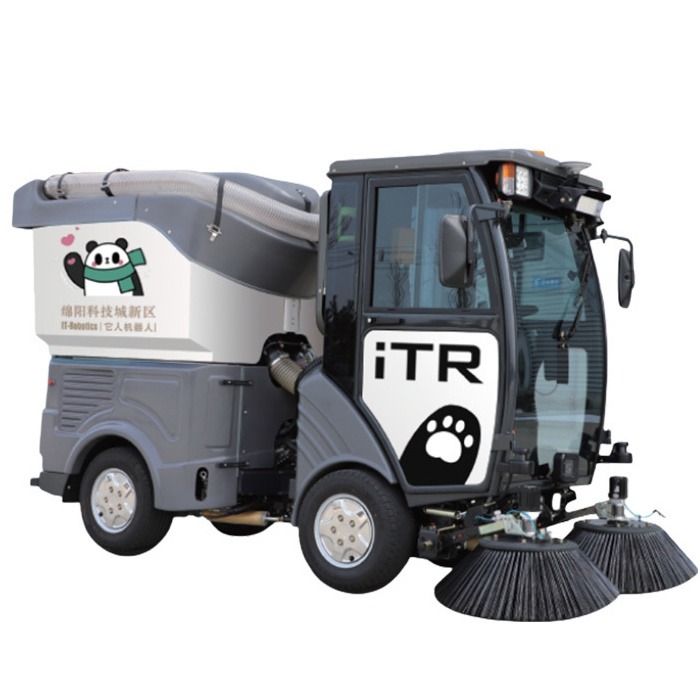
iTR OM1 Outdoor Municipal Street Sweeper
In stock
- BRAND:
- iTR Robot
- AVAILABILITY:
- CURRENTLY UNAVAILABLE
- SKU:
- ITR-OM1
iTR OM1: The Autonomous Outdoor Municipal Street Sweeper
The OM1 represents iTR's dedicated platform for public road and street cleaning, distinct from the company's commercial outdoor sweeper range in both its operational design and the regulatory and operational context of municipal deployment. iTR's official product description confirms the OM1's specific purpose: "OM1 is an outdoor municipal sweeper created by iTR specifically for the needs of municipal road cleaning, with sweeping, vacuuming, ash reduction and other functions." This positioning distinguishes the OM1 from the W1 and W2 commercial outdoor sweepers in the iSweeper series, which are designed for venue and facility management. The OM1 is designed for public road environments where vehicles and pedestrians share the operating space and where traffic management signals, road markings, and pedestrian crossings define the operational framework.
The OM1's five distinguishing technical capabilities for municipal road deployment are: multi-sensor fusion perception for navigating the complex, unpredictable outdoor road environment; traffic light recognition for compliant operation at intersections; edge cleaning for effective street gutter and curb cleaning where road debris concentrates; emergency safety braking for the safety requirements of public road operation; and self-built high-precision map navigation for consistent, repeatable route coverage. Remote management through vehicle status query, video monitoring, and task scheduling enables municipal operations center oversight of OM1 deployments across a fleet without requiring supervisory personnel to accompany each unit.
The Municipal Road Cleaning Context
Why Municipal Street Sweeping Requires a Different Platform
The operational environment of municipal road cleaning differs from commercial venue and facility cleaning in several fundamental ways, each of which shaped the OM1's specific design requirements.
Traffic compliance: Municipal roads are shared with vehicles and governed by traffic management infrastructure including traffic lights, road markings, pedestrian crossings, and speed regulations. A street sweeper operating on public roads must comply with traffic signals, yield to pedestrians at crossings, and operate at speeds appropriate for the specific road section. Commercial venue sweepers operating in parking lots and plazas do not face the same traffic management requirements.
Road surface variety: Municipal road cleaning addresses the full diversity of urban road surfaces: asphalt roadways, concrete sidewalks, granite paving in pedestrianized areas, terrazzo in covered walkways, and the mixed transitions between these surfaces at intersections and pedestrian crossings.
Gutter and edge concentration: Street debris in municipal environments accumulates most heavily in road gutters and along curb edges, where flowing water from rainfall and traffic air movement deposits leaves, paper, grit, and organic matter. Effective municipal street cleaning requires concentrated edge-cleaning capability, not just central road coverage.
7/24 scheduling flexibility: Municipal cleaning may be scheduled at any hour, from overnight passes to mid-day cleaning in pedestrianized zones, requiring a platform that can operate safely across the full range of occupancy conditions.
Remote fleet management: Municipal authorities operating fleets of street sweepers need centralized operational oversight that does not require supervisory personnel with every unit at all times, requiring robust remote monitoring and task scheduling capability.
The OM1's specification directly addresses each of these requirements.
Core Features: What Makes the OM1 Appropriate for Municipal Deployment
Traffic Light Recognition
Traffic light recognition is the operational capability most uniquely relevant to the OM1's municipal road context, and it is specifically listed in iTR's OM1 documentation as a key feature: the sweeper's "multi-sensor fusion perception and traffic light recognition contribute to its intelligent operation" and "allow it to navigate complex environments with ease."
Traffic light recognition enables the OM1 to detect and respond to red/green light states at intersections, stopping at red lights and proceeding on green in compliance with traffic management. For a robot operating on public roads where traffic law compliance is both legally required and essential for safety, this capability bridges the gap between autonomous navigation in controlled indoor environments and the regulated, unpredictable environment of public road operation.
The traffic light recognition system is part of the OM1's multi-sensor fusion approach: camera-based visual recognition of traffic signal states combined with the geometric sensing that enables safe stopping and proceeding without human intervention. For municipal authorities evaluating autonomous street sweepers, traffic light compliance is a prerequisite for public road deployment that commercial venue sweepers, designed for private controlled environments, do not need to address.
Edge Cleaning
The OM1's edge cleaning capability addresses the specific debris concentration pattern of municipal street environments. Street gutters, curb edges, and sidewalk borders are where the majority of road debris accumulates between cleaning passes: wind and vehicle air turbulence deposits debris at the road edge, rainfall channels organic matter and grit into gutters, and pedestrian activity deposits food packaging, cigarette ends, and miscellaneous waste along walking routes.
iTR's OM1 documentation specifically calls out "edge cleaning" as one of the autonomous capabilities that ensures "a thorough and safe cleaning process." For municipal cleaning efficiency, edge cleaning capability is the difference between a sweeping pass that addresses the actual debris distribution of the street and one that primarily cleans the open roadway where accumulation is lower.
Emergency Safety Braking
Operating on public roads where pedestrians cross unexpectedly, cyclists enter the road from side paths, and children move unpredictably creates collision risk scenarios that controlled indoor environments do not present. The OM1's emergency safety braking system provides a guaranteed rapid stop response to detected imminent collision risk, providing the safety failsafe that public road operation requires alongside the primary obstacle avoidance system.
iTR's documentation describes this as "an extra layer of security" beyond the obstacle avoidance capability, reflecting the layered safety architecture appropriate for municipal road deployment: standard obstacle avoidance handles the predictable cases, and emergency safety braking provides the hard stop for edge cases that the primary system may not resolve in time.
Self-Built High-Precision Map Navigation
The OM1 builds its own high-precision maps of its operating areas for navigation, eliminating the need for infrastructure installation or manual route programming in new deployment zones. iTR's documentation confirms: "its self-built high-precision maps facilitate efficient navigation."
For municipal deployment contexts where the cleaning area is an extensive road network rather than a single defined facility, self-built mapping enables the OM1 to be configured for new road sections, seasonal route changes, and special event cleaning requirements without requiring specialist infrastructure work at each new route. The map-building process is completed through an initial coverage drive, after which the OM1 follows the self-generated route autonomously in subsequent cleaning sessions.
Technology: Multi-Sensor Fusion Perception
Building on iTR's Unmanned Driving Heritage
The OM1's multi-sensor fusion perception system reflects iTR's founding technology in low-speed unmanned driving. Municipal road operation requires the same sensor fusion architecture as low-speed autonomous vehicle navigation: multiple sensor types providing overlapping environmental coverage, fused in real time to maintain accurate world representation, and feeding the decision systems that control steering, speed, and stopping.
iTR's About page characterizes the company as "one of the first robot enterprises in the world to apply unmanned technology in the field of commercial cleaning and a leading enterprise in the field of low-speed unmanned driving," establishing that the OM1's municipal road navigation technology is derived from a decade of commercial unmanned driving development rather than being adapted from consumer cleaning robot technology.
Remote Management: Video Monitoring, Task Scheduling, and Status Query
The OM1 supports three remote management functions that enable municipal fleet oversight from operations centers without requiring personnel accompaniment for every unit:
Remote vehicle status query: Enables operators to check each OM1's current location, operational status, battery level, task progress, and sensor health from a centralized dashboard. For a municipal authority operating multiple OM1 units across an urban area, remote status query provides fleet-wide operational awareness without requiring radio communication with each unit.
Video monitoring: Provides a live camera feed from the OM1's perspective, enabling remote operators to assess cleaning quality, observe operational conditions on specific road sections, and identify issues requiring human intervention without dispatching personnel.
Task scheduling: Enables cleaning schedules to be configured centrally for specific road sections, times of day, and cleaning frequencies. For municipal authorities who plan cleaning routes by time and area to minimize traffic impact, task scheduling enables consistent programmatic deployment without daily manual direction of individual units.
Confirmed Specifications and Capabilities
From iTR's official product page at itrobotgroup.com/outdoor-municipal-street-sweeper1.html and the advanced street sweeper description page:
Cleaning Functions: Sweeping, vacuuming, ash reduction
Key Autonomous Capabilities: Edge cleaning, obstacle avoidance, emergency safety braking, traffic light recognition
Navigation: Self-built high-precision map navigation, multi-sensor fusion perception
Remote Management: Remote vehicle status query, video monitoring, task scheduling
Application Scenes: Parks, factories, airports, commercial squares, campuses, parking lots (outdoor environments)
Surface Compatibility: Marble, granite, terrazzo, concrete, epoxy resin, tile, wood floor, and other hard surfaces
Specific Purpose: Municipal road cleaning (distinct from commercial venue sweeping)
Safety Systems: Multi-sensor obstacle avoidance plus emergency safety braking
Applications and Deployment Contexts
Municipal Road Networks
The OM1's primary and defining application is municipal road cleaning, confirmed in its official designation as a "municipal sweeper created by iTR specifically for the needs of municipal road cleaning." Urban road networks require regular sweeping to maintain public health standards, manage dust and particulate air quality, prevent drain blockage from accumulated debris, and maintain the aesthetic standards that public spaces require. The OM1's traffic light recognition and public road autonomous navigation directly address the operational requirements that distinguish municipal road cleaning from venue and facility cleaning.
Parks and Pedestrianized Areas
Parks and pedestrianized commercial areas share many characteristics of the public municipal environment: varied hard surfaces, shared use with pedestrians, and the need for scheduled cleaning across extensive areas. The OM1's application scenes list specifically includes parks, confirming its appropriateness for these semi-public outdoor environments where traffic light recognition is less relevant but multi-sensor pedestrian obstacle avoidance and edge cleaning are operationally important.
Airport Ground Areas and Taxiways
Airports operate extensive outdoor hard-surface areas including roadways, taxiways (away from aircraft operation), service roads, and terminal access roads that require regular sweeping for debris that creates foreign object debris (FOD) risk for aircraft, vehicles, and personnel. The OM1's surface compatibility list includes the concrete and asphalt that airport ground areas typically use, and its traffic light recognition applies to the traffic management signals that control vehicle flow in complex airport ground environments.
Commercial Plazas and Campuses
Commercial squares and campuses appear in the OM1's confirmed application list, indicating deployment in the outdoor common areas of large commercial and institutional properties where the OM1's public-road-oriented design (traffic compliance, edge cleaning, emergency braking) provides greater capability than pure indoor or private-venue sweepers in these semi-public outdoor environments.
Comparison: iTR OM1 vs. iTR W1 and W2 Commercial Outdoor Sweepers
The OM1 and the iSweeper W1 and W2 all perform outdoor sweeping but are designed for different operational contexts:
OM1 (Municipal Street Sweeper): Designed specifically for public municipal road cleaning. Key differentiators are traffic light recognition for regulatory compliance at intersections and the full suite of public road safety features including emergency safety braking. Appropriate for municipal authorities deploying autonomous sweepers on public road networks.
W1 (Large-Scale Commercial Outdoor Sweeper): Designed for large commercial outdoor venue cleaning. Positioned for private or controlled outdoor environments where traffic light compliance is not operationally required.
W2 (Medium-Scale Commercial Outdoor Sweeper): Designed for large indoor and outdoor commercial scenes with a medium cleaning width appropriate for venue and facility management.
Summary
The iTR OM1 is iTR Robot Technology's purpose-built autonomous municipal street sweeper, created specifically for the public road cleaning operational context that distinguishes it from commercial venue sweeping platforms. Its traffic light recognition for regulatory compliance at intersections, edge cleaning for gutter and curb debris, emergency safety braking for public road safety, self-built high-precision map navigation for consistent route coverage, and remote fleet management through video monitoring, task scheduling, and status query collectively provide the technical specification that municipal authorities evaluating autonomous street sweeping deployment require. Developed by a company that describes itself as "one of the first robot enterprises in the world to apply unmanned technology in the field of commercial cleaning," the OM1 brings iTR's decade of commercial autonomous driving expertise to the municipal road cleaning application context where that expertise is most directly applicable.
Frequently Asked Questions (FAQ)
What is the iTR OM1?
The iTR OM1 is an autonomous outdoor municipal street sweeper developed by iTR Robot Technology Co., Ltd. specifically for public road cleaning. It integrates sweeping, vacuuming, and ash reduction functions with autonomous capabilities including edge cleaning, obstacle avoidance, emergency safety braking, traffic light recognition, and self-built high-precision map navigation. The OM1 supports remote fleet management through video monitoring, task scheduling, and vehicle status query. It is designed for parks, commercial squares, campuses, parking lots, and public road environments requiring compliance with traffic management signals.
How does traffic light recognition work in the iTR OM1?
The OM1's traffic light recognition uses its multi-sensor fusion perception system, which includes camera-based visual detection alongside laser and ultrasonic sensing, to identify the state of traffic signals at intersections during operation. When the OM1 approaches an intersection with an active traffic management signal, the recognition system detects the current light state (red, yellow, or green) and directs the robot to stop at red, proceed cautiously at yellow, and continue at green, in compliance with standard road traffic regulations. This traffic light compliance capability is specifically noted in iTR's documentation as enabling the OM1 to "navigate complex environments with ease" in the shared vehicle and pedestrian road environment.
How is the OM1 different from iTR's W1 and W2 outdoor sweepers?
The OM1 is designed specifically for public municipal road cleaning, with traffic light recognition for intersection compliance and the full safety features required for shared vehicle and pedestrian road operation. The W1 (large-scale) and W2 (medium-scale) are iSweeper series commercial outdoor sweepers designed for private or controlled outdoor venue environments such as parking lots, commercial squares, and industrial facility grounds, where traffic light compliance is not an operational requirement. Municipal authorities planning public road deployment should evaluate the OM1; private venue operators deploying in controlled private outdoor areas should evaluate the W1 or W2.
What remote management features does the iTR OM1 provide?
The OM1 supports three remote management functions: remote vehicle status query (checking each unit's location, operational status, battery level, task progress, and sensor health from a central dashboard without requiring radio contact with each unit), video monitoring (live camera feed from the robot's perspective for remote assessment of cleaning quality and operational conditions), and task scheduling (centrally configuring cleaning schedules for specific road sections, times, and frequencies). These remote management functions enable municipal operations center oversight of OM1 fleets across an urban area without requiring supervisory personnel to accompany each unit.
- Dimensions: 3.5 × 1.2 × 2.1 m
- Sweeping width: 185 cm
- Maximum mapping area: 1,000,000 m²
- Maximum speed: 25 km/h
- Water tank capacity: 150 L
- Container capacity: 500 L
- Battery type: Lithium iron phosphate
- Battery capacity: 40.3 kWh
- Weight: 1,810 kg
- Maximum weight: 2,400 kg
- Runtime: ≥8 h