
BrainCo Revo 1 Intelligent Dexterous Bionic Hand
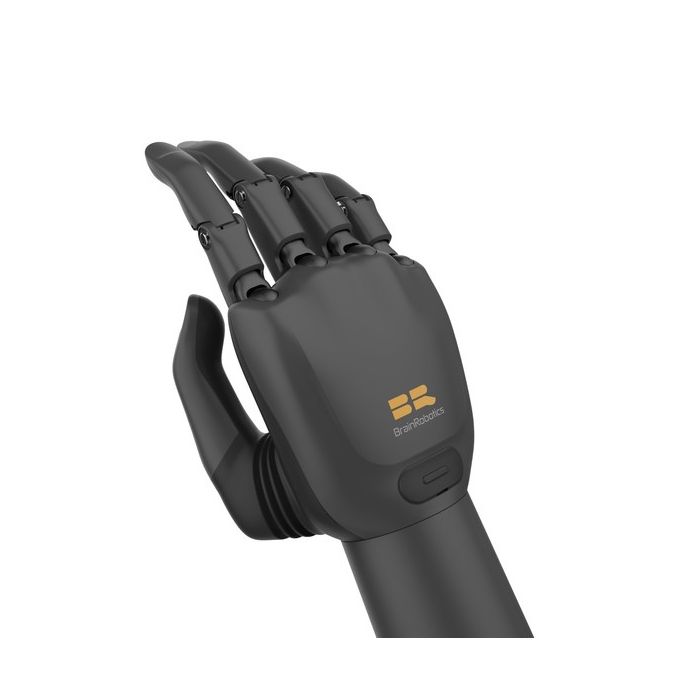
The BrainCo Revo 1 Intelligent Dexterous Bionic Hand is a robotic dexterous hand platform from BrainCo, a brain-computer-interface and human-machine-interface company that publicly lists “BrainCo Bionic Dexterous Hand Revo1” among its product lines on its official website. BrainCo positions itself as a company working across bionic hands, bionic knees, neurotechnology, and AI-oriented robotics solutions.
In stock
- BRAND:
- BRAINCO
- PART #:
- Intelligent Dexterous Bionic Hand
- ORIGIN:
- China
- Warranty:
- 12 MONTHS
- AVAILABILITY:
- SUBJECT TO AVAILABILITY
- SKU:
- BrainCo-Dexterous-Bionic-Hand
Power a robotic hand on and the first thing it should do is find itself. The BrainCo Revo 1 Intelligent Dexterous Bionic Hand does exactly that: after power-up it runs a position calibration sweep on its own, then waits for instructions from your software. That small behaviour says a good deal about its character. It is a biomimetic hand meant to be integrated, programmed and tested, not simply bolted on and opened and closed like a clamp.
Robots Middle East supplies the BrainCo Revo 1 Intelligent Dexterous Bionic Hand to research institutions, universities, robotics developers and healthcare-technology teams across the Middle East. Robots Middle East prepares each quotation, arranges delivery to your site and supports the product after it has been supplied.
Background
BrainCo and its lineage
BrainCo was founded in 2015 and was incubated by the Harvard Innovation Lab (i-Lab). The company is based in Somerville, Massachusetts, and, according to the published company description, has focused on developing a non-invasive brain-computer interface (BCI). That origin matters for understanding the hand. A company that begins with the question of how intention travels from a person to a machine will naturally care about the device at the far end of that chain: the hand that carries out the movement.
The Revo 1 belongs to this tradition of human-machine interaction. It is catalogued as part of the BrainCo Revo 1 range, and the software ecosystem around it extends to other BrainCo devices. The published software examples refer not only to the hand but also to a control glove and an EMG armband, which indicates that the hand is intended to be driven from several kinds of input as well as from ordinary programs.
Positioning and key technology
The Revo 1 is described as a biomimetic dexterous hand with six active joints and ten degrees of freedom, according to the published specification. The arrangement follows human anatomy. The thumb has two active degrees of freedom, covering abduction/adduction and flexion/extension. Each of the other four fingers has one active and one passive flexion/extension degree of freedom. The passive joint is not driven directly, which allows a finger to curl around an object using a single actuated motion.
Beyond the mechanics, the hand offers two control modes, Position and Speed, and a Turbo mode based on stall detection. Together with a ROS 2 driver and software examples in Python and C/C++, these features place the Revo 1 firmly in the category of development-friendly hardware. It is a platform on which a team can build, rather than a closed finished appliance.
Technical Specifications
| Specification | Value |
|---|---|
| Product type | Biomimetic dexterous hand |
| Active joints | 6 |
| Degrees of freedom | 10 |
| Thumb | Two active degrees of freedom: abduction/adduction and flexion/extension |
| Other four fingers | Each one active and one passive flexion/extension degree of freedom |
| Maximum hand load | 30 kg |
| Five-finger grip force | 50 N |
| Control modes | Position and Speed |
| Turbo mode | Based on stall detection; after a stall the finger pauses for the configured duration, then continues gripping at 500 ms intervals |
| Power-on behaviour | Automatic position calibration sweep |
| Device ID | Default 1; configurable from 1 to 254 |
| Interface | Located under the wrist; connector model PAP-05V-S |
| LED | Colours and patterns configurable by the user |
| Software | ROS 2 driver; Python and C/C++ examples |
| Hardware variants | Revo 1 Basic and Revo 1 Advanced; tactile sensing depends on the SKU |
| Hand weight, dimensions, IP rating | Not published by the manufacturer; confirmed at quotation |
| Box contents | Not published; confirmed at quotation |
Specifications as published by a single source; they are confirmed against the datasheet at quotation.
What makes the Revo 1 different from a conventional gripper?
A conventional gripper is designed around one question: can it hold the part? A hand is designed around a second question: how does it arrive at the hold? The Revo 1 addresses the second. Its thumb moves in two directions, so it can be placed against the fingers in several ways, and its four fingers combine a driven joint with a passive one, which lets each finger follow the contour of an object.
The control side reinforces this. Position mode suits work in which a finger must reach a defined pose. Speed mode suits work in which the rate of closing matters. Turbo mode, which per the published specification relies on stall detection, handles the moment of contact: when a finger stalls against an object it pauses for the configured stall duration and then continues gripping at 500 ms intervals. For anyone developing grasp routines, that is a useful behaviour to have available in the hardware itself.
The reported load figures put the hand in context. The published maximum hand load is 30 kg and the five-finger grip force is 50 N. These are two different measures and should not be read as interchangeable, and as single-source figures they are confirmed at quotation.
How do the Basic and Advanced variants differ?
The published information names two hardware variants, Revo 1 Basic and Revo 1 Advanced, and a Basic Touch SKU. The one difference the sources state is that tactile sensing depends on the SKU. Beyond that, the manufacturer's material that we have seen does not set out separate figures for each variant, so this page does not attribute any specification to one version rather than another.
If tactile feedback is central to your project, for example for experiments in which the hand must react to contact, state this when you request a quotation, so that the correct SKU is identified and its sensing capability confirmed in writing. Teams who prefer a later generation may also compare the BrainCo Revo 2 Touch or the Revo 2 Basic Right Dexterous Bionic Hand. The full range of this generation is listed under BrainCo Revo 1.
Who is the BrainCo Revo 1 for?
Research laboratories and universities form the clearest group. A hand with a documented joint layout, a ROS 2 driver and code examples can be brought into a teaching or research programme without first writing a driver from scratch. Students can study grasp strategy, and researchers can compare control approaches on one shared platform.
Robotics developers and integrators form the second group. They may be building humanoid or manipulation systems and need a human-like end-effector to test against real tasks. The configurable device ID, which runs from 1 to 254, is practical where several hands share one system.
The third group works in rehabilitation and assistive technology development. Because the software examples cover a control glove and an EMG armband, the hand is relevant to teams exploring how a person's movement or muscle signals might drive a robotic hand. It is a development and research platform, and this page makes no claim about clinical use. Medical-robotics buyers can also browse the Medical Robots category.
Buyers who need a different generation or a particular tactile configuration should discuss it with us; the Revo 3-21 pages, such as the Revo 3-21 Basic Robot Hand, may be worth reviewing alongside.
What is the BrainCo Revo 1 used for?
- Grasp research. Testing how a thumb and four fingers conform to different objects under Position, Speed and Turbo control.
- Humanoid end-effector trials. Giving a robot arm or humanoid platform a hand whose layout follows human anatomy.
- Teaching robotics. Demonstrating kinematics, actuation and control in the classroom with ready software examples.
- Glove and EMG teleoperation studies. Driving the hand from a control glove or an EMG armband, for which SDK examples are published.
- ROS 2 integration projects. Connecting the hand to a wider robot software stack through the published ROS 2 driver.
- Assistive-technology prototyping. Exploring how a bionic hand behaves in development work on human-machine interfaces.
Pricing and Availability
Robots Middle East does not publish a price for the BrainCo Revo 1 Intelligent Dexterous Bionic Hand. Each requirement differs, in particular the variant, whether tactile sensing is needed and the quantity, so we prepare a written quotation. Delivery, customs and support are arranged together with the quotation. Please send us your requirements through the enquiry options available on this page.
Frequently Asked Questions
How many joints and degrees of freedom does the Revo 1 have?
The published specification gives six active joints and ten degrees of freedom. The thumb has two active degrees of freedom, and each of the other four fingers has one active and one passive degree.
What load can the hand carry?
The reported maximum hand load is 30 kg, with a five-finger grip force of 50 N. These are single-source figures and are confirmed against the datasheet at quotation.
What is Turbo mode?
Turbo mode is based on stall detection. When a finger stalls against an object, it pauses for the configured stall duration and then continues gripping at 500 ms intervals.
Does the hand calibrate itself?
Yes. According to the published description, it automatically runs a position calibration sweep after being powered on.
Which software tools are available?
A ROS 2 driver is published, together with Python and C/C++ examples that also cover the control glove and the EMG armband. The default device ID is 1 and can be changed within the range of 1 to 254.
What are the weight, dimensions and IP rating?
The manufacturer has not published the hand weight, dimensions, IP rating or box contents. These details are confirmed at quotation.
Where can I buy the BrainCo Revo 1 Intelligent Dexterous Bionic Hand and what does it cost?
It is supplied by Robots Middle East. No price is printed on this page; please request a quotation, and we will confirm the variant, delivery and support with it.
Summary
The BrainCo Revo 1 Intelligent Dexterous Bionic Hand is a hand that begins by calibrating itself and goes on to adapt to what it touches. Its anatomical thumb, its driven and passive finger joints, its Position, Speed and Turbo control, and its ROS 2 and SDK support make it a practical foundation for research, teaching and integration work. Where the manufacturer has not published a figure, we say so and confirm it in writing. To specify the right variant and receive a quotation from Robots Middle East, this page is the starting point.