
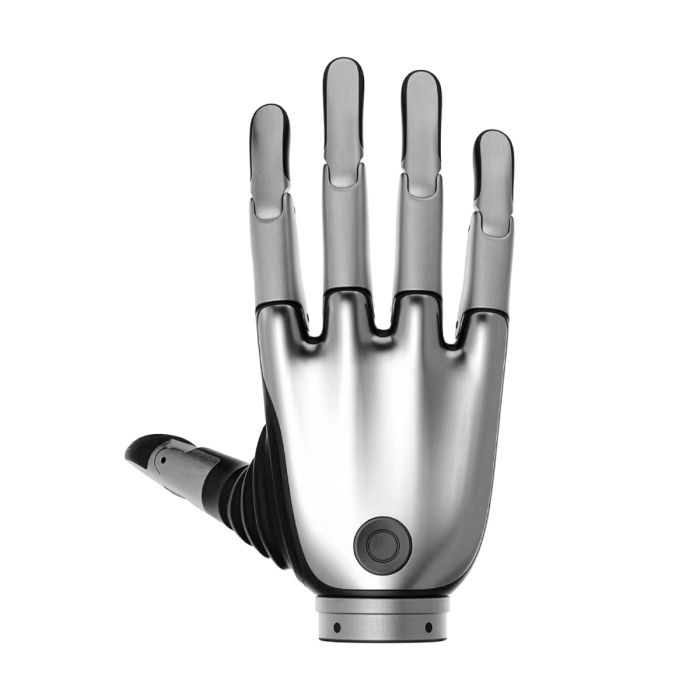
BrainCo Revo 2 Basic Right Dexterous Bionic Hand (XRR)
In stock
- BRAND:
- BRAINCO
- MODEL:
- REVO 2 BASIC
- PART #:
- XRL/XRR
- ORIGIN:
- China
- Warranty:
- 12 MONTHS
- AVAILABILITY:
- SUBJECT TO AVAILABILITY
- SKU:
- BrainCo-Revo-2-Basic
BrainCo Revo 2 Basic Right Dexterous Bionic Hand (XRR)
A robot arm may reach any point in its workspace, yet the quality of its work is settled by whatever sits at the end of the wrist. The BrainCo Revo 2 Basic Right Dexterous Bionic Hand (XRR) is built for that last few centimetres: a five-finger, right-handed hand that the published source describes as a bionic dexterous hand for robot integration and research.
Robots Middle East supplies this hand to engineering teams, laboratories and integrators across the Middle East. We prepare the quotation, arrange delivery and customs, and support the product after supply.
Background
BrainCo and the Revo 2 family
BrainCo is the manufacturer of the Revo series of dexterous hands. The Revo 2 is offered in three versions, each with a left and a right variant. The Basic version carries the version codes XRL (left) and XRR (right), the Pro version XEL and XER, and the Touch version XTL and XTR. This page concerns the Basic right hand, XRR.
The family sits within a wider catalogue of robot hands. Readers who wish to see the whole range can start from the BrainCo Revo 2 category, or browse the broader Hands category for other end effectors.
Positioning of the Basic version
The Basic version is the base configuration of the family. It is the sensible reference point for a team that needs a multi-jointed, five-finger hand on a robot and wants to compare it against the other versions before committing. The fact sheet researched for this product is deliberately narrow, so this article states only what it supports: the hand's purpose, its degrees of freedom, its communication connector, its default device identifier and its version codes.
Where a buyer would normally look for further data, such as ingress protection, dimensions including the wrist, flexion lifespan or battery, we say plainly that no source publishes it. Those items are confirmed with the manufacturer when a quotation is prepared.
Technical Specifications
| Specification | Value |
|---|---|
| Product type | Bionic dexterous hand for robot integration and research (per the published source) |
| Handedness | Right hand |
| Version code (Basic) | XRL / XRR |
| Degrees of freedom | 11 (6 active), as reported |
| Communication interface connector (Basic) | BM05B-PASS-TFT(LF)(SN), located under the wrist |
| Default device ID | 126 for the left hand, 127 for the right hand |
| IP rating | Not published |
| Dimensions with wrist | Not published |
| Flexion/extension lifespan | Not published |
| Battery | Not published |
Specifications as published by a single source; they are confirmed against the manufacturer's datasheet at quotation, and the manufacturer has not published the items marked as such.
What does the Basic version offer compared with Pro and Touch?
The sources name three versions of the Revo 2: Basic, Pro and Touch. They give each its own version codes, but the fact sheet supplies no figures that separate the versions from one another. We therefore make no claim about what the Pro or Touch versions add in grip strength, sensing or speed.
The names themselves are a reasonable guide. The Touch version, with its codes XTL and XTR, is presented on its own product page as a biomimetic hand, and a buyer whose work depends on tactile feedback should look at the Brainco Revo 2 Touch Biomimetic Dexterous Right Hand (XTR). Buyers weighing a step up from the base configuration can review the BrainCo Revo 2 Pro Dexterous Right Hand (XER). Which version suits a given project is best settled by comparing the datasheets we obtain for you.
What does the connector and device ID mean for integration?
For an integrator, the practical questions come early: how does the hand connect, and how does the controller tell two hands apart? The sources answer both. On the Basic version the communication interface sits under the wrist, and its connector model is BM05B-PASS-TFT(LF)(SN). That detail lets a cable be specified before the hand arrives.
Each hand also carries a default device identifier: 126 for the left hand and 127 for the right hand. A bimanual setup, with a left and a right hand on one bus, therefore starts from two distinct addresses. This hand, the right-hand XRR, defaults to 127. The matching left-hand model is the BrainCo Revo 2 Basic Left Dexterous Bionic Hand (XRL).
The figure of 11 degrees of freedom, of which 6 are active, is reported by a single source. It indicates a hand in which a smaller number of actuated joints drives a larger number of articulated ones. We treat it as a published specification to be confirmed at quotation.
Who is the BrainCo Revo 2 Basic Right Dexterous Bionic Hand (XRR) for?
Research laboratories are the clearest audience, since the source itself frames the hand for research. A group studying grasping, in-hand manipulation or learning-based control needs a physical hand with several joints, and the Basic version is a base configuration for that work.
System integrators building humanoid robots or dual-arm cells form a second segment. They need a hand with a defined connector and a known default identifier so that wiring and software can be planned early. Universities and technical institutes teaching robotics are a third, particularly where students move from simulation to hardware.
Developers of service and demonstration platforms may also find it relevant, provided the project does not depend on data we cannot yet state, such as ingress protection or lifespan. Teams that need tactile sensing should look to the Touch version, and a team wanting to compare it with an earlier design may consult the Revo 1 hand through the category pages above.
What is the BrainCo Revo 2 Basic Right Dexterous Bionic Hand (XRR) used for?
- Robot integration: fitting a multi-fingered hand to a robot arm or humanoid platform in place of a simple gripper.
- Manipulation research: studying grasp strategies and finger coordination on real hardware.
- Humanoid development: giving a humanoid robot a right hand that matches the form of a human limb.
- Teaching and training: letting students program a jointed hand in a laboratory setting.
- Bimanual experiments: pairing with the left-hand model, using the distinct default device IDs, for two-handed tasks.
- Prototyping and demonstration: building proof-of-concept cells that show what a dexterous end effector can do.
Pricing and Availability
Robots Middle East does not publish prices on this page. Please request a quotation, stating your quantity, your intended application and the controller you plan to use. Delivery, customs and support are arranged with the quotation, so that the whole process is handled in one place. Current information on this product is available on this page.
Frequently Asked Questions
Is this the left or the right hand?
It is the right hand, version code XRR. The left-hand counterpart in the Basic version carries the code XRL.
How many degrees of freedom does it have?
The published source reports 11 degrees of freedom, of which 6 are active. This is a single-source figure, confirmed against the datasheet at quotation.
Where is the communication connector?
On the Basic version the interface is located under the wrist. The connector model is BM05B-PASS-TFT(LF)(SN).
What is the default device ID?
The source gives 126 for the left hand and 127 for the right hand, so this right hand defaults to 127.
What is its IP rating, lifespan or battery capacity?
No source publishes the IP rating, the flexion and extension lifespan or any battery information. The manufacturer has not published these items; they are confirmed at quotation where available.
Are there other versions of the Revo 2?
Yes. The sources name Basic, Pro and Touch versions, each with left and right variants. The Basic right hand is XRR, the Pro right hand is XER and the Touch right hand is XTR.
Where can I buy the BrainCo Revo 2 Basic Right Dexterous Bionic Hand (XRR) and what does it cost?
It is supplied by Robots Middle East. We do not print prices; please request a quotation and we shall respond with the commercial terms, delivery arrangements and support.
Summary
A capable arm deserves a hand that can do more than hold. The Basic right hand of the Revo 2 family is positioned as a bionic dexterous hand for integration and research, with 11 reported degrees of freedom, a defined connector under the wrist and a default device ID of 127. Several figures that buyers usually expect remain unpublished, and we say so rather than guess. For a quotation backed by Robots Middle East, with delivery, customs and support arranged together, this page is the starting point.