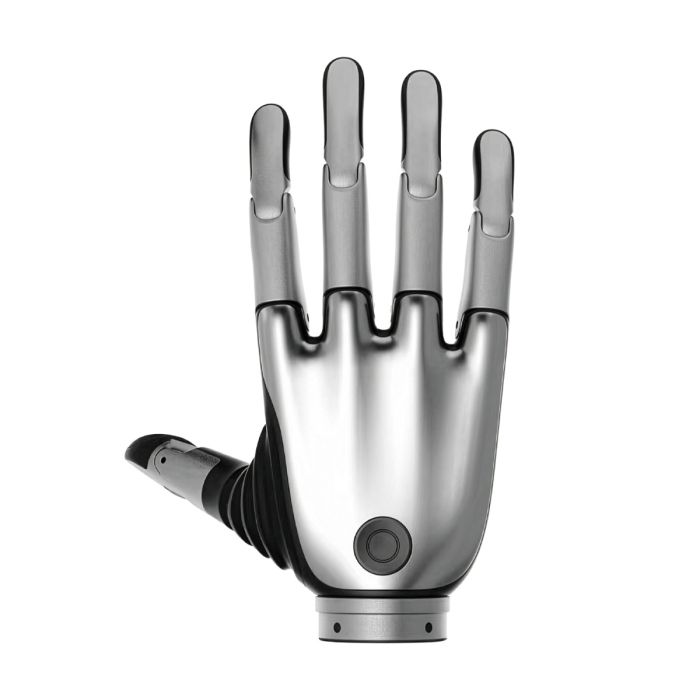
Brainco Revo 2 Touch Biomimetic Dexterous Right Hand (XTR)
In stock
- BRAND:
- BRAINCO
- MODEL:
- REVO 2 TOUCH
- PART #:
- XTR
- ORIGIN:
- China
- AVAILABILITY:
- SUBJECT TO AVAILABILITY
- SKU:
- BrainCo-Revo-2-Touch
Brainco Revo 2 Touch Biomimetic Dexterous Right Hand (XTR)
Vision can place a robot's fingers beside an object, but it cannot say what happens once they close. Whether the grip is firm, whether the object is shifting and how much force is being applied are things only the hand can report. The Brainco Revo 2 Touch Biomimetic Dexterous Right Hand (XTR) is the right-hand model of the tactile version of the Revo 2 family, a bionic dexterous hand for robot integration and research. It carries a multi-dimensional fingertip tactile module for exactly that purpose.
Robots Middle East sells the Brainco Revo 2 Touch Biomimetic Dexterous Right Hand (XTR) and supplies it to customers across the Middle East. Our team prepares the quotation, arranges delivery and supports the order, so that the hand reaches your laboratory or integration bench with the guidance a research project needs.
Background
The company and its lineage
Brainco was founded in 2015 and was incubated by the Harvard Innovation Lab. The company is based in Somerville, Massachusetts. Its work sits where human intention meets machine action, and its dexterous hands carry that outlook into robotics.
The Revo 2 is the second generation of the hand and is described by its maker as a bionic dexterous hand for robot integration and research. That wording tells a buyer what to expect. The hand is meant to be built into larger systems, driven from a controller and studied, rather than used as a closed, finished appliance. A first-generation model is also part of the range, and it is listed in our Hands category alongside the Revo 2 versions.
Positioning and key technology of the Touch version
The Revo 2 family is offered in three versions: Basic (XRL/XRR), Pro (XEL/XER) and Touch (XTL/XTR). The final letter of each code marks the side, with L for left and R for right. The XTR described here is therefore the right-hand model of the Touch version.
What distinguishes the Touch version is its multi-dimensional fingertip tactile module. A hand without touch sensing can only be told where to move. A hand with fingertip sensing can, in principle, give a controller the contact information it needs to decide what to do next. This matters for research on grasp stability, for teleoperation experiments and for any work in which contact, rather than position, is the interesting variable.
The hand also has protections that matter when it is run for long hours on a bench. These are current protection, stall protection, high-temperature protection and collision protection. They reduce the risk that a programming error or an unexpected contact damages the hand or the object.
Technical Specifications
| Specification | Value |
|---|---|
| Product type | Bionic dexterous hand for robot integration and research |
| Version code | XTL/XTR (Touch); this page covers the right hand, XTR |
| Pinch force | ≥15N |
| Control precision | 0.1° |
| Tactile module | Multi-dimensional fingertip tactile module |
| Communication interfaces | RS-485, CAN FD, EtherCAT (interface located below the wrist) |
| Software | SDK supports Python/C; compatible with Linux, Windows and ROS systems |
| Protections | Current, stall, high-temperature and collision protection |
| Default device ID (right hand) | 127 |
| Standard colours | Space Gray, Silver (bulk colour customisation supported) |
Specifications as published by the manufacturer; confirmed against the datasheet at quotation.
The manufacturer has not published the package contents, the ingress protection rating, the tactile sensor resolution or the cable length; they are confirmed at quotation.
What makes the Touch version different from the Basic and Pro versions?
The clearest difference is the tactile module. The fact sheet lists a multi-dimensional fingertip tactile module for the Touch version, while the same row carries no entry for the Basic version. If your experiment depends on contact information, the Touch version is the one that supplies it. If it depends only on position and force-limited closing, the BrainCo Revo 2 Basic Right Dexterous Bionic Hand (XRR) or the BrainCo Revo 2 Pro Dexterous Right Hand (XER) may be worth comparing.
The second difference concerns integration. The manufacturer states that the advanced and tactile versions support three communication interfaces: RS-485, CAN FD and EtherCAT, with the connector located below the wrist. For a team that already runs an industrial fieldbus, that choice shortens the path from the hand to the controller. It also lets a laboratory begin on one bus and move to another later without changing the hand.
How is the Revo 2 Touch right hand integrated and controlled?
The SDK supports Python and C and is compatible with Linux, Windows and ROS systems. A research group working in ROS can therefore connect the hand to its existing nodes, and a team working in Python can script experiments directly. The stated control precision is 0.1°, which is the figure to weigh when planning repeatable grasps.
Each hand on a robot needs its own address. For the Revo 2, the default device ID for the right hand is 127 and for the left hand 126. A bimanual setup should therefore be planned with that in mind, and the matching left hand is the Brainco Revo 2 Touch Biomimetic Dexterous Left Hand (XTL). The stated pinch force is ≥15N, a figure that can be used when judging which objects a given task will involve.
Who is the Brainco Revo 2 Touch Right Hand (XTR) for?
The hand suits university and corporate laboratories that study manipulation, tactile perception or human-robot interaction. It is also a sensible choice for companies developing humanoid robots or other platforms that need a hand with fingertip sensing, and for integrators who want to evaluate a tactile hand before committing a product design to it. Teams working on teleoperation and on learning from demonstration will find the touch channel useful, because it gives recorded grasps more than joint positions to learn from.
Buyers who need only a position-controlled hand, with no tactile requirement, should compare the Basic and Pro versions. Buyers who need a pair should plan for the left-hand counterpart, the XTL. Those exploring wider platforms can also browse our Research Robots category.
What is the Brainco Revo 2 Touch Right Hand (XTR) used for?
- Manipulation research. Studying grasp planning, in-hand motion and contact behaviour with a tactile hand.
- Humanoid robot integration. Fitting a right hand to a humanoid or upper-body platform.
- Teleoperation experiments. Pairing a human operator with a hand that reports contact back to the system.
- Data collection for learning. Recording grasps together with touch information for training policies.
- Industrial R&D. Prototyping handling tasks over EtherCAT, CAN FD or RS-485 before committing to a production design.
- Teaching and demonstration. Giving students a research-grade hand they can program in Python or through ROS.
Pricing and Availability
The Brainco Revo 2 Touch Biomimetic Dexterous Right Hand (XTR) is supplied by Robots Middle East on a quotation basis. Send us your application, the quantity and your delivery location, and we will prepare a quotation. Delivery, customs and support are arranged together with that quotation. The details of the hand that we can confirm today are available on this page.
Frequently Asked Questions
Is the XTR a right hand or a left hand?
The XTR is the right-hand model of the Touch version. The left-hand model carries the code XTL.
Which communication interfaces does the Touch version offer?
It supports RS-485, CAN FD and EtherCAT. The interface is located below the wrist.
Which software environments does the SDK support?
The SDK supports Python and C. It is compatible with Linux, Windows and ROS systems.
What protections does the hand include?
It includes current protection, stall protection, high-temperature protection and collision protection.
What colours are available?
The standard colours are Space Gray and Silver. The manufacturer states that bulk colour customisation is supported.
Is the ingress protection rating or the tactile sensor resolution published?
No. The manufacturer has not published either of them, nor the cable length or the package contents. We confirm them at quotation.
Where can I buy the Brainco Revo 2 Touch Biomimetic Dexterous Right Hand (XTR) and what does it cost?
You can buy it from Robots Middle East, which supplies the hand across the Middle East. The cost depends on quantity and delivery, so please request a quotation and we will respond with the terms.
Summary
A robot hand that cannot feel what it holds leaves the controller guessing at the moment of contact. The Brainco Revo 2 Touch Biomimetic Dexterous Right Hand (XTR) addresses that gap with a multi-dimensional fingertip tactile module, and it supports RS-485, CAN FD and EtherCAT. It comes with an SDK for Python and C that works with Linux, Windows and ROS, and it is protected against current, stall, high-temperature and collision faults. For teams who need touch as well as motion, and who want a supplier that handles quotation, delivery and support in the Middle East, this page is the starting point.
Specifications
General
Physical
Mobility
Performance
Connectivity
Software
Hand
Shipping
What's included
Videos