BrainCo Revo 2 Pro Dexterous Right Hand (XER)
In stock
- BRAND:
- BRAINCO
- MODEL:
- REVO 2 PRO
- PART #:
- XER
- ORIGIN:
- China
- Warranty:
- 12 MONTHS
- AVAILABILITY:
- SUBJECT TO AVAILABILITY
- SKU:
- BrainCo-Revo-2-Pro
BrainCo Revo 2 Pro Dexterous Right Hand (XER)
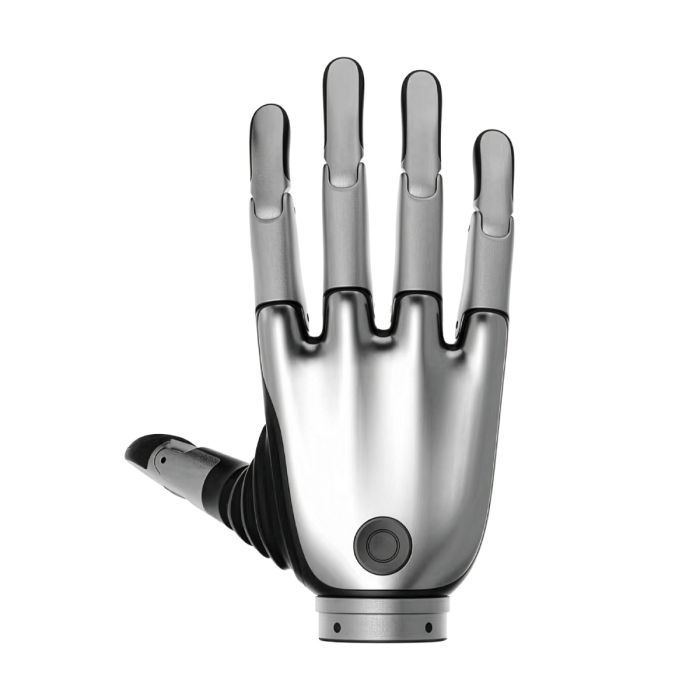
A robot hand is easily admired on a video and just as easily doubted on the integration bench. What matters is whether it connects to the controller, accepts a supply that suits the platform and protects itself when a trial goes wrong. The BrainCo Revo 2 Pro Dexterous Right Hand (XER) is, per the published specification, a bionic dexterous hand for robot integration and research, offered here in its right-hand configuration and in the Pro version.
Robots Middle East sells this hand and supplies it to customers across the Middle East. We prepare the quotation, arrange delivery and customs with it, and support the order after it is placed.
Background
BrainCo and the Revo family
BrainCo is the brand behind the Revo range of bionic hands. The range is organised in generations and in versions. The store lists an earlier BrainCo Revo 1 Intelligent Dexterous Bionic Hand, and the Revo 2 generation is gathered in the BrainCo Revo 2 category. Within Revo 2, the published specification names three versions: Basic (XRL/XRR), Pro (XEL/XER) and Touch (XTL/XTR). In each version the first code is the left hand and the second the right.
This page concerns the Pro version in its right-hand form, coded XER. The fact sheet we hold does not describe the company's history in detail, so we limit ourselves to what the product documentation states. That documentation positions the hand for integration into robots and for research work.
Positioning of the Pro version
The Pro version sits between Basic and Touch. According to the published comparison, it takes a wider supply range than Basic, 12-64V against 12-28V. It also adds EtherCAT to the 485 and CANfd interfaces that Basic offers. The Touch version is listed with the same figures for those lines. The hand has 6 active joints and 11 degrees of freedom, and the SDK supports Python and C on Linux, Windows and ROS systems. All of this is reported by a single published source and is to be confirmed against the datasheet at quotation.
Technical Specifications
| Specification | Value (Pro, XER) |
|---|---|
| Version code | XEL/XER |
| Active joints | 6 |
| Degrees of freedom | 11 |
| Weight | 383 g |
| Height (palm base to middle fingertip) | 160 mm |
| Full fist grip force | ≥50N |
| Pinch force | ≥15N |
| Max payload | ≥20kg |
| Operating noise (at 50cm) | ≤50dB |
| Flexion/extension speed | ≤0.65s |
| Communication interface | 485, CANfd, EtherCAT |
| Supply voltage | 12-64V |
| Static current | 115 mA @24V |
| Maximum current | 4.65A @24V |
| Repetitive control precision | 0.1° |
| Maximum opening and closing distance | 100mm (from thumb to index finger) |
| Operating temperature | -10 - 40℃ / 90%RH |
| Smart protection | Current, stall, high-temperature and anti-collision protection |
| SDK | Python/C; Linux, Windows and ROS systems |
| Online upgrade | OTA online upgrades supported |
| Standard colours | Space Gray, Silver (bulk colour customisation supported) |
| In the box | One dexterous hand, one 485/CANFD communication cable, one power cable, one EtherCAT communication cable |
Specifications as published by a single source; they are confirmed against the datasheet at quotation. The manufacturer has not published a tactile sensing specification, an IP rating, the wrist flange dimensions, a weight specific to the right hand or a service life. Each of these is confirmed at quotation.
What makes the Pro version different from Basic?
The difference lies mainly in the electrical and communication lines rather than in the mechanics. Per the published comparison, Basic lists 485 and CANfd, a 12-28V supply, a static current of 65 mA @24V and a maximum current of 4.6 A @24V. The Pro version lists 485, CANfd and EtherCAT, a 12-64V supply, 115 mA @24V static current and 4.65A @24V maximum current. The repetitive control precision is given as 0.1° for all three versions.
For an integrator, this means the Pro hand can be connected to an EtherCAT network and powered from a broader range of supplies. A project whose bus is already EtherCAT, or whose power rail is above 28V, would find the Basic version unsuitable on paper. The BrainCo Revo 2 Basic Right Dexterous Bionic Hand (XRR) remains the lighter-specified alternative for projects that need neither.
How is the hand protected and kept current?
The published specification lists four forms of smart protection: current protection, stall protection, high-temperature protection and anti-collision protection. In research, hands are driven into unexpected contact more often than in production, and protection of this kind limits the cost of a failed trial. How each protection is configured is not detailed in the sources we hold, so we advise asking for the datasheet.
The hand also supports OTA online upgrades. In practice, that allows firmware to be updated without dismantling the hand from the robot. The SDK supports Python and C and is compatible with Linux, Windows and ROS systems, so it fits the software environments commonly used in robotics laboratories. The operating range is given as -10 to 40℃ at 90%RH, and the operating noise as ≤50dB at 50cm. No IP rating has been published, so dusty or wet environments should be discussed with us before an order is placed.
Who is the BrainCo Revo 2 Pro Dexterous Right Hand (XER) for?
The hand suits university and corporate laboratories that study grasping, manipulation and human-robot interaction. It also suits robot manufacturers and system integrators that need a documented end-effector with several communication options. Buyers who run an EtherCAT-based control architecture, or a platform with a supply above 28V, will find the Pro version the natural choice.
This is the right-hand configuration. A bimanual platform would normally pair it with the BrainCo Revo 2 Pro Dexterous Left Hand (XEL). Teams whose work depends on tactile feedback should look at the Brainco Revo 2 Touch Biomimetic Dexterous Right Hand (XTR), while noting that the Pro fact sheet publishes no tactile specification. Those wishing to compare other options can browse the Hands category.
What is the BrainCo Revo 2 Pro Dexterous Right Hand (XER) used for?
- Robot integration: it is fitted as the right end-effector of a humanoid or other robotic platform.
- Grasping research: its 6 active joints and 11 degrees of freedom support studies of grip strategies.
- Manipulation trials: repetitive control precision of 0.1° is published for repeatable motion experiments.
- Controller development: the Python/C SDK and ROS compatibility support the development of control software.
- Bimanual work: paired with the left hand, it supports tasks that need both hands.
- Teaching and demonstration: a bionic hand serves academic courses and technical showcases in robotics.
Pricing and Availability
Prices are not published on this page. Please request a quotation from Robots Middle East, stating your platform, quantity and intended use. Delivery, customs and support are arranged with the quotation. The current terms for the BrainCo Revo 2 Pro Dexterous Right Hand (XER) are available on this page.
Frequently Asked Questions
Is this the right-hand or left-hand version?
This page covers the right hand, version code XER. The left-hand equivalent in the Pro version carries the code XEL.
Which communication interfaces does it support?
The published specification lists 485, CANfd and EtherCAT for the Pro version. The sources also describe RS485, CAN FD and EtherCAT as supported interfaces.
What supply voltage does it accept?
The Pro version is listed with a 12-64V supply, with a static current of 115 mA @24V and a maximum current of 4.65A @24V. These figures are to be confirmed against the datasheet.
Which software environments are supported?
The SDK supports Python and C. It is reported as compatible with Linux, Windows and ROS systems.
What is included in the box?
The package is reported to contain one dexterous hand, one 485/CANFD communication cable, one power cable and one EtherCAT communication cable.
Is there an IP rating or a tactile sensing specification?
The manufacturer has not published either; both are confirmed at quotation. Tactile sensing is the subject of the separate Touch version.
Where can I buy the BrainCo Revo 2 Pro Dexterous Right Hand (XER) and what does it cost?
It is sold by Robots Middle East, which supplies it across the Middle East. No price is shown on this page; please request a quotation and it will be prepared for your project.
Summary
A robot hand earns its place on the integration bench rather than on the video reel. Per the published specification, the BrainCo Revo 2 Pro Dexterous Right Hand (XER) offers 6 active joints, 11 degrees of freedom, three communication interfaces, a wide supply range, four protections and OTA upgrades. Several items remain unpublished and are confirmed at quotation. For a quotation from Robots Middle East, this page is the starting point.
Specifications
| MODEL | REVO 2 PRO |
|---|---|
| PART # | XER |
| ROBOT TYPE | HAND |
| ROBOT USE | EDUCATION, MEDICAL |
| TOTAL DOF | 11 DOF |
| ACTIVE JOINTS | 6 |
| CONNECTIVITY | CANFD, ETHERCAT, RS485 |
| SECONDARY DEVELOPMENT | SUPPORTED |
| MAXIMUM PAYLOAD | 20 KG (44.1 LBS) |
| GRIPPING FORCE | ≥ 50N |
| PINCHING FORCE | ≥ 15N |
| POSITIONING ACCURACY | 0.1 DEGREES |
| VOLTAGE | 12-64V |
| BRAND | BRAINCO |
| ROBOT ACCESSORY TYPE | ROBOT HAND |
| LENGTH | 160 mm |
| WIDTH | 76 mm |
| WEIGHT | 383 grams |
Feature
1. High quality and stability – five years of product iteration and professional production lines.
2. Lightweight (383 grams), with 5 kg active grip force, 20 kg single-hand load capacity, and a grip-to-weight ratio of 53.
3. Ergonomic Bionic Design – supports curved surface grasping with anti- collision finger design.
4. Multi-dimensional tactile perception – pressure, friction, direction, proximity, and surface texture.
5. High Sensitivity Tactile Perception – max resolution of 0.01N.
6. Wide voltage support – 64V.
7. Universal Interfaces – RS485 & CAN-FD, and EtherCAT.
8. Standard Protocols and SDKs – Modbus & Protobuf protocols, SDKs for Python / C / ROS.