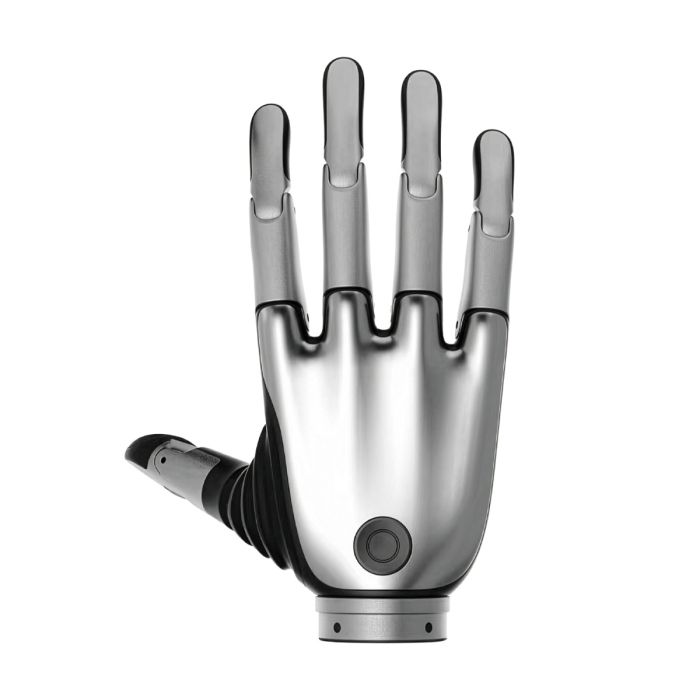
BrainCo Revo 2 Basic Left Dexterous Bionic Hand (XRL)
In stock
- BRAND:
- BRAINCO
- MODEL:
- REVO 2 BASIC
- PART #:
- XRL
- ORIGIN:
- China
- Warranty:
- 12 MONTHS
- AVAILABILITY:
- SUBJECT TO AVAILABILITY
- SKU:
- BrainCo-Revo-2-Basic-Left
BrainCo Revo 2 Basic Left Dexterous Bionic Hand (XRL)
A humanoid or dual-arm platform is judged by what it does with both hands, and a single capable hand leaves half of the task unsolved. The BrainCo Revo 2 Basic Left Dexterous Bionic Hand (XRL) is the left-hand member of the Revo 2 family: a five-finger bionic hand that, according to the published description, is intended for robot integration and research. It is the Basic configuration, the version that pairs a straightforward electrical interface with a developer SDK.
Robots Middle East sells and supplies the BrainCo Revo 2 Basic Left Dexterous Bionic Hand (XRL) to customers across the Middle East. Robots Middle East prepares the quotation, arranges delivery and supports the product after sale.
Background
The Revo 2 family and its versions
BrainCo markets the Revo 2 as its second-generation dexterous hand, and the sources name three versions: Basic (XRL for the left hand, XRR for the right), Pro (XEL/XER) and Touch (XTL/XTR). Each version is sold as a left and a right hand, so a bimanual robot can be fitted with a matched pair. The hand described here is the Basic left, version code XRL. Its right-hand counterpart is the BrainCo Revo 2 Basic Right Dexterous Bionic Hand (XRR).
The first-generation hand remains on the market as a separate product, the BrainCo Revo 1 Intelligent Dexterous Bionic Hand. Buyers who have worked with it will find that the Revo 2 is presented as the newer platform. The detailed history of the company and the differences between the generations are not part of the researched fact sheet, so this page does not describe them.
Positioning and key technology
The Basic version is the entry point to the Revo 2 range. Per the published specification, it has 11 degrees of freedom, of which 6 are active joints. That is a common design choice in dexterous hands: fewer motors than joints keeps the mechanism light and the control problem manageable, while the fingers still close around an object in a natural, adaptive way.
The control features are listed as position, velocity and current feedback control, together with cascaded control and compliance control. Protection is listed as current protection, stall protection, high-temperature protection and anti-collision protection. Together these describe a hand meant to be driven by software and to look after itself when a command or an obstacle is more demanding than expected. Firmware can be updated over the air, as the specification lists OTA online upgrades.
Technical Specifications
| Specification | Value (Basic, XRL) |
|---|---|
| Version code | XRL (left) / XRR (right) |
| Degrees of freedom | 11 (6 active) |
| Weight | 383 g |
| Height (palm base to middle fingertip) | 160 mm |
| Full fist grip force | ≥50N |
| Pinch force | ≥15N |
| Max payload | ≥20kg |
| Maximum opening and closing distance | 100mm (from thumb to index finger) |
| Flexion/extension speed | ≤0.65s |
| Operating noise (at 50cm) | ≤50dB |
| Repetitive control precision | 0.1° |
| Supply voltage | 12-28V |
| Static current | 65 mA @24V |
| No-load average current (five-finger flexion and extension) | 350mA @24V |
| Maximum current | 4.6 A @24V |
| Communication interface | RS-485 or CAN FD |
| Interface connector | Under the wrist; model BM05B-PASS-TFT(LF)(SN) |
| SDK | Python/C; Linux, Windows and ROS |
| Default device ID | Left hand 126 (right hand 127) |
| Operating temperature | -10 - 40℃ / 90%RH |
| Standard colours | Space Gray, Silver (bulk colour customisation supported) |
| Width, IP rating, materials, package contents, cable length, service life | Not published; confirmed at quotation |
Specifications as published by a single source; they are confirmed against the datasheet at quotation.
What makes the Basic version different from the Pro and Touch versions?
The published comparison table lists the three versions side by side, and the differences it shows for the Basic are mostly electrical. The Basic supply range is 12-28V, whereas the Pro and Touch versions are listed at 12-64V. Static current is given as 65 mA at 24V for the Basic and 115 mA at 24V for the other two. No-load average current is 350mA at 24V for the Basic against 390mA at 24V, and maximum current is 4.6 A at 24V against 4.65A at 24V. Repetitive control precision is the same 0.1° for all three.
For an integrator, this means the Basic suits a robot whose power bus sits within 12-28V and whose designers want a lower standby draw. A platform with a higher-voltage bus would need to look at the other versions. The source sheet does not detail what else the Pro and Touch hands add, so this page does not speculate. The pages for the BrainCo Revo 2 Pro Dexterous Left Hand (XEL) and the Brainco Revo 2 Touch Biomimetic Dexterous Left Hand (XTL) are the places to compare them, and we will confirm differences in writing at quotation.
How is the hand connected and programmed?
The published specification states that the Basic version communicates and is controlled through a 485 or CAN FD interface. The connector sits under the wrist, and its model is given as BM05B-PASS-TFT(LF)(SN). Cable length is not published, so the cabling for a given robot should be discussed at quotation.
On the software side, the SDK is reported to support Python and C and to be compatible with Linux, Windows and ROS systems. That covers most research benches and a large share of humanoid control stacks. When two hands share one bus, the default device ID is what tells them apart: the left hand is listed with ID 126 and the right hand with ID 127. A matched left and right pair therefore does not need an address to be set before first use, although the IDs can be confirmed against the datasheet.
Who is the BrainCo Revo 2 Basic Left Dexterous Bionic Hand (XRL) for?
The first group is humanoid-robot developers, who need a left hand to complement an existing right hand or to equip a new bimanual platform. The second group is university and corporate research laboratories, where the hand's SDK, ROS compatibility and feedback control make it a practical subject for manipulation studies and teleoperation experiments. The third group is system integrators building demonstration cells or service-robot prototypes, who value a compact hand that is driven over a standard bus.
If the right-hand side is needed, the matching Basic version is the XRR. If the robot runs from a supply above 28V, the Pro or Touch version is the better place to start, since their published supply range is wider. Browse the wider BrainCo Revo 2 range or the Hands category for the alternatives.
What is the BrainCo Revo 2 Basic Left Dexterous Bionic Hand (XRL) used for?
- Bimanual humanoid manipulation: it serves as the left hand of a matched pair on a humanoid or dual-arm robot.
- Robotics research: laboratories use it to study grasping, in-hand behaviour and compliant control with its position, velocity and current feedback.
- Robot integration projects: integrators fit it to arms and mobile platforms through the RS-485 or CAN FD interface.
- Teleoperation and demonstrations: an operator's commands can be mapped to the fingers through the Python or C SDK.
- Software development: teams build and test control code on Linux, Windows or ROS systems.
- Education and training: universities and training centres use it to teach dexterous manipulation on real hardware.
Pricing and Availability
Robots Middle East does not publish a price for this hand on the page; quotation is the route to a figure. Send us the quantity, whether you need the left hand only or a left and right pair, and the target application, and we will respond with a written quotation. Delivery, customs and support are arranged with the quotation, and the details you need are available on this page.
Frequently Asked Questions
Is this the left or the right hand?
It is the left hand of the Basic version, code XRL. The right-hand version is XRR.
How many joints does it have?
The published specification gives 11 degrees of freedom, of which 6 are active joints.
What communication interfaces does it support?
The Basic version is reported to communicate over RS-485 or CAN FD. The connector is under the wrist and is listed as BM05B-PASS-TFT(LF)(SN).
Which software environments are supported?
The SDK is reported to support Python and C and to work with Linux, Windows and ROS. Over-the-air firmware upgrades are also listed.
What supply voltage does it need?
The Basic version is listed at 12-28V, with a static current of 65 mA at 24V. The Pro and Touch versions are listed at 12-64V.
Is the ingress protection rating or the material published?
No. The IP rating, materials, width, cable length and service life are not published by the manufacturer; they are confirmed at quotation.
Where can I buy the BrainCo Revo 2 Basic Left Dexterous Bionic Hand (XRL) and what does it cost?
Robots Middle East supplies it in the Middle East. The cost is provided in a written quotation, so please request one with your quantity and application.
Summary
A left hand that cannot keep pace with the right is a weakness in any bimanual robot. The BrainCo Revo 2 Basic Left Dexterous Bionic Hand (XRL) addresses this with a five-finger design of 11 degrees of freedom, standard RS-485 or CAN FD connections, a Python and C SDK and built-in protections, all as reported in the published specification. Its Basic electrical profile, 12-28V, defines which robots it suits best. To request a quotation from Robots Middle East, this page is the starting point.
Specifications
| MODEL | REVO 2 BASIC |
|---|---|
| PART # | XRL |
| ROBOT TYPE | HAND |
| ROBOT USE | EDUCATION, RESEARCH |
| TOTAL DOF | 11 DOF |
| ACTIVE JOINTS | 6 |
| CONNECTIVITY | CANFD, RS485 |
| SECONDARY DEVELOPMENT | SUPPORTED |
| MAXIMUM PAYLOAD | 20 KG (44.1 LBS) |
| GRIPPING FORCE | ≥ 50N |
| PINCHING FORCE | ≥ 15N |
| POSITIONING ACCURACY | 0.1 DEGREES |
| VOLTAGE | 12-28V |
| BRAND | BRAINCO |
| ROBOT ACCESSORY TYPE | ROBOT HAND |
| LENGTH | 160 mm |
| WIDTH | 76 mm |
| WEIGHT | 383 grams |