
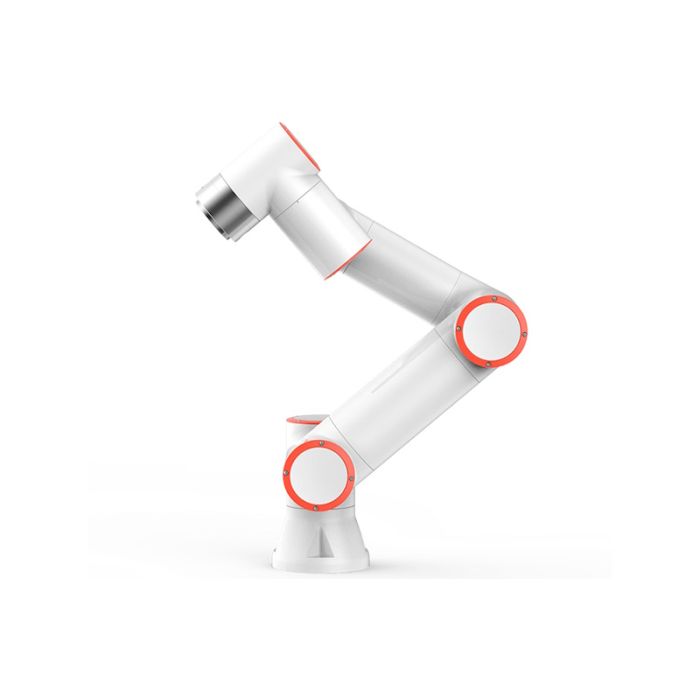
Fairino FR5 Collaborative Robot (Cobot)
In stock
- BRAND:
- FAIRINO
- PART #:
- FR5
- ORIGIN:
- China
- Warranty:
- 12 MONTHS
- AVAILABILITY:
- ALLOW 2-4 WEEKS FOR DELIVERY
- SKU:
- Fairino-FR5
- Buy 2 for AED 21,543.30 each and save 5%
- Buy 5 for AED 20,862.99 each and save 8%
- Buy 10 for AED 19,955.90 each and save 12%
- Buy 20 for AED 19,275.59 each and save 15%
Fairino FR5 Collaborative Robot (Cobot)
On many factory floors, the biggest threat to a robot is not a heavy workload. It is the fine dust drifting in from the yard, the coolant mist around the machine tools, and a controller that cannot talk to the PLC that already runs the line. On such a floor, choosing an arm starts with two questions: how well it is sealed, and how easily it joins the equipment already in place. The Fairino FR5 Collaborative Robot (Cobot) answers both with options rather than compromises. It is a next-generation 6-axis collaborative arm, offered in IP54 and IP65 versions, with ±0.02mm pose repeatability under ISO 9283 and a broad set of software and communication tools that let it fit a production cell as the cell already is.
Robots Middle East sells the Fairino FR5 and supplies it to manufacturers, integrators and research facilities across the Middle East, from a single pilot cell to a multi-station line. Our team prepares each quotation around the version and configuration you need, arranges delivery to your site and remains your point of contact for support once the arm is in service.
Background
FAIRINO and the FR family
FAIRINO builds collaborative robots under its FR designation, a family that spans several sizes so that a single control concept can serve tasks of very different scale. The FR5 sits alongside the FR3, FR3-C, FR10, FR16, FR20 and FR30 in that range. The manufacturer describes it as a next-generation 6-axis cobot built for precision, safety and rapid deployment. Collaborative robots of this kind are generally designed to share space with people rather than sit behind fixed guarding. This makes them attractive to workshops that cannot spare the floor area for a fenced industrial cell, and to manufacturers who want to move one arm between jobs as orders change.
An open platform rather than a closed cell
The FR5's strongest argument lies in its connectivity rather than its mechanics. As standard, the arm communicates over TCP/IP, Modbus TCP and Modbus RTU. PROFINET, EtherNet/IP, EtherCAT and CC-Link are available as optional interfaces, which covers the fieldbuses most often found in automotive, packaging and electronics plants. For teams that write their own applications, FAIRINO provides SDKs for C#, C++, Python, ROS and ROS 2. An integrator can therefore drive the FR5 from a PLC on the shop floor, while a university laboratory or an R&D department can work with it from ROS without a proprietary toolchain in between.
Technical Specifications
| Specification | Value |
|---|---|
| Product type | Next-generation 6-axis collaborative robot (cobot) |
| Pose repeatability (ISO 9283) | ±0.02mm |
| Wrist 3 working range | ±175° (Optional ±360°) |
| Versions | FR5 IP54 (standard); FR5 IP65; FR5 IP54 Black Edition |
| Colours | IP54: white or black; IP65: white |
| Standard communication | TCP/IP, Modbus TCP, Modbus RTU |
| Optional communication | PROFINET, EtherNet/IP, EtherCAT, CC-Link |
| SDKs | C#, C++, Python, ROS, ROS 2 |
| Applications | Robotic welding (Laser/MIG/TIG), CNC/machine tending, pick & place, light assembly, inspection, packaging |
Specifications are as published by the manufacturer and are confirmed against the datasheet at quotation.
The manufacturer has not published the power consumption, the supply voltage, the joint torque limits, the cable length between arm and controller, the controller's dimensions and weight, the certifications or a full list of box contents; we confirm all of these with your quotation.
Which FR5 version suits your environment: IP54 or IP65?
The FR5 comes in three forms: the standard IP54 model in white, the same IP54 model as the Black Edition, and an IP65 version in white. The choice between them follows from the conditions the arm will work in, not from what it will do. Under the IEC ingress protection code, the first digit describes protection against solids and the second against water. An IP54 enclosure is protected against dust to a degree that does not interfere with operation and against splashing water. An IP65 enclosure is dust-tight and protected against water jets.
For a clean assembly room, an electronics bench or a laboratory, the standard IP54 version is the natural starting point. The Black Edition offers the same rating for customers who want the arm to match darker equipment or a particular cell design. Where the arm will stand beside CNC machines throwing off coolant, in a packaging hall that is washed down, or in a workshop where airborne dust is part of daily life, the IP65 version is the more prudent choice. Because the versions differ in sealing and colour, a project can be planned on one platform and the protection level decided once the site has been assessed.
How does the FR5 connect to the PLCs and software you already run?
Few automation projects start on an empty floor. In most cases, the cobot must take signals from a PLC, report to a supervisory system and hand parts to a conveyor or machine that was installed years earlier. The FR5's standard Modbus TCP and Modbus RTU support covers a great deal of existing equipment without additional hardware. Plants built around a specific industrial Ethernet standard can specify PROFINET, EtherNet/IP, EtherCAT or CC-Link as an option at the time of ordering.
On the software side, the range of SDKs means the arm is not tied to a single programming style. A production engineer can script a routine in Python, a software team can build a dedicated application in C# or C++, and robotics researchers can bring the FR5 into an existing ROS or ROS 2 environment. This flexibility suits the varied mix of operations in the region, where the same arm may be asked to tend a machine one quarter and support a pilot welding cell the next.
Who is the Fairino FR5 Collaborative Robot (Cobot) for?
The first group is small and medium-sized manufacturers taking their first step into automation. For them, a collaborative arm that shares space with operators and can be redeployed between jobs lowers the barrier to entry. Metal fabricators form a second group, as the FR5 is presented for laser, MIG and TIG welding, where repeatable torch paths matter as much as operator safety.
System integrators are a third audience. The open communication options and SDKs allow them to build the FR5 into turnkey cells for their own clients without fighting a closed controller. Universities, technical colleges and research centres make up a fourth, drawn by ROS and ROS 2 support for teaching and experimentation. Finally, plants that need a robust enclosure for dusty or wet areas will find the IP65 version relevant.
Where a task calls for a different size of arm, the wider FAIRINO range is available, including the Fairino Cobot (FR3) and the Fairino FR10 Collaborative Robot (Cobot). Our team will advise which model matches your payload and reach requirements. The full range can be browsed under Fairino and in our Cobots category.
What is the Fairino FR5 Collaborative Robot (Cobot) used for?
- Robotic welding – laser, MIG and TIG welding, where a consistent path supports a consistent seam.
- CNC and machine tending – loading and unloading machine tools so that spindles keep running between operator shifts.
- Pick and place – moving parts between trays, fixtures and conveyors in a compact cell.
- Light assembly – repetitive joining and fitting steps alongside human workers.
- Inspection – presenting parts to cameras or sensors, or carrying an inspection tool to defined positions.
- Packaging – placing products into cartons and preparing them for end-of-line handling.
Pricing and Availability
The price of the Fairino FR5 depends on the version you choose, the optional communication interfaces and the tooling your application requires. For that reason, Robots Middle East quotes each project individually rather than publishing a single figure. Delivery, customs clearance and after-sales support are arranged with your quotation, so that the full scope of the supply is clear before you commit. To start, tell us about your application, your site conditions and the systems the arm must connect to; a quotation for the Fairino FR5 Collaborative Robot (Cobot) can be requested through the form available on this page.
Frequently Asked Questions
How many axes does the Fairino FR5 have?
The FR5 is a 6-axis collaborative robot, giving it the freedom of movement needed for welding paths, machine tending and assembly tasks.
What repeatability does the FR5 achieve?
The FR5 has a pose repeatability of ±0.02mm, measured in accordance with ISO 9283.
Which versions of the FR5 are available?
There are three: the standard FR5 IP54 in white, the FR5 IP54 Black Edition, and the FR5 IP65 in white. The IP65 version is the one to consider for dusty or wet environments.
Can the wrist rotate continuously?
The working range of wrist 3 is ±175° as standard, with ±360° available as an option. Please mention this option when requesting your quotation if your application needs it.
Which industrial protocols does the FR5 support?
TCP/IP, Modbus TCP and Modbus RTU come as standard. PROFINET, EtherNet/IP, EtherCAT and CC-Link are available as optional interfaces.
Can I program the FR5 with my own software?
Yes. FAIRINO provides SDKs for C#, C++, Python, ROS and ROS 2, so the arm can be integrated into custom applications and research environments.
Where can I buy the Fairino FR5 Collaborative Robot (Cobot) and what does it cost?
You can buy the Fairino FR5 from Robots Middle East, which supplies it across the Middle East. The cost depends on the version and options you select, so we prepare an individual quotation that includes delivery, customs and support.
Summary
A cobot earns its place on a demanding floor by coping with the conditions around it and by speaking the language of the machines beside it. The Fairino FR5 Collaborative Robot (Cobot) addresses the first through a choice of IP54 and IP65 versions, and the second through standard Modbus and TCP/IP communication, optional fieldbus interfaces and SDKs from Python to ROS 2. With ±0.02mm pose repeatability under ISO 9283 and a published range of uses from welding to packaging, it gives manufacturers, integrators and researchers in the Middle East one platform that can be adapted to the job rather than the other way round. To match the right version to your site, this page is the starting point.