
SIASUN Collaborative Robot (GCR20-1400)
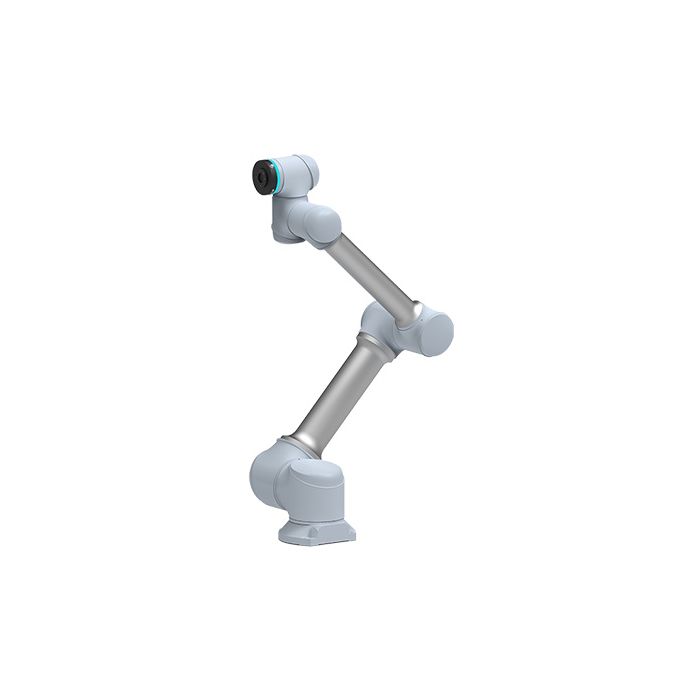
In stock
- BRAND:
- SIASUN
- PART #:
- GCR20-1400
- ORIGIN:
- China
- AVAILABILITY:
- FOR OPPORTUNITIES OVER 1 MILLION USD
- SKU:
- SIASUN-GCR20-1400
SIASUN Collaborative Robot (GCR20-1400)
The heaviest part of most robot projects is not the arm. It is the weeks of programming, the safety reviews and the integration work that stand between a crate arriving at the loading bay and a cell that runs a full shift. The SIASUN Collaborative Robot (GCR20-1400) is designed to lighten that second burden. It is a high-end, general-purpose collaborative robot of the GCR series that carries a 20kg maximum payload across a 1400mm reach. It is taught by guiding it by hand and brings 16 TÜV-certified safety features for human-robot collaboration to the shop floor.
Robots Middle East supplies the GCR20-1400 to manufacturers, system integrators, research institutions and logistics operators across the Middle East. Our team prepares your quotation, coordinates delivery to your site and remains your point of contact for technical questions and support after installation. One partner therefore accompanies the project from the first enquiry to commissioning and beyond.
Background
SIASUN and the GCR series
SIASUN is a Chinese robotics manufacturer whose portfolio extends from collaborative arms to mobile robots and automation equipment. The GCR series is its family of collaborative robots. It is offered in several combinations of payload and reach, so that a plant can match the arm to the task rather than bend the task to suit the arm. Within that family, the manufacturer positions the GCR20-1400 as a high-end, general-purpose model. It is intended for a broad spread of handling, tending and process work rather than a single niche application. The sources also name a GCR20-1400-EX variant. No separate figures for that variant are published, so its specification should be confirmed with us when you request a quotation.
Sensing, teaching and connectivity
Three ideas shape the GCR20-1400. The first is perception. The robot integrates 2D/3D vision depth fusion with highly sensitive force sensing and control, so it can locate parts and respond to contact rather than simply replaying a fixed path. The second is accessibility. Drag-and-drop teach programming lets an operator move the arm by hand to record positions, which lowers the threshold for staff who have never written robot code. The third is connectivity. A range of scenario-specific software packages and multiple external interfaces sit alongside cloud-based monitoring of robot data and over-the-air (OTA) remote updates, so the arm can be supervised and kept current without a technician standing beside it.
Technical Specifications
| Specification | Value |
|---|---|
| Product type | High-end, general-purpose collaborative robot, GCR series |
| Degrees of freedom | 6 |
| Maximum payload | 20kg |
| Reach | 1400mm |
| Repeatability | ±0.05 mm |
| Maximum TCP speed | 2.2 m/s |
| Maximum straight-line speed | 1.5 m/s |
| IP rating | IP54/IP65 |
| Safety | 16 TÜV-certified safety features for human-robot collaboration |
| Communication | TCP/IP, Modbus/TCP, Profinet, EtherNet/IP |
| Tool flange | GB/T 14468.1-50-4-M6 (equivalent to ISO 9409-1) |
| Tool-end I/O | 2 digital I/O, 24V, 0.6A |
| Mounting | Installation in any orientation |
| Power supply | 220-240VAC 47-63Hz 10A / 100-200VAC 47-63Hz 16A |
| Power consumption | Typical 600W |
| Operating temperature | -10°C to 50°C |
| Robot dimensions | 1695x388x205mm |
| Net/gross weight | 66kg/75kg |
| Packaging dimensions | 1060x500x600mm |
Specifications are as published by the manufacturer and are confirmed against the datasheet at quotation.
The manufacturer has not published the contents of the box, the controller dimensions, the teach pendant, the noise level, the service life or the software compatibility; these details are confirmed at quotation.
How do vision and force sensing change what the GCR20-1400 can do?
A conventional arm is only as good as the accuracy of the fixtures around it. If a part arrives a few millimetres out of place, the robot misses it. If a surface varies, a polishing or fitting path either loses contact or presses too hard. The GCR20-1400 addresses both problems at the sensing level. 2D/3D vision depth fusion gives it a way to see where a workpiece actually lies. Its highly sensitive force sensing and control give it a way to feel how hard it is pressing. Together they open up tasks that would otherwise demand expensive precision tooling or manual finishing.
The motion figures support this. A repeatability of ±0.05 mm means a taught point is revisited consistently, cycle after cycle. A maximum TCP speed of 2.2 m/s and a straight-line speed of 1.5 m/s leave room for productive cycle times where the risk assessment allows. Six degrees of freedom let the tool approach a part from the angle the process needs rather than the angle the arm prefers. Because the robot can be installed in any orientation, the same capabilities are available whether it stands on a pedestal, hangs from a gantry or is fixed to a wall.
Is the GCR20-1400 suited to working beside people?
Collaboration is the reason this class of robot exists, and SIASUN has built the GCR20-1400 around 16 TÜV-certified safety features for human-robot collaboration. Third-party certification of that scope gives safety engineers a documented basis for their own work. Whether a particular cell can run without guarding still depends on the application. A sharp tool, a heavy part at full speed or a pinch point against a fixture all change the picture. For that reason, every collaborative installation should begin with a risk assessment of the complete cell. What the GCR20-1400 offers is a robot designed from the outset to share space, combined with a programming method that keeps operators close to the arm while they teach it.
Who is the SIASUN Collaborative Robot (GCR20-1400) for?
The GCR20-1400 suits manufacturers who have outgrown light bench cobots but are not ready for a fenced industrial cell. With 20kg of payload, a gripper, the part and an intermediate fixture can often be carried together. The 1400mm reach covers a machine door, a conveyor and a pallet position from a single base. Small and medium-sized plants benefit particularly from drag-and-drop teaching, because their staff can redeploy the arm themselves when a product changes.
System integrators will value the industrial communication options, namely TCP/IP, Modbus/TCP, Profinet and EtherNet/IP, together with the ISO 9409-1-equivalent tool flange, which eases the fitting of standard end effectors. Universities and research laboratories can make use of the vision and force-sensing integration as a platform for experiments in perception and compliant control.
Where a task calls for a different balance of payload and reach, the same family offers alternatives. These include the SIASUN Collaborative Robot (GCR16-960), the SIASUN Collaborative Robot (GCR16-2000), the SIASUN Collaborative Robot (GCR25-1800) and the SIASUN Collaborative Robot (GCR30-1100). The full line-up is presented under SIASUN GCR Series Cobots, and our team will gladly help you compare the models against your application.
What is the SIASUN Collaborative Robot (GCR20-1400) used for?
- Machine tending: loading and unloading CNC machines, presses and moulding machines, where the arm must reach into the machine and back to a parts tray.
- Palletising and handling: moving cartons, bags or parts between conveyors and pallets at the end of a production line.
- Assembly: fitting, inserting and fastening operations in which force control helps to seat components without damage.
- Surface finishing: grinding, sanding and polishing, where steady contact pressure matters as much as the path itself.
- Vision-guided picking and inspection: locating parts that arrive unordered and checking them before they move on.
- Dispensing and gluing: laying beads of adhesive or sealant along a programmed path on components of varying position.
Pricing and Availability
Robots Middle East supplies the GCR20-1400 on the basis of an individual quotation that reflects your configuration, your application and the place of installation. Delivery, customs clearance and technical support are arranged together with your quotation. If you are unsure whether the GCR20-1400 or the GCR20-1400-EX variant better matches your requirements, please mention your application and environment in your enquiry and we will clarify it for you. A quotation for the SIASUN Collaborative Robot (GCR20-1400) can be requested via the enquiry form available on this page.
Frequently Asked Questions
What payload and reach does the GCR20-1400 offer?
The GCR20-1400 has a maximum payload of 20kg and a reach of 1400mm. It is a six-axis arm with a repeatability of ±0.05 mm.
Does the robot have to be programmed in code?
No. The GCR20-1400 supports drag-and-drop teach programming, so an operator can guide the arm by hand to record positions. Scenario-specific software packages are also available for common tasks.
Which industrial networks can it connect to?
The robot supports TCP/IP, Modbus/TCP, Profinet and EtherNet/IP. It also provides two digital I/O at the tool end, rated at 24V and 0.6A.
Can it be mounted on a wall or ceiling?
Yes. The GCR20-1400 can be installed in any orientation, which gives considerable freedom when planning a cell.
What power supply does it require?
The robot accepts 220-240VAC 47-63Hz 10A or 100-200VAC 47-63Hz 16A, with a typical power consumption of 600W.
Is the teach pendant included?
The manufacturer has not published the teach pendant or the contents of the box. Robots Middle East will confirm the scope of supply with your quotation.
Where can I buy the SIASUN Collaborative Robot (GCR20-1400) and what does it cost?
You can buy the GCR20-1400 from Robots Middle East, which supplies it across the Middle East. The cost depends on your configuration and project, so please request an individual quotation through this page.
Summary
A collaborative robot proves its worth not in the catalogue but in how quickly it becomes productive on the floor. The SIASUN Collaborative Robot (GCR20-1400) is built with that in mind. It combines a 20kg payload and a 1400mm reach with hand-guided teaching, 2D/3D vision and force sensing, and 16 TÜV-certified safety features. Its common industrial interfaces, cloud monitoring and OTA updates keep the integration and upkeep that follow as light as the arm's first lessons. For a plant in the Middle East that wants to share its workspace with a capable robot and reach production sooner, this page is the starting point.