
SIASUN Collaborative Robot (GCR16-960)
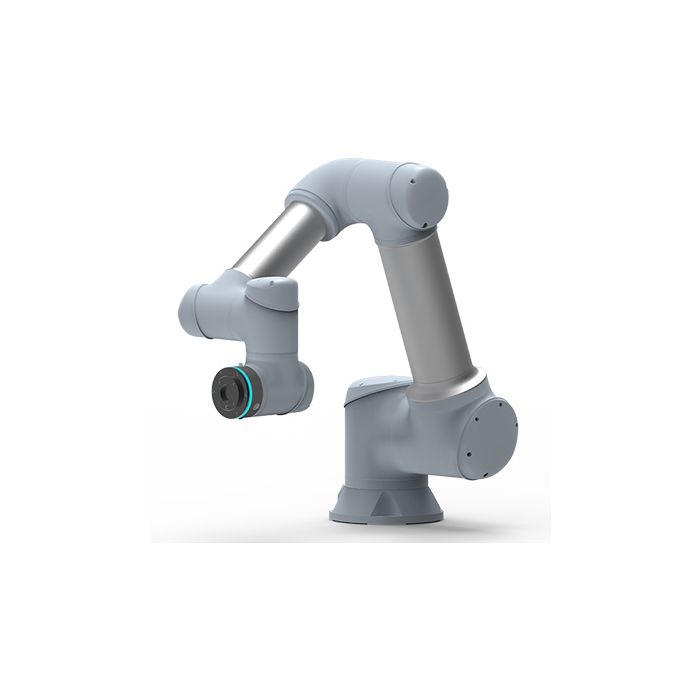
In stock
- BRAND:
- SIASUN
- PART #:
- GCR16-960
- ORIGIN:
- China
- AVAILABILITY:
- FOR OPPORTUNITIES OVER 1 MILLION USD
- SKU:
- SIASUN-GCR16-960
SIASUN Collaborative Robot (GCR16-960)
Strength and finesse rarely arrive in the same arm. A robot sturdy enough to carry a heavy gripper and part is usually fenced off and coarse in its movements. One delicate enough to return to the same point within a few hundredths of a millimetre is usually too light to carry much at all. The SIASUN Collaborative Robot (GCR16-960) sits deliberately between those extremes: a 16 kg maximum payload, ±0.03 mm repeatability and a 960 mm reach, in a six-axis collaborative arm designed to work beside people rather than behind a guard. It belongs where a task is too heavy or too repetitive for an operator, yet too varied and too close to people for a conventional industrial robot.
Robots Middle East supplies the GCR16-960 to manufacturers, system integrators, research institutions and training centres across the Middle East. Our team prepares the quotation, coordinates delivery to your site and remains your point of contact for technical support once the robot is in service. One regional partner therefore handles the project from the first enquiry through to after-sales support.
Background
SIASUN and the GCR series
SIASUN is a Chinese robotics manufacturer whose portfolio extends from industrial automation to collaborative robots. The GCR series is its family of collaborative arms, and the sources name ten versions within it, from the GCR3-618 to the GCR30-1100. Offering so many sizes allows an integrator to select the arm to suit the job, rather than adapting the job to suit the arm. In the case of the GCR16-960, the model code mirrors its headline figures: 16 kg of payload and 960 mm of reach. The manufacturer describes it as a high-end, general-purpose member of the series, which places it among the models intended for a broad range of production tasks rather than a single specialised process.
Sensing, safety and software
What sets the arm apart is less its mechanics than the intelligence around them. The GCR16-960 carries 16 TUV-certified safety features for safety-focused collaboration between people and machines. It integrates 2D/3D vision depth fusion together with high-sensitivity force perception and control, so it can locate parts and respond to contact rather than simply repeat a fixed path. Programming is done by drag-and-drop teaching, which lowers the threshold for new users and simplifies day-to-day operation. On the software side, SIASUN provides a variety of scenario-specific software packages and compatibility with multiple external interfaces, along with cloud-based monitoring of robot data and remote over-the-air (OTA) updates.
Technical Specifications
| Specification | Value |
|---|---|
| Product type | High-end, general-purpose collaborative robot of the GCR series |
| Degrees of freedom | 6 |
| Maximum payload | 16 kg |
| Reach | 960 mm |
| Repeatability | ±0.03 mm |
| Maximum TCP speed | 3.0 m/s |
| Maximum straight-line speed | 1.5 m/s |
| IP class | IP54/IP65 |
| Safety | 16 TUV-certified safety features for human–machine collaboration |
| Vision and force sensing | 2D/3D vision depth fusion; high-sensitivity force perception and control |
| Programming | Drag-and-drop teach programming |
| Software and connectivity | Scenario-specific software packages; multiple external interfaces; cloud-based robot data monitoring; remote OTA updates |
Specifications are as published by the manufacturer and are confirmed against the datasheet at quotation.
The manufacturer has not published the rated power, the controller model, the pose accuracy, the noise level, the software version, the service life or the list of included accessories; these are confirmed at quotation.
What makes the GCR16-960 different from a conventional industrial robot arm?
A conventional industrial arm is built for speed within a sealed cell. It is programmed by specialists, guarded by fencing and largely blind to what happens around it. The GCR16-960 starts from a different premise. Its 16 TUV-certified safety features are there so that the robot can share a workspace with people, and its high-sensitivity force perception gives it a sense of touch: it can detect contact, regulate the pressure it applies and handle operations in which the part must be seated, pressed or followed along a surface rather than merely placed.
The 2D/3D vision depth fusion matters for the same reason. Parts that arrive in slightly different positions, or in mixed batches, are a common obstacle to automation in plants that do not run long, identical production runs. A robot that can perceive depth as well as outline is better placed to cope with that variation without costly fixtures.
The way the robot is taught is equally different. With drag-and-drop teach programming, an operator guides the arm through the motion and builds the routine without writing code, so a change of product does not have to wait for an outside programmer. Cloud-based data monitoring and remote OTA updates extend that flexibility over the life of the cell, keeping the software current and giving engineers visibility of how the robot performs. As with any collaborative installation, the complete application, including the tooling and the workpiece, still requires a risk assessment before people and robot share the space.
Why choose the GCR16-960 within the GCR series?
The answer lies in the proportion between its load and its reach. A 16 kg payload leaves generous margin for a substantial gripper, a screwdriving unit or a vision head together with the part itself, while a 960 mm reach keeps the arm's working envelope compact. That combination suits benches, machine fronts and conveyor stations where floor space is at a premium and where a longer arm would simply sweep through space the cell does not have.
Speed is not sacrificed for that compactness. The arm reaches a maximum TCP speed of 3.0 m/s and a maximum straight-line speed of 1.5 m/s, which helps keep cycle times competitive in handling and tending work. Its IP class of IP54/IP65 indicates protection against dust and water for production environments that are not perfectly clean. For buyers who want a capable arm with a tight footprint, the GCR16-960 is a balanced choice in the series.
Who is the GCR16-960 for?
The first group is small and medium-sized manufacturers taking their first step into automation. For them, drag-and-drop teaching and scenario-specific software packages reduce dependence on specialist programmers, and collaborative operation spares them the cost and floor space of a fully guarded cell. The second group is system integrators, who benefit from the multiple external interfaces when combining the arm with grippers, conveyors, machine tools and plant software. The third is established producers in sectors such as automotive components, electronics, metal fabrication and consumer goods, who need a robot that can change task as product mixes change. Universities, research institutes and technical training centres form a fourth group, drawn by the combination of vision, force sensing and an accessible programming method.
Not every application suits this particular arm. Where the layout calls for a much longer reach or a heavier payload, the series offers alternatives such as the SIASUN Collaborative Robot (GCR16-2000), the SIASUN Collaborative Robot (GCR20-1400) and the SIASUN Collaborative Robot (GCR25-1800), while the SIASUN GCR12-1300 is worth comparing for lighter tooling; each has its own product page. The full range is collected in the SIASUN GCR series cobots category, and Robots Middle East will gladly help you compare the options against your task.
What is the GCR16-960 used for?
- Machine tending: loading and unloading CNC machines, presses and injection moulding machines at the front of the machine.
- Assembly: fitting and seating components with force control where precise, repeatable placement is required.
- Screwdriving and fastening: carrying a fastening tool and applying controlled force at each joint.
- Pick-and-place and packing: moving parts between conveyors, trays and cartons at end-of-line stations.
- Inspection and quality control: using 2D/3D vision to locate, check and sort parts during production.
- Surface finishing: sanding, polishing and deburring, where force perception keeps contact pressure consistent.
Pricing and Availability
The price of the GCR16-960 depends on the configuration, the end-of-arm tooling, the software packages and the scope of integration your application requires, so Robots Middle East prepares each offer as an individual quotation. Share a brief description of the task, the parts to be handled and the environment in which the robot will operate, and our team will propose a suitable configuration. Delivery, customs clearance and technical support are arranged together with your quotation. To begin, use the quotation request available on this page.
Frequently Asked Questions
What payload can the GCR16-960 handle?
The GCR16-960 has a maximum payload of 16 kg. This load includes the end-of-arm tooling as well as the workpiece, which should be considered when the gripper is selected.
What is the reach of the GCR16-960?
The arm has a reach of 960 mm. This compact working envelope suits benches, machine fronts and conveyor stations with limited space.
How precise is the GCR16-960?
Its repeatability is ±0.03 mm, which suits assembly, fastening and handling tasks that demand consistent placement.
Can the GCR16-960 work alongside people without guarding?
The robot carries 16 TUV-certified safety features designed for human–machine collaboration. Whether guarding is needed depends on the complete application, which should always be assessed for risk before operation.
How is the GCR16-960 programmed?
It uses drag-and-drop teach programming, so operators can guide the arm through a task and build routines without writing code. Scenario-specific software packages are also available for common applications.
Is the GCR16-960 suitable for dusty or damp environments?
The GCR16-960 has an IP class of IP54/IP65, giving it protection against dust and water. Our team will help you match the configuration to the conditions on your shop floor.
Where can I buy the SIASUN Collaborative Robot (GCR16-960) and what does it cost?
You can buy the GCR16-960 from Robots Middle East, which supplies it across the Middle East. The cost depends on configuration and integration scope, so please request a quotation through this page.
Summary
The SIASUN Collaborative Robot (GCR16-960) answers a familiar dilemma in automation: how to obtain real lifting capacity without giving up fine control or the ability to work beside people. With a 16 kg payload, ±0.03 mm repeatability and a 960 mm reach, it pairs strength with finesse in a compact envelope, and its vision, force sensing, TUV-certified safety features and drag-and-drop teaching make that capability usable on a working shop floor. Robots Middle East quotes, delivers and supports it throughout the region. For anyone planning a collaborative cell that must be both capable and careful, this page is the starting point.