
SIASUN GCR3-618
In stock
- BRAND:
- SIASUN
- PART #:
- GCR3-618
- ORIGIN:
- China
- AVAILABILITY:
- FOR OPPORTUNITIES OVER 1 MILLION USD
- SKU:
- SIASUN-GCR3-618
SIASUN GCR3-618
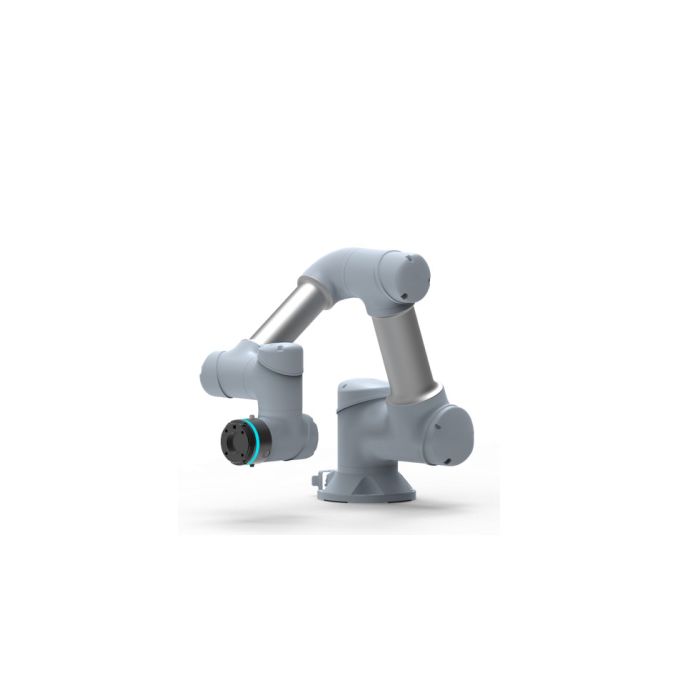
Teaching most industrial robots still means writing code line by line, then testing, correcting and testing again. The SIASUN GCR3-618 takes a more direct route. The operator takes hold of the arm, guides it through the motion and lets the robot remember the path, much as a craftsman guides an apprentice's hand. Behind that simple gesture sits a compact six-axis collaborative robot with 3kg of payload, 618mm of reach and ±0.02mm repeatability. It also carries 16 TUV-certified safety features intended for work alongside people rather than behind a fence.
Robots Middle East supplies the GCR3-618 to manufacturers, integrators, laboratories and training institutions across the Middle East. Robots Middle East prepares the quotation and coordinates delivery to your site. It also remains your point of contact for technical questions and after-sales support, from the first enquiry to the running workcell.
Background
SIASUN and the DUCO sub-brand
SIASUN is the brand behind the GCR series. Its collaborative robots are developed under SIASUN DUCO, a sub-brand focused on intelligent robotics. SIASUN DUCO has broken foreign technology monopolies in several fields, and all of its core components are developed independently. For a buyer, that lineage matters. A robot whose joints, drives and control are designed in-house tends to come with a more coherent development path for its software and spare parts than one assembled from third-party modules.
Where the GCR3-618 sits in the GCR series
The GCR3-618 is described as a high-end, general-purpose collaborative robot. Within the GCR series it is the compact, light-payload member. The sources also name a GCR3-618-W variant and the larger GCR5-910 and GCR7-910 models. Its technical character rests on three pillars:
- 2D/3D vision depth fusion combined with high-sensitivity force perception and control.
- A set of scenario-specific software packages.
- Cloud-based data monitoring with remote OTA upgrades.
Together, these position it less as a bare arm and more as a platform that can be equipped for a particular task.
Technical Specifications
| Specification | Value |
|---|---|
| Product type | High-end, general-purpose collaborative robot (GCR series) |
| Max payload | 3kg |
| Reach | 618mm |
| Repeatability | ±0.02mm |
| Max TCP speed | 1.0m/s |
| Max straight-line speed | 0.8m/s |
| Degrees of freedom | 6 |
| IP class | IP54/IP65 |
| Safety features | 16 TUV-certified safety features for human-machine collaboration |
| Vision and force sensing | 2D/3D vision depth fusion, high-sensitivity force perception and control |
| Programming | Drag-and-drop teach programming |
| Software and connectivity | Scenario-specific software packages, multiple external interfaces, cloud-based robot data monitoring, remote OTA upgrades |
Specifications are as published by the manufacturer and are confirmed against the datasheet at quotation. The manufacturer has not published the net weight, the power supply and consumption, the specific communication interfaces, the package contents or the controller and teach pendant model; these details are confirmed at quotation.
How does drag-and-drop teaching change cobot deployment?
Drag-and-drop teach programming is designed to lower the threshold for using the robot and to make operation easier. In practice, a production engineer or an experienced operator can define a path by moving the arm by hand, without first becoming a robot programmer. This shortens the gap between the robot arriving on site and the robot doing useful work. It also makes redeployment less daunting: when a product changes or a cell is rearranged, the motion can be re-taught on the spot rather than rewritten offline.
Teaching by hand only pays off if the robot then repeats the taught motion faithfully. With ±0.02mm repeatability, the GCR3-618 returns to a taught point within a very tight band. That is the property that matters for repetitive placement, fastening and inspection positioning. The scenario-specific software packages extend the same idea, giving the integrator a ready starting point for common tasks instead of a blank screen.
What do vision and force sensing add to the GCR3-618?
A collaborative robot that can only follow a fixed path is limited to parts that arrive in exactly the same place every time. The GCR3-618 integrates 2D/3D vision depth fusion with high-sensitivity force perception and control. This combination is aimed at tasks in which the robot must locate a part, sense contact and adjust its behaviour accordingly. Vision addresses where things are, while force perception addresses how firmly the robot is touching them. Together they support work such as insertion, fitting and surface contact that would otherwise demand precise fixtures.
The same sensing underpins the robot's role beside people. The 16 TUV-certified safety features are directed at human-machine collaboration, which is the reason to choose a cobot over a conventional industrial arm in the first place. Every installation still requires its own risk assessment, covering the tool, the workpiece and the layout of the cell. Robots Middle East can discuss these points as part of the quotation.
Who is the SIASUN GCR3-618 for?
The GCR3-618 suits small and medium-sized manufacturers taking their first step into automation. For them, a compact footprint, hand-guided teaching and work beside existing staff matter more than raw speed. Electronics, light assembly and precision component producers will recognise the value of its repeatability for small parts. System integrators can use it as a light-duty building block, drawing on its external interfaces and software packages to adapt it to a customer's cell. Universities, technical colleges and research laboratories form another natural audience. The combination of vision, force control and an approachable programming method makes it a capable platform for teaching and experimentation.
Buyers whose tooling and parts together exceed the 3kg payload, or whose workpieces lie beyond the 618mm reach, should look further up the range. The SIASUN GCR5-910 collaborative robot arm is the next step, and heavier tasks may call for the SIASUN GCR10-1300. The full family is presented in the SIASUN GCR series cobots category. Robots Middle East can help you compare the models against your actual parts and cycle requirements.
What is the SIASUN GCR3-618 used for?
- Light assembly: placing, fitting and fastening small components at a shared workbench.
- Pick-and-place: moving lightweight parts between trays, conveyors and fixtures with consistent positioning.
- Quality inspection: presenting parts to cameras or carrying a vision system around a workpiece.
- Machine tending: loading and unloading small parts at test benches and compact machines.
- Force-guided tasks: insertion and surface contact work in which sensing contact matters as much as position.
- Education and research: teaching robotics, vision and force control in laboratories and training centres.
Pricing and Availability
Robots Middle East supplies the SIASUN GCR3-618 on quotation, prepared for your configuration and intended application. Delivery, customs clearance and technical support are arranged together with the quotation, so that the full scope is clear before you commit. To begin, describe your task, parts and site, and our team will respond with a tailored proposal. The quotation request form is available on this page.
Frequently Asked Questions
What payload and reach does the GCR3-618 offer?
The GCR3-618 carries a maximum payload of 3kg and has a reach of 618mm. Remember that the payload must include the gripper or tool as well as the part.
How precise is the GCR3-618?
Its repeatability is ±0.02mm. This suits small-part assembly, placement and inspection positioning.
Is the GCR3-618 safe to use alongside operators?
It has 16 TUV-certified safety features designed for human-machine collaboration. Each application still needs its own risk assessment covering the tool, workpiece and cell layout.
Do I need programming experience to operate it?
No in-depth coding is needed for basic tasks, because the robot supports drag-and-drop teach programming by hand-guiding the arm. Scenario-specific software packages provide a starting point for common applications.
Can the robot be monitored and updated remotely?
Yes. The GCR3-618 supports cloud-based robot data monitoring and remote OTA upgrades.
What is the weight of the robot and what is included in the delivery?
The manufacturer has not published the net weight, the package contents or the controller model for this robot. Robots Middle East confirms these details with the quotation.
Where can I buy the SIASUN GCR3-618 and what does it cost?
You can buy the SIASUN GCR3-618 from Robots Middle East, which supplies it across the Middle East. The cost depends on configuration and project scope, so please request a quotation through this page.
Summary
The SIASUN GCR3-618 brings the apprentice's lesson to automation: show it once by hand and it repeats the motion within ±0.02mm. Around that core sit a compact 618mm reach, a 3kg payload, six degrees of freedom and an IP54/IP65 class. It adds 2D/3D vision fused with force perception and 16 TUV-certified safety features for working beside people. Cloud monitoring and OTA upgrades keep the platform current after installation. For manufacturers, integrators and educators in the Middle East who want precise light-duty automation without a programming barrier, Robots Middle East offers quotation, delivery and support, and this page is the starting point.