
SIASUN GCR7-910
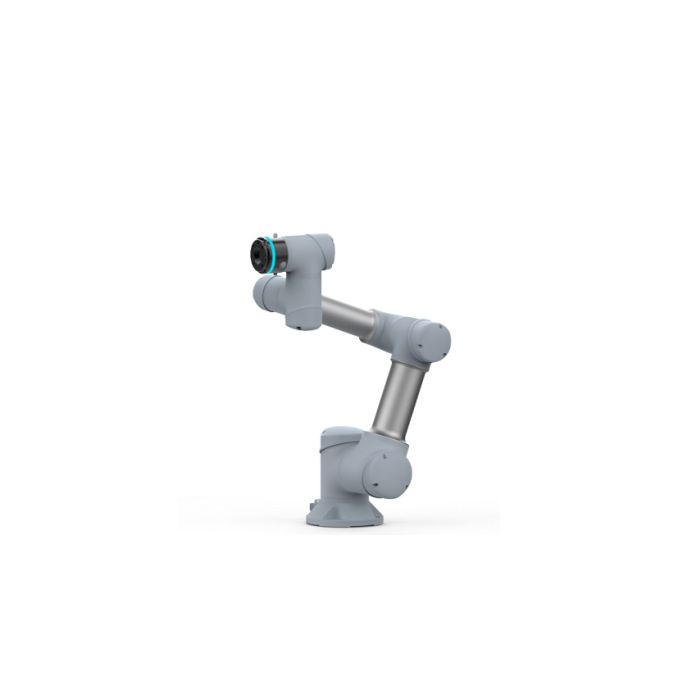
In stock
- BRAND:
- SIASUN
- PART #:
- GCR7-910
- ORIGIN:
- China
- AVAILABILITY:
- FOR OPPORTUNITIES OVER 1 MILLION USD
- SKU:
- SIASUN-GCR7-910
SIASUN GCR7-910
In most workshops the real cost of a robot is not the arm on the bench but the hours spent teaching it each new job. The SIASUN GCR7-910 is built to shorten that gap. It is a high-end, general-purpose collaborative robot that an operator can guide by hand, that sees its work through combined 2D/3D vision and feels it through sensitive force perception, and that carries 7kg across a reach of 917mm with a repeatability of ±0.02mm. Rather than asking the factory to adapt to the robot, it is designed to be taught, moved and taught again as production changes.
Robots Middle East sells the SIASUN GCR7-910 and supplies it to manufacturers, integrators, laboratories and training centres across the Middle East. We prepare each quotation against the buyer's application, arrange delivery to the site and remain the point of contact for support once the cobot is working on the line.
Background
SIASUN DUCO and the GCR series
The GCR7-910 comes from SIASUN DUCO, the sub-brand through which SIASUN concentrates on intelligent robotics. SIASUN DUCO states that it has broken foreign technology monopolies in multiple fields and that all of its core components are developed in-house. For a buyer, that matters less as a point of pride than as a question of continuity: a manufacturer that designs its own joints, drives and controllers is in a position to support and update its products over their working life. The GCR series is the company's family of collaborative arms, and the sources name five versions within it: GCR3-618, GCR5-910, GCR7-910, GCR10-1300 and GCR12-1300. The full range is presented in our Cobots category, and the wider manufacturer catalogue under SIASUN.
Sensing, teaching and connected software
What positions the GCR7-910 as a high-end model is the way it brings perception, programming and data together. SIASUN integrates 2D/3D vision depth fusion with high-sensitivity force perception and control, so that the arm can locate parts and respond to contact rather than simply repeating a fixed path. Drag-and-drop teach programming lowers the threshold for operation: a technician moves the arm through the task and records it, instead of writing every point in code. Around this sits a software layer of scenario-specific packages, support for multiple external interfaces, cloud-based monitoring of robot data and remote over-the-air (OTA) upgrades. Together these features describe a robot meant to be connected, observed and improved after installation, not left untouched once commissioned.
Technical Specifications
| Specification | Value |
|---|---|
| Product type | High-end, general-purpose collaborative robot, GCR series |
| Max payload | 7kg |
| Reach | 917mm |
| Repeatability | ±0.02mm |
| Max TCP speed | 3.6m/s |
| Max straight-line speed | 1.5m/s |
| Degrees of freedom | 6 |
| IP class | IP54/IP65 |
| Safety | 16 TUV-certified safety features for human-machine collaboration |
| Vision and force sensing | 2D/3D vision depth fusion, high-sensitivity force perception and control |
| Programming | Drag-and-drop teach programming |
| Software and connectivity | Scenario-specific software packages, multiple external interfaces, cloud-based robot data monitoring, remote OTA upgrades |
Specifications are as published by the manufacturer and are confirmed against the datasheet at quotation. SIASUN has not published the ambient temperature range, the joint ranges, the noise level, the contents of the control cabinet or the contents of the package; Robots Middle East confirms these details at quotation.
What makes the GCR7-910 different from a conventional industrial robot?
A conventional industrial arm is usually programmed by a specialist, enclosed behind guarding and left to perform one task for years. The GCR7-910 is designed around a different assumption: that people will work near it and that its task will change. The 16 TUV-certified safety features for human-machine collaboration are the foundation of that approach, allowing the robot to share space with operators where a risk assessment of the cell supports it. Collaborative operation is always a property of the whole application, including the tool, the part and the layout, so the safety functions are a starting point for that assessment rather than a substitute for it.
The second difference lies in how the robot is taught. Drag-and-drop teach programming means the operator who knows the process can also set up the robot, which reduces dependence on outside programmers and makes small-batch work worthwhile. The third lies in perception. With 2D/3D vision depth fusion and force perception built into the platform, the arm can find parts that are not perfectly positioned and can apply controlled contact during insertion, polishing or testing. These are tasks where a blind, position-only robot struggles.
None of this comes at the expense of precision or pace. A repeatability of ±0.02mm suits fine assembly and accurate placement, while a maximum TCP speed of 3.6m/s and a maximum straight-line speed of 1.5m/s give the arm the movement it needs when it runs at full rate within a cell that permits it.
Is the GCR7-910 suited to dusty or damp environments?
SIASUN publishes the IP class of the GCR7-910 as IP54/IP65. Under the IEC ingress protection system, IP54 indicates protection against dust and splashing water, while IP65 indicates a dust-tight enclosure protected against water jets. The listing of two classes suggests that the rating may differ between configurations or between the arm and other parts of the system. Buyers planning installations near coolant, washdown or airborne dust should therefore state their conditions when requesting a quotation, so that Robots Middle East can confirm which protection level applies to the configuration being supplied. Because the ambient temperature range has not been published, sites with high operating temperatures, which are common in parts of the region, should raise this at the same stage.
Who is the GCR7-910 for?
The GCR7-910 suits manufacturers that want to automate without redesigning their production floor. Electronics and electrical assemblers can use its repeatability for fine placement and screw driving. Metalworking and plastics plants can assign it to machine tending, where a 7kg payload covers many grippers and workpieces. Automotive suppliers can use its force sensing for insertion and fitting tasks. Its drag-and-drop teaching makes it equally relevant to small and medium-sized enterprises that have no in-house robot programmers.
System integrators will value the multiple external interfaces and scenario-specific software packages, which help connect the arm to tools, vision and line controls. Universities, research institutes and technical training centres gain a platform that combines collaborative safety, vision, force control and cloud data in a single arm, which makes it well suited to teaching modern automation.
Where the payload or reach of a task points to a different size of arm, the series offers alternatives. A lighter-duty application may be better served by the SIASUN GCR5-910, while a larger workpiece or wider work envelope may call for the SIASUN GCR10-1300. Each version has its own published specification, and Robots Middle East will compare them against your task before you commit.
What is the GCR7-910 used for?
- Machine tending: loading and unloading CNC machines, presses and moulding machines while operators supervise several stations.
- Precision assembly: placing, fitting and fastening components where repeatable positioning matters.
- Force-controlled processes: insertion, polishing, grinding or deburring that depend on consistent contact pressure.
- Vision-guided picking: locating and picking parts presented without fixed fixtures, using combined 2D/3D vision.
- Inspection and testing: presenting parts to cameras or test equipment, or pressing buttons and connectors in functional tests.
- Education and research: teaching collaborative robotics, sensing and connected automation in laboratories and training centres.
Pricing and Availability
Robots Middle East supplies the SIASUN GCR7-910 on quotation, because the right configuration depends on your application, tooling, environment and software requirements. Tell us what the robot will handle, where it will operate and how it must connect to your existing equipment, and we will prepare a proposal for that specific project. Delivery, customs clearance and support are arranged together with the quotation. To begin, use the quotation request available on this page.
Frequently Asked Questions
What payload and reach does the GCR7-910 offer?
The GCR7-910 has a maximum payload of 7kg and a reach of 917mm. The payload includes the end-of-arm tool, so the weight of the gripper should be taken into account when sizing an application.
How precise is the GCR7-910?
Its repeatability is ±0.02mm, which suits fine assembly, accurate placement and repeatable inspection tasks.
Can people work alongside the GCR7-910?
The robot includes 16 TUV-certified safety features for human-machine collaboration. Whether a particular cell can run collaboratively is determined by a risk assessment of the complete application.
Do operators need programming experience?
No specialist coding is required for many tasks, as drag-and-drop teach programming lets an operator guide the arm by hand and record its movements. Scenario-specific software packages support more involved applications.
Does the GCR7-910 support vision and force control?
Yes. SIASUN integrates 2D/3D vision depth fusion with high-sensitivity force perception and control in the platform.
Can the robot be monitored and updated remotely?
The GCR7-910 supports cloud-based robot data monitoring and remote OTA upgrades, allowing performance to be tracked and software to be updated without a site visit.
Where can I buy the SIASUN GCR7-910 and what does it cost?
You can buy the SIASUN GCR7-910 from Robots Middle East, which supplies it across the Middle East. The cost depends on the configuration and project scope, so please request a quotation and we will prepare one for your application.
Summary
The SIASUN GCR7-910 addresses the part of automation that most often holds projects back: the time and expertise needed to teach a robot its work. Drag-and-drop programming brings that task to the operator, vision and force sensing let the arm cope with real parts and real contact, and cloud monitoring with OTA upgrades keeps the system improving after installation. Beneath this sit a 7kg payload, a 917mm reach, ±0.02mm repeatability and 16 TUV-certified safety features, developed by a SIASUN sub-brand whose core components are its own. For manufacturers, integrators and educators in the Middle East who want a collaborative arm that can be taught and retaught as their needs change, this page is the starting point.