
Unitree H2 EDU SMART A Humanoid Robot
In stock
- BRAND:
- UNITREE ROBOTICS
- MODEL:
- H2-EDU-SMART-A
- PART #:
- H2-EDU-SMART-A
- ORIGIN:
- China
- Warranty:
- 12 MONTHS
- AVAILABILITY:
- SUBJECT TO AVAILABILITY
- SKU:
- Unitree-H2-EDU-SMART-A
Unitree H2 EDU SMART A Humanoid Robot
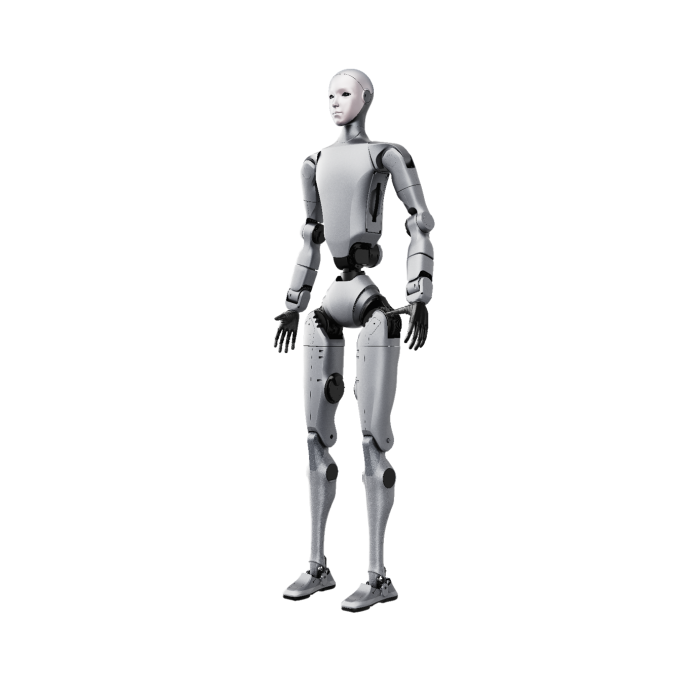
In a research laboratory, a humanoid robot spends far more of its working life being reprogrammed than being admired. The hours that count are the ones at the bench: a new gait controller tried, a grasping policy retrained, a speech pipeline replaced and tested again. The Unitree H2 EDU SMART A Humanoid Robot is shaped for those hours. It is a full-size body with 31 degrees of freedom and leg joints rated to 360 N·m. For a development team, however, its defining trait is what surrounds that body: an Intel Core i5 paired with an i7 for custom development, options for a high-power compute module such as Thor, and a choice of dexterous hand models. It is a platform meant to be rewritten, not merely operated.
Robots Middle East supplies the Unitree H2 EDU SMART A Humanoid Robot to universities, research institutes, system integrators and corporate innovation teams across the Middle East. Each quotation is prepared by Robots Middle East against the exact configuration requested. Robots Middle East also arranges delivery to the customer's site and remains the point of contact for technical support once the robot is in service.
Background
Unitree Robotics and its route to full-size humanoids
Unitree Robotics built its reputation on legged machines, first with quadruped robots and then with humanoid platforms aimed at research, education and applied development. That lineage matters to a buyer. A company that has spent years on dynamic balance, actuator design and locomotion control brings that experience to a larger body, where the demands on joints, batteries and controllers rise sharply. The H2 belongs to the full-size end of the Unitree humanoid range. The sources name three versions in the family: the H2, the H2 EDU and the H2 Plus. The product on this page is an EDU build, and the figures quoted here are those published for the H2 EDU.
The EDU build: a body designed to be developed on
An education and development edition answers a different question from a demonstration robot. The question is not only what the machine can do on delivery, but how much of it a research group can reach, modify and extend. The H2 EDU answers with layered computing: a base Intel Core i5, an additional i7 dedicated to custom development, and the option of a high-power compute module for heavier perception and learning workloads. Around that core sit a binocular head camera with a wide field of view, an array microphone with a high-power speaker, and a bionic head with facial features. The structure combines aircraft-grade aluminium, titanium and engineering plastics. The result is a full-size humanoid whose hardware has been arranged so that software teams can build on it rather than work around it.
Technical Specifications
| Specification | Value (H2 EDU) |
|---|---|
| Total degrees of freedom | 31 |
| Leg joint max torque | 360 N·m |
| Arm joint max torque | 120 N·m |
| Arm max payload | Peak ~15 kg · rated ~7 kg |
| Standing dimensions | 1820 × 456 × 218 mm |
| Weight (with battery) | ~70 kg |
| Battery | 15 Ah · 0.972 kWh · ~3 h |
| Connectivity | WiFi 6 · Bluetooth 5.2 |
| Base compute | Intel Core i5 + i7 (custom dev) |
| High-power compute module | Options (Thor, etc.) |
| Dexterous hand | Yes — multiple model options |
| Sensing | Binocular head camera (wide FOV) |
| Voice interaction | Array mic + high-power speaker |
| Materials | Aircraft-grade aluminium + titanium + engineering plastics |
| Bionic head with facial features | Yes |
Specifications are as published by the manufacturer and are confirmed against the datasheet at quotation.
The manufacturer has not published the walking speed, the IP rating, the charging time, the operating temperature range, whether a lidar is fitted, or the exact contents of the SMART A configuration; each of these is confirmed at quotation.
What does the EDU specification give a development team?
The first answer is computing headroom. Alongside the Intel Core i5 that runs the base system, the EDU specification lists an i7 set aside for custom development. In practice, this separation lets a team run its own experiments without competing for resources with the robot's core functions. Where those experiments outgrow the onboard processors, for example in large vision models or on-robot learning, the EDU build offers a high-power compute module, with Thor named among the options.
The second answer is manipulation. The EDU specification includes dexterous hands, with multiple models available. Combined with arm joints rated to 120 N·m and an arm payload of ~7 kg rated and ~15 kg peak, this gives researchers a body that can lift, place and handle real objects instead of only gesturing. The choice of hand model shapes which grasping and tool-use studies the robot can support, so it deserves careful thought from the outset.
The third answer is interaction. A binocular head camera with a wide field of view, an array microphone, a high-power speaker and a bionic head with facial features together give the robot the means to see, hear, speak and present a face. For human–robot interaction research, these elements are the experiment rather than accessories to it. Wireless connectivity through WiFi 6 and Bluetooth 5.2 completes the picture for teams that stream data to workstations during trials.
How should a buyer approach the SMART A configuration?
The SMART A name identifies a specific package within the H2 EDU line. The sensible approach is to treat the EDU specification above as the foundation and to settle the package contents, including the hand model, the compute option and any accessories, before an order is placed. Robots Middle East sets out these contents in writing with the quotation, so that the buyer can compare like with like.
Buyers weighing alternatives can review the wider Unitree H2 EDU range, which also includes packages such as the Unitree H2 EDU SMART B Humanoid Robot, the Unitree H2 EDU SMART C Humanoid Robot and the Unitree H2 EDU SMART M Humanoid Robot. The comparison between these packages is best made with a specialist from Robots Middle East against the project's own requirements.
Who is the Unitree H2 EDU SMART A Humanoid Robot for?
The clearest fit is a university or research institute working on locomotion, whole-body control or manipulation at human scale. A body standing 1820 mm tall and weighing ~70 kg with its battery behaves very differently from a small humanoid, and research that aims at real-world deployment often needs that scale from the outset.
Human–robot interaction groups form a second segment. The bionic head, voice system and wide-angle binocular camera give them a platform on which expression, dialogue and attention can be studied together. Applied AI teams form a third: the dedicated development computer and the high-power compute option suit groups that train and deploy their own perception or behaviour models.
System integrators and corporate innovation departments make up a fourth segment, using the robot to evaluate whether humanoid platforms can take on tasks in their own facilities. Finally, engineering faculties and technology centres can use the robot for advanced teaching, where students work on a real full-size system. Where a project calls for a different hand, compute or accessory set, the other packages in the Unitree H2 EDU range are worth comparing before a decision is made.
What is the Unitree H2 EDU SMART A Humanoid Robot used for?
- Locomotion research: developing and testing walking and balance controllers on a full-size bipedal body.
- Manipulation studies: grasping, placing and tool use with dexterous hands and strong arm joints.
- Embodied AI development: training and deploying perception and behaviour models on onboard or high-power compute.
- Human–robot interaction: studying speech, expression and attention through the bionic head, microphone array and speaker.
- Advanced teaching: giving engineering and computer science students hands-on work with a full-size humanoid.
- Applied evaluation: assessing humanoid platforms for tasks in industrial, service or public-facing settings.
Pricing and Availability
The Unitree H2 EDU SMART A Humanoid Robot is supplied on quotation, because the final configuration, including the hand model, the compute option and the package contents, determines what is delivered. Robots Middle East prepares each quotation for the specific project. Delivery, customs clearance and technical support are arranged together with the quotation. To begin, please use the quotation request available on this page.
Frequently Asked Questions
How many degrees of freedom does the robot have?
The H2 EDU has 31 degrees of freedom in total, with leg joints rated to 360 N·m and arm joints rated to 120 N·m.
How much can the arms carry?
The arm payload is ~7 kg rated and ~15 kg at peak.
How long does the battery last?
The battery is rated at 15 Ah and 0.972 kWh, with a runtime of ~3 h.
What computing does the EDU build include?
It pairs an Intel Core i5 with an i7 for custom development, and a high-power compute module, with Thor among the options, can be added.
Are dexterous hands included?
The EDU specification includes dexterous hands, with multiple models available. Robots Middle East specifies the hand model for the SMART A package in the quotation.
What wireless connectivity does the robot offer?
The H2 EDU supports WiFi 6 and Bluetooth 5.2, which suits teams that stream data to workstations during trials.
Where can I buy the Unitree H2 EDU SMART A Humanoid Robot and what does it cost?
Robots Middle East supplies the robot across the Middle East on a quotation basis. The cost depends on the chosen configuration and is set out in a written quotation, which you can request on this page.
Summary
A research humanoid earns its place through the work it makes possible after delivery, and the Unitree H2 EDU SMART A Humanoid Robot is arranged with that work in mind. Its full-size body, 31 degrees of freedom and strong leg and arm joints provide the physical capability. The dedicated development computer, the high-power compute option, the choice of dexterous hands and the interaction hardware give teams the room to reprogramme, retrain and extend it. Robots Middle East sets out the exact SMART A package in the quotation. For laboratories and development teams ready to build on a full-size humanoid, this page is the starting point.