
Unitree H2 EDU SMART B Humanoid Robot
In stock
- BRAND:
- UNITREE ROBOTICS
- MODEL:
- H2-EDU-SMART-B
- PART #:
- H2-EDU-SMART-B
- ORIGIN:
- China
- Warranty:
- 12 MONTHS
- AVAILABILITY:
- SUBJECT TO AVAILABILITY
- SKU:
- Unitree-H2-EDU-SMART-B
Unitree H2 EDU SMART B Humanoid Robot
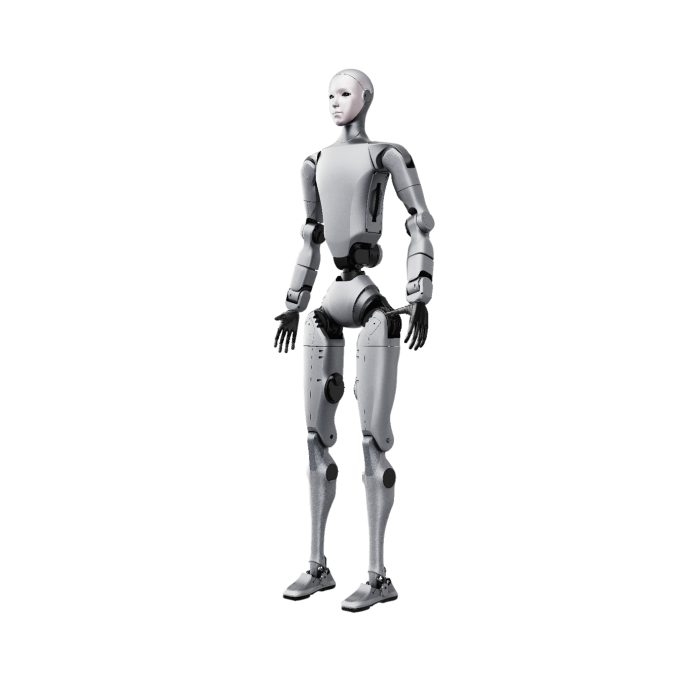
Most humanoids see the world from one place: the head. When a hand reaches into a cluttered tray or behind the edge of a shelf, the arm itself blocks that view at the very moment the grasp is decided. The Unitree H2 EDU SMART B Humanoid Robot answers this by giving each hand its own eye. Two Dex3-1 hands, each with a wrist-mounted RGB camera, sit on a full-size H2 EDU body that stands 1820 mm tall. The wide-angle binocular camera in the head still surveys the scene, while the wrists supply a close view of the contact itself. For teams working on manipulation, that second viewpoint changes which experiments become practical.
Robots Middle East supplies the Unitree H2 EDU SMART B to universities, research institutes, innovation centres and corporate laboratories across the Middle East. Our team prepares the quotation for this exact configuration, coordinates delivery to your site and remains your point of contact for technical support once the robot is in service.
Background
Unitree Robotics and the move to full-size humanoids
Unitree Robotics built its reputation on agile legged robots, first with quadrupeds used in research, inspection and education, and then with humanoid platforms aimed at laboratories and developers. The H2 family continues that path at full human scale. Its body is built from aerospace-grade aluminium, titanium alloy and high-strength engineering plastics, and it is designed to give researchers a human-proportioned machine on which locomotion, whole-body control and manipulation can be studied on the same hardware.
Where the SMART B sits in the H2 range
The sources name several H2 versions: H2 BASIC, H2 EDU STANDARD, SMART A with DEX1-1 Plus hands and SMART B with DEX3-1 hands. The EDU designation is what opens the platform to custom work. Its specification lists a PC2 development computer with an Intel Core i7, support for a high-performance computing module up to Jetson AGX Thor (2070 TOPS), and secondary development. The SMART B builds on that EDU body by adding the Dex3-1 hand package, so the developer computing and the dexterous hands arrive together in one configuration rather than as separate projects.
Technical Specifications
| Specification | Value |
|---|---|
| Hands | 2 × three-finger Dex3-1 hands with wrist-mounted RGB cameras |
| Degrees of freedom per hand | 7 DoF |
| Weight per hand | 650 g |
| Finger control | Three-finger force control |
| Tactile feedback | No |
| Standing dimensions | 1820 x 456 x 218 mm |
| Weight with battery | Approximately 70 kg |
| Degrees of freedom (body) | 6 DoF per leg, 7 DoF per arm, 3 DoF at the waist, 2 DoF at the head |
| Maximum leg joint torque | 360 N.m |
| Maximum arm joint torque | 120 N.m |
| Arm payload | Peak: ~15 kg; nominal: ~7 kg |
| Battery | 15 Ah (0.972 kWh) |
| Battery life | Approximately 3 h |
| Computing for custom development | PC2: Intel Core i7 |
| High-performance computing module | Up to Jetson AGX Thor (2070 TOPS) |
| Vision sensor | Wide-angle humanoid binocular camera |
| Voice interaction | Array microphones + high-power speaker |
| Connectivity | Wi-Fi 6, Bluetooth 5.2 |
| Materials | Aerospace-grade aluminium + titanium alloy + high-strength engineering plastics |
| Secondary development | Yes |
| Included accessories | Charger, manual remote controller, removable smart battery |
Specifications are as published by the manufacturer and are confirmed against the datasheet at quotation.
The manufacturer has not published the walking speed, the IP rating, whether a lidar is fitted, the operating temperature range, the charging time, the camera resolution, the hand payload or the packaged dimensions; these are confirmed at quotation.
What do wrist cameras and Dex3-1 hands add to the H2 EDU?
A camera in the head is ideal for finding an object and planning an approach, but it loses detail as the hand closes in, and the forearm often hides the fingers at the decisive moment. A camera on the wrist travels with the hand, so the final centimetres of a grasp stay in view. Pairing that close view with the head's binocular camera gives a learning system two complementary perspectives: one for the scene, one for the contact.
The Dex3-1 hands themselves offer 7 DoF each with three-finger force control, which allows the fingers to be commanded by force rather than position alone. That matters when the task involves objects of uncertain shape or softness, where a purely positional grasp either slips or squeezes too hard. At 650 g per hand, the package adds little mass at the end of an arm that is rated for a nominal payload of ~7 kg and a peak of ~15 kg, leaving most of the arm's capacity for the work itself. Each arm carries 7 DoF of its own, so the hand can be placed and oriented with the freedom that dexterous tasks require.
Does the H2 EDU SMART B have a sense of touch?
No. The Dex3-1 configuration on this version has no tactile feedback, and it is worth being clear about this before planning a project. Force control at the fingers is available, but there are no touch sensors reporting contact across the finger surfaces. In practice, this pushes the research towards vision-guided manipulation, where the wrist cameras and the head camera supply the information that tactile skins would otherwise provide. For many grasping, sorting and handover studies that is an advantage rather than a limitation, because it keeps the sensing pipeline simpler and the data easier to reproduce. Teams whose work depends specifically on tactile signals should raise that requirement during quotation so that the right configuration is discussed.
Who is the Unitree H2 EDU SMART B for?
The clearest fit is a manipulation laboratory that wants to move beyond tabletop arms to a full humanoid body without building its own hand and camera integration. University departments teaching embodied artificial intelligence will find a platform on which students can work across locomotion, perception and grasping, with an Intel Core i7 development computer and secondary development support for their own code. Corporate research and innovation teams evaluating humanoids for handling tasks in logistics, retail or light assembly can use the SMART B to test whether vision-guided grasping meets their needs before committing to a wider programme. Groups training learned policies from demonstration benefit from the wrist-camera data, which captures exactly what the hand sees during each attempt.
Not every buyer needs the Dex3-1 package. Teams whose work centres on locomotion and whole-body control rather than hands may prefer to compare the Unitree H2 EDU Standard Humanoid Robot, while those interested in the DEX1-1 Plus hand option should review the Unitree H2 EDU SMART A Humanoid Robot. The full set of configurations can be compared in the Unitree H2 EDU category.
What is the Unitree H2 EDU SMART B used for?
- Vision-guided grasping research — studying how close-range wrist views improve grasp success on varied objects.
- Learning from demonstration — recording paired head and wrist camera data to train manipulation policies.
- Bimanual manipulation — coordinating two dexterous hands for tasks such as opening, passing or holding and operating.
- Embodied AI development — running perception and control models on the development computer and an optional high-performance module.
- Human-robot interaction — combining array microphones, a speaker and handover tasks in studies of natural collaboration.
- Teaching and demonstration — giving students and visitors a full-size platform for coursework, competitions and showcases.
Pricing and Availability
Robots Middle East supplies the Unitree H2 EDU SMART B on a quotation basis, because the final configuration, computing options and project requirements shape what each institution receives. Send us your intended use, delivery location and any integration needs, and our team will prepare a quotation for this exact version. Delivery, customs clearance and after-sales support are arranged together with your quotation. The quotation request for the Unitree H2 EDU SMART B Humanoid Robot is available on this page.
Frequently Asked Questions
What hands does the H2 EDU SMART B use?
It is fitted with two three-finger Dex3-1 hands, each with 7 DoF, three-finger force control and a wrist-mounted RGB camera. Each hand weighs 650 g.
How tall and heavy is the robot?
Its standing dimensions are 1820 x 456 x 218 mm, and it weighs approximately 70 kg with the battery fitted.
How long does the battery last?
The battery is rated at 15 Ah (0.972 kWh) with a battery life of approximately 3 h. It is a removable smart battery, and a charger is included.
Can we run our own software on it?
Yes. The EDU specification includes secondary development, a PC2 development computer with an Intel Core i7, and support for a high-performance computing module up to Jetson AGX Thor (2070 TOPS).
Do the hands have tactile sensing?
No, this configuration has no tactile feedback. Grasping relies on force control at the fingers together with the wrist and head cameras.
How does the robot connect to our network?
It supports Wi-Fi 6 and Bluetooth 5.2, and a manual remote controller is included for direct operation.
Where can I buy the Unitree H2 EDU SMART B and what does it cost?
Robots Middle East supplies it across the Middle East on a quotation basis. Request a quotation on this page and our team will confirm the configuration, delivery and support for your project.
Summary
The Unitree H2 EDU SMART B moves part of a humanoid's vision to where the work actually happens. A full-size H2 EDU body with 7 DoF arms, an Intel Core i7 development computer and secondary development support carries two Dex3-1 hands, each watching its own grasp through a wrist camera while the head camera keeps the wider scene in view. It does not offer touch sensing, and it is honest about that; what it offers instead is a clean, vision-led platform for grasping, demonstration learning and bimanual research at human scale. For laboratories across the Middle East ready to study how robots see and handle the world at close range, with Robots Middle East handling quotation, delivery and support, this page is the starting point.