
Unitree H2 EDU Humanoid Robot
In stock
- BRAND:
- UNITREE ROBOTICS
- MODEL:
- H2 EDU
- ORIGIN:
- China
- Warranty:
- 12 MONTHS
- AVAILABILITY:
- ALLOW 2-4 WEEKS FOR DELIVERY
- SKU:
- Unitree-H2-EDU
Unitree H2 EDU Humanoid Robot
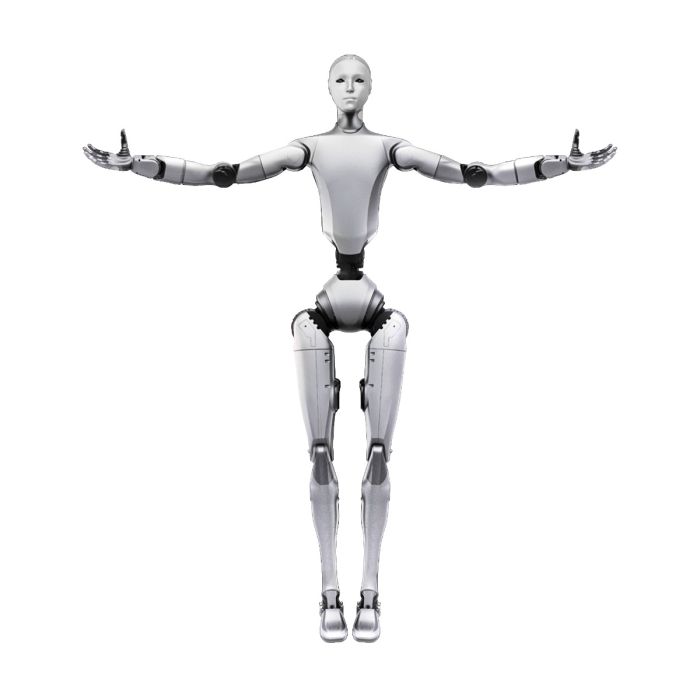
Every humanoid researcher knows the moment. A walking policy that behaved perfectly in simulation takes its first step on a real floor, and something unexpected happens. Friction, backlash, sensor noise and the sheer mass of a moving body refuse to be modelled away. The Unitree H2 EDU Humanoid Robot is built for teams who want to close that gap on hardware with the proportions and presence of an adult person. Standing 1820 mm tall, weighing approximately 70 kg with its battery and articulated through 31 degrees of freedom, it is a platform opened to secondary development, so that code written at a desk meets a body that answers back honestly.
Robots Middle East supplies the Unitree H2 EDU Humanoid Robot to universities, research institutes, corporate innovation centres and system integrators across the Middle East. Robots Middle East prepares each quotation for the configuration requested, arranges delivery and import into the destination country, and remains your point of contact for technical support once the robot is in service.
Background
Unitree Robotics and its path to full-size humanoids
Unitree Robotics, based in Hangzhou, China, built its reputation on legged robots. Its quadrupeds became familiar tools in research, inspection and teaching, and the company then carried its experience with in-house actuators and motion control into bipedal machines. Earlier humanoids such as the H1 and the compact G1 brought walking robots within reach of many laboratories that had previously only read about them. The H2 family continues that lineage at full adult scale, with a body designed for corridors, workbenches and doorways that were planned around people rather than machines.
The EDU configuration and its development focus
The H2 family is offered in several configurations, and the EDU designation identifies the one intended for developers. Its specification includes support for secondary development, a high-performance computing module of up to Jetson AGX Thor (2070 TOPS), dexterous hands available in several model options and intelligent OTA updates. In practical terms, the H2 EDU is positioned not as a finished appliance but as a research instrument: a humanoid body, a sensor suite and on-board computing that a team can programme, extend and refine according to its own research agenda.
Technical Specifications
| Specification | Value |
|---|---|
| Standing dimensions | 1820 x 456 x 218 mm |
| Weight with battery | Approximately 70 kg |
| Total degrees of freedom | 31 |
| DoF per arm | 7 |
| DoF per leg | 6 |
| Waist DoF | 3 |
| Head DoF | 2 |
| Max. leg joint torque | 360 N.m |
| Max. arm joint torque | 120 N.m |
| Arm payload | Peak: ~15 kg; nominal: ~7 kg |
| Battery | 15 Ah (0.972 kWh) |
| Battery life | Approximately 3 h |
| High-performance computing module | Up to Jetson AGX Thor (2070 TOPS) |
| Vision sensor | Wide-angle humanoid binocular camera |
| Voice interaction | Array microphones + high-power speaker |
| Connectivity | Wi-Fi 6, Bluetooth 5.2 |
| Materials | Aerospace-grade aluminium + titanium alloy + high-strength engineering plastics |
| Cooling | Local air cooling |
| Secondary development | Yes |
| Charger | Yes |
| Manual remote controller | Yes |
| Dexterous hands | Yes, several model options |
| Intelligent OTA | Yes |
Specifications are as published by the manufacturer and are confirmed against the datasheet at quotation.
The manufacturer has not published the top speed, IP rating, camera resolution, lidar provision, charging time, operating temperature range or battery weight, nor whether a dexterous hand is included in the base EDU configuration; these points are confirmed at quotation.
Is the Unitree H2 EDU suitable for embodied AI research?
Embodied AI research depends on three things working together: a body rich enough to express complex behaviour, sensors that perceive the world in a way the software can learn from, and enough computing power on board to run models without a cable to a workstation. The H2 EDU addresses each of them. Its 31 degrees of freedom are distributed across arms with 7 each, legs with 6 each, a waist with 3 and a head with 2, so whole-body behaviour can be studied rather than walking alone. A waist that turns and bends allows the robot to reach and reorient its upper body while its legs hold balance, which is exactly the kind of coupled problem that makes humanoid control demanding.
Perception comes from a wide-angle humanoid binocular camera, positioned as human eyes are and therefore well suited to research that draws on human demonstration or head-mounted data. Array microphones and a high-power speaker support voice interaction studies, while Wi-Fi 6 and Bluetooth 5.2 connect the robot to the laboratory network and peripherals. The computing module, offered up to Jetson AGX Thor (2070 TOPS), gives teams the headroom to run perception and policy models on the robot itself. Secondary development support means that this hardware is open to the team's own software, and intelligent OTA keeps the platform current between projects.
How much can the Unitree H2 EDU carry and how strong are its joints?
Manipulation research quickly becomes limited by what the arms can actually hold. The H2 EDU has an arm payload with a peak of about 15 kg and a nominal value of about 7 kg, together with a maximum arm joint torque of 120 N.m. That distinction matters for planning experiments: the nominal figure is the sensible basis for sustained tasks, while the peak describes brief, demanding moments. In the legs, a maximum joint torque of 360 N.m supports a body of approximately 70 kg through standing, walking and recovery manoeuvres.
The structure combines aerospace-grade aluminium, titanium alloy and high-strength engineering plastics, and the drive system relies on local air cooling. With a 15 Ah (0.972 kWh) battery rated at approximately 3 h of operation, a typical research session can run for a meaningful period before the robot returns to its charger, which is part of the delivery. A manual remote controller is also supplied, giving operators direct control during testing, setup and demonstrations.
Who is the Unitree H2 EDU Humanoid Robot for?
The H2 EDU is aimed first at university departments and research institutes working on locomotion, whole-body control, manipulation and embodied intelligence, where an adult-scale body and open development access are the core requirements. Corporate research and innovation centres exploring humanoids for logistics, manufacturing or customer-facing roles will find it a realistic test platform before committing to wider programmes. System integrators can use it to develop and validate applications for their own clients, while government-backed technology initiatives and science centres across the region may value its scale and voice interaction for public-facing projects alongside research.
Buyers who already know which hands and computing configuration their work needs should also review the SMART configurations listed within the Unitree H2 EDU range, such as the Unitree H2 EDU SMART A Humanoid Robot and the Unitree H2 EDU SMART L Humanoid Robot. Robots Middle East will set out the differences between configurations so that each option can be compared side by side. The wider family is presented in the Unitree H2 category.
What is the Unitree H2 EDU Humanoid Robot used for?
- Locomotion research – developing and testing walking, balance and recovery controllers on a full-size bipedal body.
- Manipulation studies – investigating grasping and handling with seven-axis arms and the dexterous hand options.
- Embodied AI and learning – training and deploying perception and control models on the on-board computing module.
- Human–robot interaction – exploring voice-based dialogue through the array microphones and speaker.
- Application prototyping – trialling humanoid workflows for logistics, inspection or service settings before wider deployment.
- Teaching and demonstration – giving engineering students hands-on experience with an adult-scale humanoid platform.
Pricing and Availability
The Unitree H2 EDU Humanoid Robot is supplied by quotation, because the final configuration depends on choices such as the dexterous hand model and the computing module. Robots Middle East prepares each quotation around the intended application and the configuration your team selects. Delivery, customs clearance and after-sales support are arranged together with the quotation. To begin, please submit your requirements through the quotation request available on this page.
Frequently Asked Questions
How tall and heavy is the Unitree H2 EDU?
The H2 EDU has standing dimensions of 1820 x 456 x 218 mm and weighs approximately 70 kg with its battery.
How long does the battery last?
The robot uses a 15 Ah (0.972 kWh) battery with a battery life of approximately 3 h.
Are dexterous hands available for the H2 EDU?
Yes, dexterous hands are available in several model options. Robots Middle East helps you choose the hand model that suits your manipulation work.
What computing hardware does the H2 EDU use?
The high-performance computing module is offered up to Jetson AGX Thor (2070 TOPS). The module is selected together with the rest of your configuration.
Can we develop our own software for the robot?
Yes. The H2 EDU supports secondary development, and intelligent OTA updates keep the platform's software current.
What is supplied with the robot?
A charger and a manual remote controller are supplied with the H2 EDU. The remote controller gives operators direct control during setup, testing and demonstrations.
Where can I buy the Unitree H2 EDU Humanoid Robot and what does it cost?
The robot is available from Robots Middle East, which supplies it across the Middle East. The cost depends on the chosen configuration and is provided in a formal quotation, which you can request on this page.
Summary
The distance between a simulated humanoid and a real one is where much of today's robotics research is decided, and the Unitree H2 EDU Humanoid Robot is built to bring that distance into the laboratory. It offers an adult-scale body with 31 degrees of freedom, strong leg and arm joints, binocular vision, voice interaction and computing up to Jetson AGX Thor, all open to secondary development. For teams that want their algorithms tested against real mass, real friction and real balance, supplied, delivered and supported by Robots Middle East, this page is the starting point.
Specifications
General
Physical
Mobility
Performance
Computing
Connectivity
Software
Battery + Power
What's included
- Unitree H2 EDU Humanoid Robot
- Charger
- Smart Battery (Quick-release)
- Handheld Remote Controller
- Free Delivery
Videos
Related Products
Out of stock