
Unitree H2 EDU SMART D Humanoid Robot
In stock
- BRAND:
- UNITREE ROBOTICS
- MODEL:
- H2-EDU-SMART-D
- PART #:
- H2-EDU-SMART-D
- ORIGIN:
- China
- Warranty:
- 12 MONTHS
- AVAILABILITY:
- SUBJECT TO AVAILABILITY
- SKU:
- Unitree-H2-EDU-SMART-D
Unitree H2 EDU SMART D Humanoid Robot
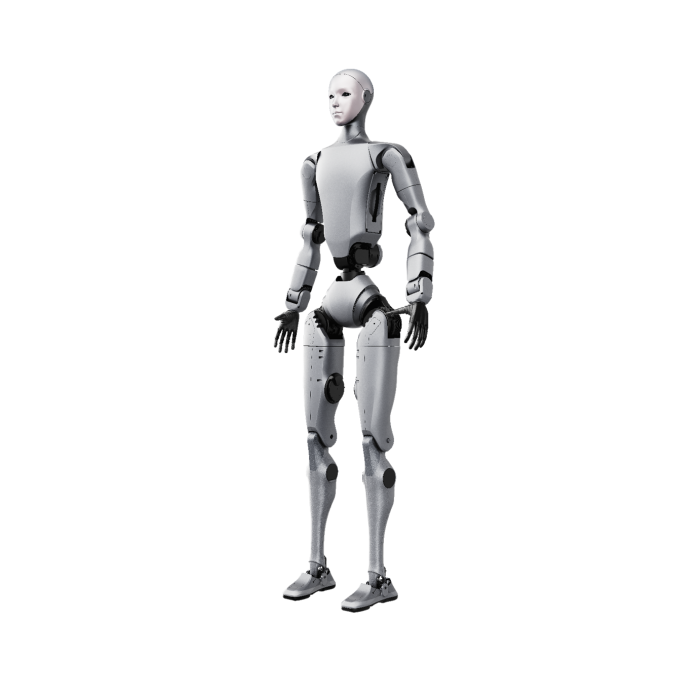
Choosing a humanoid from the H2 range is closer to writing a specification than to picking a product off a shelf. The H2 is listed in eleven configurations, and each letter of the EDU SMART series gives a different answer to the same question: what should the robot be able to do with its hands? The Unitree H2 EDU SMART D Humanoid Robot answers with two Dex5-1 five-finger hands. Each hand has its own wrist-mounted RGB camera and 16 degrees of freedom, and both are fitted to a full-size bipedal body that is open to secondary development. It is the configuration for teams that want human-like grasping today and are prepared to work without tactile sensing in the fingers.
Robots Middle East sells the Unitree H2 EDU SMART D Humanoid Robot and supplies it to universities, research institutes, corporate innovation teams and system integrators across the Middle East. Robots Middle East prepares each quotation for the exact configuration requested, arranges delivery to the customer's site and provides support once the robot is in service.
Background
Unitree Robotics and the H2 family
Unitree Robotics built its reputation on legged machines, first quadrupeds and then humanoids. The company has consistently offered platforms that research groups can program, not merely operate. The H2 is its full-size humanoid line. It stands 1820 mm tall and weighs approximately 70 kg with its battery, which places it in the class of robots that work at human scale, among human furniture, tools and workspaces. The EDU versions are the development-oriented branch of the family. They support secondary development, and their motion-control algorithms evolve continuously through over-the-air updates, so the robot's locomotion keeps improving after it has been delivered.
Dexterity without touch: where SMART D sits
Within the EDU SMART series, the letter mainly identifies the end effector. The range runs from the SMART A with Dex1-1 Plus hands, through the Dex3-1 options of the SMART B and C, to the Revo 2 hands of the SMART F and G and the Inspire DFQ of the SMART H. The SMART D and SMART E share the five-finger Dex5-1 family. The SMART E pairs it with tactile sensing, while the SMART D deliberately leaves it out. What the SMART D adds instead is a camera at each wrist. This gives every hand its own close-range view of the object it is grasping, which complements the wide-angle binocular camera in the head.
Technical Specifications
| Specification | Value |
|---|---|
| Hands (SMART D configuration) | 2 × five-finger Dex5-1 hands with wrist-mounted RGB cameras |
| DoF per hand | 16 |
| Tactile feedback | None |
| Standing dimensions | 1820 x 456 x 218 mm |
| Weight with battery | Approximately 70 kg |
| Body degrees of freedom | 31 |
| DoF per leg | 6 |
| DoF per arm | 7 |
| Waist DoF | 3 |
| Head DoF | 2 |
| Max. leg joint torque | 360 N.m |
| Max. arm payload | Peak: ~15 kg; nominal: ~7 kg |
| Battery | 15 Ah (0.972 kWh) |
| Battery life | Approximately 3 h |
| High-performance computing module | Up to Jetson AGX Thor (2070 TOPS) |
| Vision sensor | Wide-angle humanoid binocular camera |
| Voice interaction | Array microphones + high-power speaker |
| Connectivity | Wi-Fi 6, Bluetooth 5.2 |
| Secondary development | Supported |
| Motion control updates | Algorithms evolve continuously via OTA |
| Operating temperature | 0°C to 40°C (32°F to 104°F) |
| Water and dust protection | Not waterproof or dustproof |
Specifications are as published by the manufacturer and are confirmed against the datasheet at quotation.
The manufacturer has not published the top speed, the IP rating, the weight of the SMART D hands, the charging time, the camera resolution or a complete in-the-box list for this configuration; these are confirmed at quotation.
What do the Dex5-1 hands change on the H2 EDU?
A humanoid body with 31 degrees of freedom can walk, balance, turn at the waist and direct its gaze. What it can do once it reaches a workbench depends on its hands. With 16 degrees of freedom in each Dex5-1 hand, the fingers can be driven with considerable independence. This opens up grasps that resemble those of a human hand: pinching small parts, wrapping around handles and holding tools designed for people rather than for robots. For researchers, that matters because the objects in a real laboratory, warehouse or kitchen were never designed with a gripper in mind.
The wrist-mounted RGB cameras are the second half of the argument. A head camera sees the scene; a wrist camera sees the grasp. Placing a viewpoint at each hand gives manipulation policies a close, unobstructed image of the contact area, which is useful wherever fine positioning matters. Behind the hands, each arm offers 7 degrees of freedom and a nominal payload of around 7 kg, with a peak of around 15 kg. On board, the computing module can be specified up to Jetson AGX Thor at 2070 TOPS, enough to run perception and control models on the robot itself rather than relying on an external workstation.
Should you choose the SMART D or a tactile configuration?
The SMART D has no tactile feedback. Grasp control therefore relies on vision and on the robot's own joint sensing rather than on touch sensors in the fingers. For many projects this is a sensible boundary. Learning pipelines built on camera data, teleoperation demonstrations and visual imitation work naturally with a hand that is watched rather than felt, and the sensing stack stays more compact.
Research that depends on measuring contact, such as slip detection, force-sensitive assembly or handling fragile objects by feel, points to a different letter. The Unitree H2 EDU SMART E Humanoid Robot keeps the five-finger Dex5-1 family but uses the tactile Dex5-1P variant. The Unitree H2 EDU SMART C Humanoid Robot and the Unitree H2 EDU SMART G Humanoid Robot carry tactile and touch-equipped hands from other families. Robots Middle East can set these configurations side by side in a single quotation, so the decision rests on the research question rather than on the catalogue.
Who is the Unitree H2 EDU SMART D Humanoid Robot for?
The clearest fit is a university or research institute working on dexterous manipulation, embodied AI or humanoid learning. Such groups need human-scale hands and an open platform for their own software. Corporate research and development teams form a second group. They evaluate whether humanoids can take on handling tasks in their own facilities, and they need a robot that can grip real objects rather than simply demonstrate walking. System integrators and technology centres that build demonstrators for clients in the region will also find that the combination of a full-size body, five-finger hands and voice interaction gives them a convincing showcase.
Not every project needs this level of dexterity. Where simpler grasping is enough, the Unitree H2 EDU SMART A Humanoid Robot is a reasonable starting point. Where touch is central to the work, the tactile configurations described above are the better match. The full family is gathered in the Unitree H2 EDU category.
What is the Unitree H2 EDU SMART D Humanoid Robot used for?
- Dexterous manipulation research: studying multi-finger grasping, in-hand repositioning and tool use on a full-size humanoid.
- Imitation learning and teleoperation: collecting demonstration data with wrist-camera views for training manipulation policies.
- Embodied AI development: running perception and control models on board with a high-performance computing module.
- Human-robot interaction: exploring spoken dialogue through the array microphones and speaker alongside gesture and handover tasks.
- Teaching and curriculum work: giving robotics and AI students a programmable humanoid for practical courses and final-year projects.
- Industrial task evaluation: testing humanoid handling of real parts and tools in indoor pilot environments before wider deployment.
Pricing and Availability
The Unitree H2 EDU SMART D Humanoid Robot is offered by quotation, because the computing module, accessories and support scope are defined for each project. A quotation from Robots Middle East sets out the exact configuration for your project. Delivery, customs clearance and after-sales support are arranged as part of the quotation. To begin, please send your requirements through the quotation request available on this page.
Frequently Asked Questions
How many degrees of freedom does the H2 EDU SMART D have?
The body has 31 degrees of freedom: 6 per leg, 7 per arm, 3 at the waist and 2 at the head. Each Dex5-1 hand adds 16 degrees of freedom of its own.
Do the Dex5-1 hands on the SMART D have tactile sensing?
No, the SMART D configuration has no tactile feedback. Projects that need touch sensing should consider the SMART E, which uses the tactile Dex5-1P hands.
How long does the battery last?
The 15 Ah (0.972 kWh) battery gives approximately 3 h of operation.
Can we develop our own software for the robot?
Yes. Secondary development is supported on the EDU version, and motion-control algorithms continue to evolve through over-the-air updates.
Is the robot suitable for outdoor use in the Gulf climate?
The operating temperature range is 0°C to 40°C (32°F to 104°F), and the robot is not waterproof or dustproof. It is best planned for climate-controlled indoor environments.
What computing power does the robot carry?
The high-performance computing module can be specified up to Jetson AGX Thor at 2070 TOPS, which allows perception and control models to run on the robot itself.
Where can I buy the Unitree H2 EDU SMART D Humanoid Robot and what does it cost?
Robots Middle East supplies the robot across the Middle East and prices it by quotation, according to the configuration and support you require. Please submit a quotation request through this page to receive a tailored offer.
Summary
Specifying an H2 means deciding what its hands should be. The SMART D makes a clear choice: two five-finger Dex5-1 hands with 16 degrees of freedom each, cameras at the wrists and no tactile layer. All of this is mounted on a 31-degree-of-freedom body with substantial leg torque, a useful arm payload and onboard computing that can be specified up to Jetson AGX Thor. For teams whose manipulation research runs on vision, it is a focused and capable platform. Where touch matters more, a neighbouring letter in the range will serve better. For a configuration quoted, delivered and supported by Robots Middle East, this page is the starting point.