
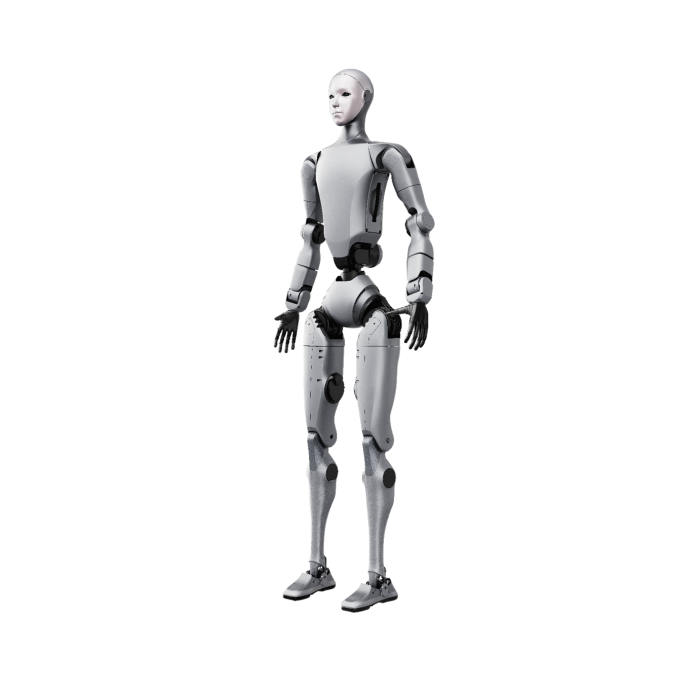
Unitree H2 EDU SMART E Humanoid Robot
In stock
- BRAND:
- UNITREE ROBOTICS
- MODEL:
- H2-EDU-SMART-E
- PART #:
- H2-EDU-SMART-E
- ORIGIN:
- China
- Warranty:
- 12 MONTHS
- AVAILABILITY:
- SUBJECT TO AVAILABILITY
- SKU:
- Unitree-H2-EDU-SMART-E
Unitree H2 EDU SMART E Humanoid Robot
Choosing a letter from a lineup of hand configurations sounds like an ordering detail, yet for a manipulation laboratory it decides what kind of research the coming years will hold. Fit a simple gripper and your experiments are about positioning. Fit a hand that registers pressure and they become about contact, slip and force. The Unitree H2 EDU SMART E Humanoid Robot is the configuration that takes the second path. It is a full-size bipedal H2 EDU body carrying a pair of Dex5-1P tactile hands, each with a wrist-mounted RGB camera, so that every grasp yields both an image and a map of where the fingers are pressing.
Robots Middle East sells the Unitree H2 EDU SMART E Humanoid Robot and supplies it to universities, research institutes, innovation centres and corporate laboratories across the Middle East. Our team prepares each quotation against the exact configuration you specify and coordinates delivery to your site. We also remain your point of contact for technical support once the robot is in service, so that a single, accountable partner handles the platform from first enquiry onwards.
Background
Unitree Robotics and the H2 family
Unitree Robotics built its reputation on legged machines, first with quadruped robots and then with a growing range of humanoids aimed at research, education and applied development. The H2 is the company's full-size humanoid, and the sources name several versions of it: the H2 BASIC, the H2 EDU STANDARD, a series of H2 EDU SMART configurations lettered A to M that differ in their hands, the H2 EDU SMART E DEX5-1P Tactile, and the H2 Plus. The EDU designation marks the versions intended for developers. On the EDU, secondary development is supported, which means research teams can write and deploy their own control and perception software rather than working only with factory behaviours. The SMART E sits inside this EDU line, so it shares the EDU body and development access and differs in the hands it is fitted with.
Tactile hands as the defining technology
The defining feature of the SMART E is its pair of five-finger Dex5-1P hands. Each hand offers 16 degrees of freedom and carries 94 pressure sensors, giving the robot tactile feedback during manipulation rather than relying on vision alone. A wrist-mounted RGB camera on each hand adds a close-range view of the object being handled, complementing the wide-angle humanoid binocular camera in the head. Together, these sensors let a researcher record what the robot saw, where it touched and how hard it pressed in a single grasp. For anyone working on dexterous manipulation, learning from demonstration or contact-rich control, that combination of data streams is the reason to choose this configuration over a hand without touch sensing.
Technical Specifications
| Specification | Value |
|---|---|
| Hands (SMART E configuration) | 2 × five-finger tactile Dex5-1P hands with wrist-mounted RGB cameras |
| Hand degrees of freedom | 16 DoF per hand |
| Tactile sensing | 94 pressure sensors per hand |
| Standing dimensions | 1820 x 456 x 218 mm |
| Weight with battery | Approximately 70 kg |
| Maximum leg joint torque | 360 N.m |
| Maximum arm joint torque | 120 N.m |
| Arm payload | Peak: ~15 kg; nominal: ~7 kg |
| Materials | Aerospace-grade aluminium + titanium alloy + high-strength engineering plastics |
| Battery | 15 Ah (0.972 kWh) |
| Battery life | Approximately 3 h |
| High-performance computing module (H2 EDU) | Up to Jetson AGX Thor (2070 TOPS) |
| Vision sensor | Wide-angle humanoid binocular camera |
| Voice interaction | Array microphones + high-power speaker |
| Connectivity | Wi-Fi 6, Bluetooth 5.2 |
| Secondary development | Supported on EDU |
Specifications are as published by the manufacturer and are confirmed against the datasheet at quotation.
The manufacturer has not published the top walking speed, the IP rating, the camera resolution, the hand payload, the operating noise level, the charging time or the compute module included with the SMART E configuration; we confirm each of these with you at quotation.
What do the Dex5-1P tactile hands add to the H2 EDU?
A humanoid body without capable hands can walk to a workbench but can do little once it arrives. The H2 EDU body already provides the reach and strength for serious manipulation work: arm joints rated to 120 N.m and an arm payload of ~7 kg nominal and ~15 kg at peak. The Dex5-1P hands turn that strength into controlled interaction with objects. With 16 degrees of freedom per hand, the fingers can form a wide range of grasps, from a power grip around a tool handle to a precision pinch.
The 94 pressure sensors per hand are what change the nature of the research. Vision alone tells a controller where an object appears to be. Pressure data tells it whether contact has actually been made, how the load is distributed across the fingers and whether the object is beginning to slip. That feedback is essential for handling fragile, deformable or irregular items, and it is equally valuable as training data for learning-based policies. The wrist-mounted RGB cameras close the loop at short range, keeping the object in view even when the head camera's line of sight is blocked by the arm or the hand itself.
How does the SMART E differ from other H2 EDU SMART configurations?
The sources describe the H2 EDU SMART A to M variants as hand configurations. In other words, the letter identifies what is mounted at the end of the arms, while the body, sensors, battery and development access belong to the H2 EDU platform. The SMART E is defined by its tactile Dex5-1P hands with wrist cameras. If your project needs touch sensing and high finger dexterity, this is the configuration designed around those requirements.
Because the fact sheet does not detail the hands of each sibling, we recommend comparing them directly. The Unitree H2 EDU category gathers the range, and individual pages such as the Unitree H2 EDU SMART A Humanoid Robot and the Unitree H2 EDU SMART F Humanoid Robot describe their own configurations. Our team will gladly set out the differences side by side in your offer.
Who is the Unitree H2 EDU SMART E Humanoid Robot for?
The first group is university and institute laboratories that specialise in dexterous manipulation, haptics and contact-rich control. For them, the combination of high finger dexterity and dense pressure sensing on a full-size humanoid is the core of the research programme. A second group is teams developing embodied AI and learning-from-demonstration methods. The tactile, wrist-camera and head-camera streams together form a rich dataset for training and evaluating manipulation policies.
Engineering faculties and innovation centres form a third group. They can use the platform for advanced teaching in humanoid control, perception and software integration, supported by EDU-level secondary development. Corporate research and development departments make up the fourth, evaluating whether humanoids can take on handling tasks in logistics, manufacturing or service settings and wishing to test grasping behaviour with real force feedback.
Teams whose work centres on locomotion, balance or whole-body control, and who do not need touch sensing in the hands, may find that another configuration in the Unitree H2 EDU range suits them better. Our team can advise on that choice before you commit.
What is the Unitree H2 EDU SMART E Humanoid Robot used for?
- Dexterous manipulation research: studying grasp planning, in-hand manipulation and finger coordination on a full-size humanoid.
- Tactile and haptic studies: using the pressure sensors to investigate contact detection, slip and force distribution.
- Embodied AI data collection: recording synchronised vision and touch data to train and benchmark learning-based manipulation policies.
- Higher education and teaching: giving students hands-on experience with humanoid control, perception and software development.
- Industrial handling trials: evaluating how a humanoid picks, places and manipulates parts and tools in realistic workcell conditions.
- Human–robot interaction: exploring spoken and physical interaction through the array microphones, speaker and sensitive hands.
Pricing and Availability
Robots Middle East supplies the Unitree H2 EDU SMART E Humanoid Robot by quotation. Each offer reflects your chosen configuration, compute module and any accessories your project requires. Please tell us about your application, your site and your timeline, and our team will prepare a quotation tailored to your project. Delivery, customs and support are arranged with the quotation, so that your institution deals with a single partner from order to commissioning. To begin, please use the quotation request available on this page.
Frequently Asked Questions
How dexterous are the hands on the SMART E configuration?
Each of the two five-finger Dex5-1P hands offers 16 degrees of freedom and carries 94 pressure sensors. A wrist-mounted RGB camera on each hand adds a close-range view of the object being handled.
Which computing module is available for the H2 EDU?
The H2 EDU platform accepts high-performance computing modules up to Jetson AGX Thor (2070 TOPS). Our team will discuss the module best suited to your research workload when preparing your offer.
How long does the battery last?
The H2 EDU uses a 15 Ah (0.972 kWh) battery with a battery life of approximately 3 h.
Can our team develop its own software for the robot?
Yes. Secondary development is supported on the EDU versions, which allows your researchers to build and deploy their own control, perception and manipulation software.
How much can the arms carry?
The arm payload is ~7 kg nominal and ~15 kg at peak, with arm joint torque of 120 N.m.
How does the robot connect to our network and devices?
The H2 EDU provides Wi-Fi 6 and Bluetooth 5.2 connectivity. For voice interaction, it carries array microphones and a high-power speaker.
Where can I buy the Unitree H2 EDU SMART E Humanoid Robot and what does it cost?
You can buy it from Robots Middle East, which supplies the robot across the Middle East. The cost depends on the configuration and services you require, so please request a quotation through this page.
Summary
The letter E in this model name is a research decision as much as an ordering code. It pairs the full-size H2 EDU body with Dex5-1P hands that combine 16 degrees of freedom and 94 pressure sensors each, backed by wrist-mounted RGB cameras. The result turns every grasp into measurable contact data. Strong arms, a robust aluminium and titanium structure, open secondary development and modern connectivity make it a platform on which laboratories can build programmes in touch-guided manipulation and embodied AI. Robots Middle East quotes, delivers and supports it throughout the region. For teams ready to work on how robots handle the world rather than simply reach it, this page is the starting point.