
Unitree H2 EDU SMART I Humanoid Robot
In stock
- BRAND:
- UNITREE ROBOTICS
- MODEL:
- H2-EDU-SMART-I
- PART #:
- H2-EDU-SMART-I
- ORIGIN:
- China
- Warranty:
- 12 MONTHS
- AVAILABILITY:
- SUBJECT TO AVAILABILITY
- SKU:
- Unitree-H2-EDU-SMART-I
Unitree H2 EDU SMART I Humanoid Robot
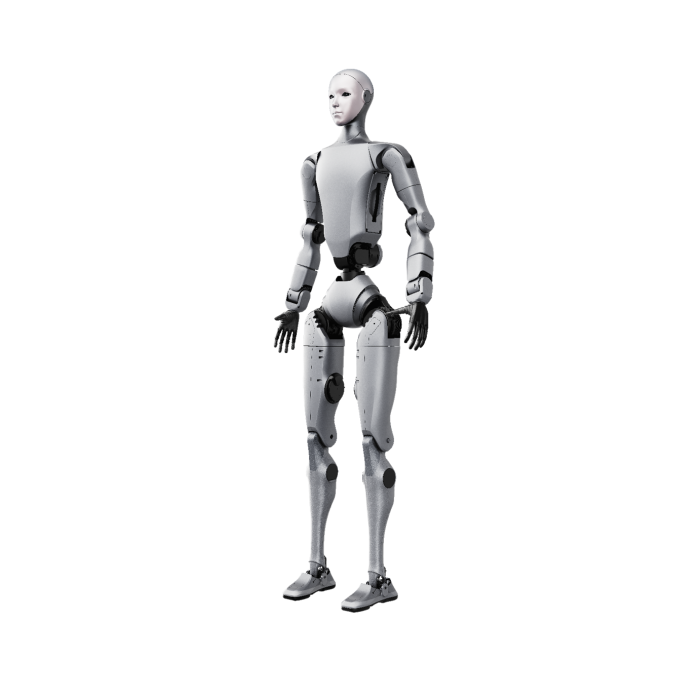
This machine is built on a deliberate contrast. Its body stands 1820 mm tall, weighs approximately 70 kg with its battery and drives its leg joints with up to 360 N.m of torque. The parts that define this configuration, however, are a pair of hands at 790 g each, carrying 17 tactile sensors apiece. The Unitree H2 EDU SMART I Humanoid Robot pairs full-size humanoid strength with the light touch of two five-finger Inspire RH56E2 hands, each fitted with a wrist-mounted RGB camera. A research team can therefore study force and finesse on a single platform rather than on two.
Robots Middle East supplies the Unitree H2 EDU SMART I to universities, research institutes, innovation centres and corporate laboratories across the Middle East. Robots Middle East prepares the quotation for the exact configuration, arranges delivery to your site and remains your point of contact for technical support once the robot is in service.
Background
Unitree Robotics and the H2 line
Unitree Robotics, based in Hangzhou, China, made its name with agile legged robots before turning its engineering to humanoids. The H2 is its full-size humanoid line, which the manufacturer describes as offering 31 degrees of freedom, 360N.m joint torque and precise dynamic movement replication. The line is sold as a sequence of versions: H2 BASIC, H2 EDU STANDARD, the lettered H2 EDU SMART configurations from A to I, and H2 Plus. The practical consequence for a buyer is that the body is chosen first and the equipment around it second. Within the EDU family, the letter after SMART identifies the hand package.
Tactile manipulation on a full-size body
The SMART I is the configuration Unitree labels Inspire E2 Tactile. Each Inspire RH56E2 hand offers 6 degrees of freedom and 17 tactile sensors, so contact is measured at the fingers rather than inferred from vision alone. A wrist-mounted RGB camera on each hand gives a close, moving view of the object being handled. This complements the body's wide-angle humanoid binocular camera, which surveys the wider scene. Behind these sensors sits a high-performance computing module of up to Jetson AGX Thor (2070 TOPS), giving room for perception and learning models to run on the robot itself.
Technical Specifications
| Specification | Value |
|---|---|
| Degrees of freedom (H2 series) | 31 |
| End effectors | 2 × five-finger tactile Inspire RH56E2 hands with wrist-mounted RGB cameras |
| Hand degrees of freedom | 6 DoF per hand |
| Hand weight | 790 g |
| Tactile sensors | 17 tactile sensors per hand |
| Standing dimensions | 1820 x 456 x 218 mm |
| Weight with battery | Approximately 70 kg |
| Maximum leg joint torque | 360 N.m |
| Maximum arm joint torque | 120 N.m |
| Maximum arm payload | Peak: ~15 kg; nominal: ~7 kg |
| High-performance computing module | Up to Jetson AGX Thor (2070 TOPS) |
| Vision sensor | Wide-angle humanoid binocular camera |
| Voice interaction | Array microphones + high-power speaker |
| Connectivity | Wi-Fi 6, Bluetooth 5.2 |
| Materials | Aerospace-grade aluminium + titanium alloy + high-strength engineering plastics |
| Intelligent OTA updates | Yes |
| Operating temperature | 0°C to 40°C (32°F to 104°F), not waterproof or dustproof |
Specifications are as published by the manufacturer and are confirmed against the datasheet at quotation.
The manufacturer has not published the maximum walking speed, the camera resolution, the charging time, the noise level or the hand grip force, nor whether a lidar is fitted; these points are confirmed at quotation.
What does the SMART I configuration add to the H2 EDU?
The figures that describe the body come from the H2 EDU specification: the standing dimensions, the weight with battery, the joint torques, the arm payload, the connectivity and the materials. What the letter I adds is a particular way of meeting the world. Two Inspire RH56E2 hands replace a simple gripping concept with five fingers, 6 degrees of freedom and 17 tactile sensors on each hand.
Tactile sensing changes the questions a laboratory can ask. A camera shows where an object is. Sensors in the fingers report when contact begins, how it is distributed across the hand and how it changes as the object moves. Combined with a wrist-mounted RGB camera that travels with each hand, this gives a researcher a close visual record and a contact record of the same grasp. That pairing suits work on dexterous manipulation, grasp stability and learning from touch.
The arms set the scale of what those hands can do. With a maximum arm joint torque of 120 N.m and an arm payload given as peak ~15 kg and nominal ~7 kg, the platform can move beyond fingertip experiments to handling tasks with real household and workshop objects. When you compare it with other lettered versions, examine the hand package first, because the body specification is shared across the H2 EDU family.
Can the Unitree H2 EDU SMART I operate in Middle Eastern conditions?
The operating temperature for the H2 EDU SMART versions is 0°C to 40°C (32°F to 104°F), and the robot is not waterproof or dustproof. In practice this places it in climate-controlled environments: university laboratories, research halls, innovation centres and indoor exhibition spaces. Outdoor summer operation in the Gulf or exposure to sand and dust falls outside what the manufacturer specifies. Plan the installation room, air conditioning and storage before delivery. Robots Middle East can discuss suitable site conditions as part of the quotation.
Who is the Unitree H2 EDU SMART I for?
The first audience is university robotics and artificial intelligence departments whose research centres on manipulation. For these groups the combination of tactile fingers, wrist cameras and a full-size body is the reason to choose this configuration over a simpler hand package. Graduate projects on grasp planning, in-hand manipulation and multimodal learning fit naturally here.
The second audience is embodied-intelligence teams in technology companies and national research programmes. Such teams collect demonstration data and train control policies, and onboard computing of up to Jetson AGX Thor (2070 TOPS) allows models to be tested on the robot rather than only in simulation.
A third group comprises industrial research and development units evaluating whether humanoids can take on handling work in logistics, manufacturing or services. A tactile-equipped platform lets them examine delicate and variable objects that defeat rigid grippers.
Innovation centres and science institutions may also value the array microphones and high-power speaker for public demonstrations of voice interaction alongside manipulation.
Teams whose work does not centre on touch-based manipulation should compare the other configurations in the Unitree H2 EDU range. These include the Unitree H2 EDU SMART A Humanoid Robot and the Unitree H2 EDU SMART B Humanoid Robot, and each lettered version carries its own hand package.
What is the Unitree H2 EDU SMART I used for?
- Dexterous manipulation research: studying how five-finger hands grasp, reposition and release objects of varied shape.
- Tactile learning: training models that use contact data from the sensors in each hand alongside camera images.
- Teleoperation and demonstration capture: recording human-guided tasks to build datasets for imitation learning.
- Humanoid locomotion and whole-body control: combining walking and balance with arm and hand tasks on a full-size body.
- Industrial handling trials: evaluating humanoid handling of delicate or irregular parts in controlled pilot settings.
- Education and public engagement: teaching robotics courses and demonstrating voice interaction and manipulation at exhibitions.
Pricing and Availability
The Unitree H2 EDU SMART I is supplied on quotation, because the final package depends on the configuration, the computing module and the support you require. Robots Middle East confirms the specification with you and prepares a formal offer for your organisation. Delivery, customs clearance and after-sales support are arranged together with the quotation. The request for a quotation is available on this page.
Frequently Asked Questions
Which hands does the Unitree H2 EDU SMART I use?
It uses two five-finger tactile Inspire RH56E2 hands, each with a wrist-mounted RGB camera. Each hand provides 6 degrees of freedom and 17 tactile sensors.
How large and heavy is the robot?
The H2 EDU stands at 1820 x 456 x 218 mm and weighs approximately 70 kg with its battery.
How much can its arms carry?
The maximum arm payload is given as peak ~15 kg and nominal ~7 kg, with a maximum arm joint torque of 120 N.m.
What computing power does it offer?
The H2 EDU accepts a high-performance computing module of up to Jetson AGX Thor (2070 TOPS). The exact module for your order is confirmed in the quotation.
Can it be used outdoors?
The operating temperature is 0°C to 40°C, and the robot is not waterproof or dustproof. It is therefore best suited to indoor, climate-controlled spaces.
Does the software receive updates?
Yes. The H2 EDU supports intelligent OTA updates, and it connects over Wi-Fi 6 and Bluetooth 5.2.
Where can I buy the Unitree H2 EDU SMART I Humanoid Robot and what does it cost?
You can buy it from Robots Middle East, which supplies it across the Middle East. The cost depends on the configuration and the services included, so Robots Middle East provides it in a formal quotation prepared for your project.
Summary
The Unitree H2 EDU SMART I resolves the contrast it begins with. A heavy, high-torque humanoid body carries the power for walking and lifting, while two tactile Inspire RH56E2 hands with wrist cameras supply the sensitivity that manipulation research demands. Onboard computing of up to Jetson AGX Thor (2070 TOPS) and a shared H2 EDU specification complete a platform designed for laboratories that want strength and touch in the same experiment. Robots Middle East quotes, delivers and supports it across the region. For any research group weighing a tactile humanoid, this page is the starting point.