
Unitree H2 EDU SMART J Humanoid Robot
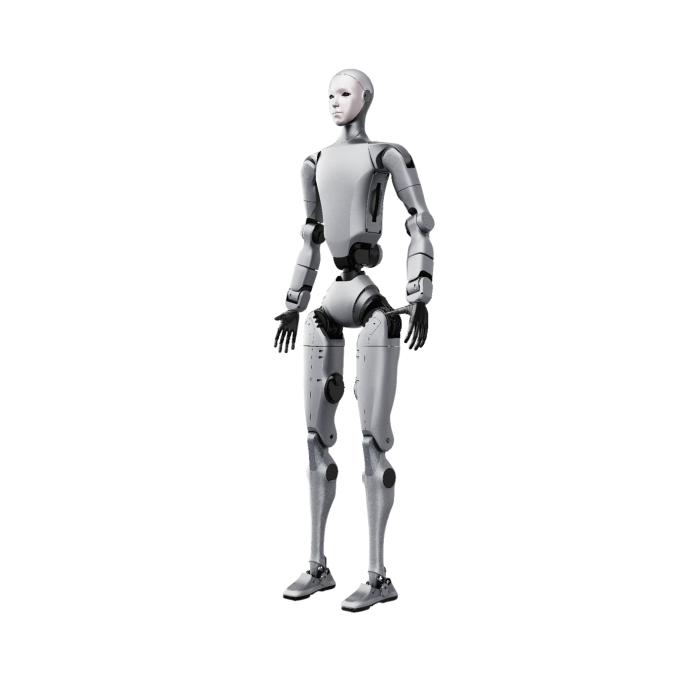
In stock
- BRAND:
- UNITREE ROBOTICS
- MODEL:
- H2-EDU-SMART-J
- PART #:
- H2-EDU-SMART-J
- ORIGIN:
- China
- Warranty:
- 12 MONTHS
- AVAILABILITY:
- SUBJECT TO AVAILABILITY
- SKU:
- Unitree-H2-EDU-SMART-J
Unitree H2 EDU SMART J Humanoid Robot
Inside a full-size humanoid, one question goes unasked until the first crash in the lab: whose code is running? On the Unitree H2 EDU SMART J Humanoid Robot the answer is built into the hardware. One computer keeps the platform standing and moving, a second belongs entirely to the developer, and a third slot is left open for whatever the project grows into. Add a pair of BrainCo Revo 3 U21 hands with cameras at the wrists, and you have a research humanoid built on a simple principle: the robot's own housekeeping and your experiments should never compete for the same processor.
Robots Middle East sells the Unitree H2 EDU SMART J Humanoid Robot and supplies it to universities, research institutes and corporate innovation teams throughout the Middle East. Our team prepares the quotation, arranges delivery to your site and provides support after handover. A laboratory in the region therefore deals with a single partner from the first enquiry to the first experiment, and has one point of contact whenever questions arise later in the project.
Background
Unitree Robotics and the H2 line
Unitree Robotics is a Chinese manufacturer that built its reputation on agile legged machines, first quadrupeds and then humanoids. It has become a familiar name in university laboratories and development teams around the world. The H2 is its full-size humanoid, built to human proportions, with 31 degrees of freedom across the legs, arms, waist and head. The EDU designation marks the versions intended for development and research. The lettered SMART configurations, which run from A to M, are packages built on that EDU body, and SMART J is the configuration described on this page.
What defines the SMART J configuration
Two choices set the SMART J apart: its hands and its computing layout. In place of simpler end effectors, it carries two BrainCo Revo 3 U21 hands, each a high-end direct-drive design with 21 degrees of freedom and an RGB camera mounted at the wrist. Behind the hands sits a three-computer arrangement. An Intel Core i5 machine (PC1) handles platform functions, an Intel Core i7 machine (PC2) is reserved for user development, and a third bay (PC3) is left empty in this version so that an Nvidia Jetson Thor can be added as an option. The result is a configuration built for teams whose research happens at the fingertips, while the robot's own control remains separate from their work.
Technical Specifications
| Specification | Value |
|---|---|
| End effectors (SMART J) | 2 × BrainCo Revo 3 U21 hands with wrist-mounted RGB cameras |
| Hand degrees of freedom and tactile sensing (SMART J) | 21 DoF per hand; no tactile feedback; high-end direct-drive hand |
| Base computing, PC1 (SMART J) | Intel Core i5 (platform functions) |
| Development computer, PC2 (SMART J) | Intel Core i7 (user development) |
| Optional compute slot, PC3 (SMART J) | Empty in this version; 1 Nvidia Jetson Thor can optionally be added |
| Standing dimensions (H2 EDU) | 1820 x 456 x 218 mm |
| Weight with battery (H2 EDU) | Approximately 70 kg |
| Body degrees of freedom (H2 EDU) | 31 total: 6 per leg, 7 per arm, 3 waist, 2 head |
| Maximum peak torque at leg joints (H2 EDU) | 360 N·m |
| Maximum peak torque at arm joints (H2 EDU) | 120 N·m |
| Battery (H2 EDU) | 15 Ah (0.972 kWh) |
| Battery life (H2 EDU) | Approximately 3 h |
| Vision sensor (H2 EDU) | Wide-angle humanoid binocular camera |
| Connectivity (H2 EDU) | Wi-Fi 6, Bluetooth 5.2 |
Specifications are as published by the manufacturer and are confirmed against the datasheet at quotation.
The manufacturer has not published the maximum walking speed, the IP rating, the weight of the SMART J hands, the sensing range of the wrist cameras, the operating temperature range, the charging time or SDK documentation specific to the SMART J; each of these is confirmed with you at quotation.
Why does the H2 EDU SMART J carry three computers?
A humanoid has to do two very different kinds of work at once. The first is to keep a body of approximately 70 kg balanced and responsive, with 31 joints under control at every moment. The second is whatever the research team actually wants to study: perception pipelines, grasp planning, learned policies, interaction experiments. Placing both on one machine invites trouble, because a heavy experimental workload can disturb the timing that the platform depends on.
The SMART J separates the two. PC1, with its Intel Core i5, is dedicated to platform functions. PC2, with its Intel Core i7, is the developer's own machine, where code can be written, deployed and revised without touching the layer that keeps the robot upright. PC3 is the forward-looking part of the design. It ships empty in this version, and you may choose to have one Nvidia Jetson Thor fitted there. For teams that expect to run demanding on-board models later, this means the robot does not have to be replaced when the workload grows; the decision can be made at the outset.
What do the BrainCo Revo 3 U21 hands bring to the robot?
The hands set this configuration apart from a walking demonstrator. Each BrainCo Revo 3 U21 offers 21 degrees of freedom in a high-end direct-drive design, which gives researchers a great deal of articulation to work with when studying how a humanoid grasps, holds and repositions objects. The RGB camera on each wrist gives the robot a close, hand-level view of what it is about to touch, alongside the wide-angle binocular camera in the head.
It is equally important to be clear about what the hands do not have: they offer no tactile feedback. For some projects this is a deliberate simplification, because the work concentrates on vision-guided manipulation and the wrist cameras supply the view at hand level. For projects whose central question depends on touch sensing, it is a limitation to weigh carefully, and our team will gladly go through it with you.
Who is the Unitree H2 EDU SMART J for?
The natural home of the SMART J is the university robotics laboratory with a focus on manipulation. Groups studying dexterous grasping, hand-eye coordination or learning from demonstration will find that the combination of highly articulated hands and wrist cameras gives them a substantial research instrument, and the dedicated development computer keeps their work cleanly separated from platform control.
Embodied AI teams form a second audience. Researchers who train policies off-board and want to deploy them on a full-size humanoid will value the Intel Core i7 development machine and the option of an Nvidia Jetson Thor in the PC3 slot. Corporate research and innovation departments in the region evaluating humanoids for future handling tasks are a third group, as are institutions that want a credible, human-scale platform for advanced teaching.
Not every project needs this particular combination of hands and computing. If your priorities lie elsewhere, compare the other lettered configurations in the Unitree H2 EDU range, such as the Unitree H2 EDU SMART A Humanoid Robot or the Unitree H2 EDU SMART B Humanoid Robot. Robots Middle East will help you choose the package that matches your research plan.
What is the Unitree H2 EDU SMART J used for?
- Dexterous manipulation research: studying how a humanoid with highly articulated hands grasps, holds and reorients objects.
- Vision-guided grasping: using the wrist-mounted RGB cameras to close the loop between what the hand sees and what it does.
- Learning from demonstration: collecting manipulation data on a human-scale body for imitation and reinforcement learning work.
- On-board AI deployment: running user models on the development computer, with optional Jetson Thor capacity for heavier workloads.
- Whole-body loco-manipulation: combining walking, waist and arm motion with hand tasks in experiments that involve the full body.
- Advanced teaching and demonstration: giving postgraduate students hands-on experience with a full-size research humanoid.
Pricing and Availability
Robots Middle East prepares each quotation for the exact configuration you require, including whether the PC3 slot is to be fitted with an Nvidia Jetson Thor and which documentation your team needs. Delivery, customs clearance and after-sales support are arranged together with the quotation, so that you receive a complete proposal rather than a list of loose ends. To begin, please send us your requirements using the quotation request available on this page.
Frequently Asked Questions
What hands does the Unitree H2 EDU SMART J use?
It carries two BrainCo Revo 3 U21 hands, each with 21 degrees of freedom, a high-end direct-drive design and an RGB camera mounted at the wrist.
Do the hands provide tactile feedback?
No, the SMART J hands have no tactile feedback. If touch sensing is central to your research, please raise it with our team.
What computers are installed in the robot?
PC1 is an Intel Core i5 machine for platform functions and PC2 is an Intel Core i7 machine for user development. The PC3 slot is empty in this version.
Can more computing power be added?
Yes, one Nvidia Jetson Thor can optionally be fitted in the PC3 slot, which ships empty in this version.
How long does the battery last?
The H2 EDU platform runs for approximately 3 h on its 15 Ah (0.972 kWh) battery.
How large and heavy is the robot?
The H2 EDU platform stands 1820 x 456 x 218 mm and weighs approximately 70 kg with its battery, so it should be handled and housed as a full-size humanoid.
Where can I buy the Unitree H2 EDU SMART J Humanoid Robot and what does it cost?
You can buy it from Robots Middle East, which supplies it across the Middle East. The cost depends on the configuration and options you select, so we provide it in a tailored quotation that also covers delivery, customs and support.
Summary
The Unitree H2 EDU SMART J answers the question of whose code is running with clarity. The platform keeps its own computer, the developer keeps another, and a third slot waits for the day the project needs more. Around that architecture sit a full-size H2 EDU body with 31 degrees of freedom and two BrainCo Revo 3 U21 hands with wrist cameras, a combination aimed squarely at manipulation and embodied AI research. Its absence of tactile feedback is worth weighing against your research plan, and Robots Middle East will work through it with you. For a laboratory in the region ready to put a dexterous humanoid to work, this page is the starting point.