Keenon DINERBOT T10 Delivery & Marketing Expert Robot

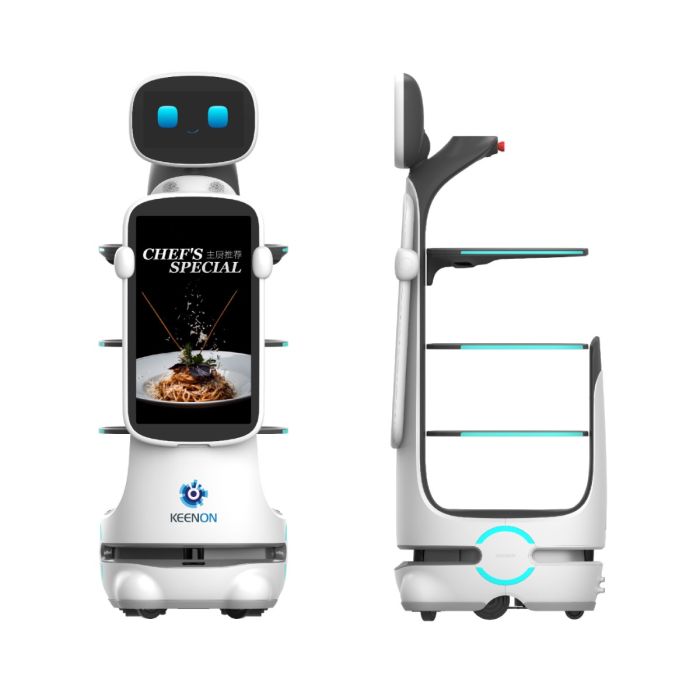
The Keenon DINERBOT T10 is a commercial autonomous delivery robot developed by KEENON Robotics Co., Ltd. and officially described by the company as its "Delivery and Marketing Expert," a positioning that reflects its dual commercial function: automating food and beverage delivery in restaurant, hotel, and commercial venues while simultaneously serving as an in-venue advertising and customer engagement platform through a 23.8-inch advertising display screen and movable interactive head.

In stock

BRAND:
KEENON
MODEL:
T10
ORIGIN:
الصين
AVAILABILITY:
SUBJECT TO AVAILABILITY
SKU:
KEENON-T10
٩٬٩٩٥٫٠٠ US$
Loading...

Keenon DINERBOT T10: The Delivery and Marketing Expert Robot

The T10 builds on KEENON's established DINERBOT platform heritage, specifically the T9 Pro's multi-environment navigation capability, and extends it with a substantially richer interaction and advertising system. Where the T9 and T9 Pro focus on efficient delivery as the primary value proposition, the T10 integrates four distinct capabilities described in Keenon's engineering documentation as "efficient delivery," "comprehensive sensor detection," "multi-modal interaction," and "effective advertising." These four pillars give the T10 a commercial value argument that extends beyond labor cost substitution into revenue generation and customer experience enhancement.

The T10's Design Philosophy: Four Pillars of Commercial Value

Engineering.com's coverage of the T10's World Robot Conference debut reported on Keenon's official framework directly: "Tang Xuanlai, DINERBOT T10 seamlessly integrates four major features: 'efficient delivery,' 'comprehensive sensor detection,' 'multi-modal interaction,' and 'effective advertising.'" This four-pillar framing reflects a product design philosophy where the T10 is not simply a better delivery robot but a qualitatively different commercial asset that serves purposes beyond transport automation.

Pillar One: Efficient Delivery

Delivery efficiency in the T10 rests on a 40-kilogram load capacity across its multi-tier tray system, a 59-centimeter minimum passage width enabling navigation through the narrow aisles of many restaurant and hotel floor plans, and the open-design large-capacity tray layout with plate detection for automatic meal retrieval confirmation. The elevated chassis ensures liquid stability across floor surface transitions, a critical operational requirement for beverage delivery. Vehicle-grade independent suspension from CAE simulation absorbs vibration that would otherwise risk spilling soups, beverages, and sauces during transit.

Pillar Two: Comprehensive Sensor Detection

The T10's sensor system represents a meaningful upgrade from the standard T9 configuration. The package includes five stereo vision sensors providing 300-degree 3D detection, four RGB cameras for ultra-wide and clear visual coverage, LiDAR for precise mapping and positioning, and VSLAM (Visual Simultaneous Localization and Mapping) for complementary visual-inertial positioning in environments where LiDAR may have limitations. ProServBots.com's detailed listing confirms the full sensing specification: "Four Stereo Vision Sensors, LiDAR, VSLAM Navigation, Range 300° 3D Detection."

This multi-modal sensing suite adapts to complex lighting conditions across the range of restaurant and hotel environments, from the bright open environments of cafeterias to the low ambient lighting of fine dining establishments. The fusion of LiDAR, stereo vision, and RGB cameras handles the complete range of obstacle types that indoor service environments present.

Pillar Three: Multi-Modal Interaction

The T10's movable head, which allows the robot to turn and orient its face toward nearby people during interaction, combined with the 23.8-inch advertising screen and 11.6-inch touch screen (at 1920×1080 resolution), creates an interaction profile substantially richer than fixed-screen delivery robots. The head's adaptive movements respond to contextual cues: the robot can turn toward a nearby person who touches it or calls out to it, physically orienting its attention display in the direction of the interaction.

The multi-modal interaction combines voice recognition for verbal commands and questions, touch interface through the touchscreen for menu navigation and feedback, and visual processing through the camera system for customer recognition and tray collection detection. When a customer approaches the robot to collect their food, the T10 visually detects the collection event through tray sensors and guidance systems rather than requiring a button press or verbal confirmation, streamlining the delivery completion process in crowded restaurant environments where getting a customer's attention for confirmation can be awkward.

Voice interaction is supported alongside configurable expressions, animated skin overlays, and optional head accessories that allow the robot to be customized for specific venue identities, seasonal themes, or character concepts. This customization depth enables restaurant operators to create robot-based mascot characters that reinforce their brand identity through the delivery platform.

Pillar Four: Effective Advertising

The 23.8-inch advertising screen with cloud-based advertising operating system is the T10's most commercially distinctive feature and the element that most directly distinguishes it from the T9 and most competing restaurant delivery robots. The screen supports custom image and video playback managed through Keenon's cloud advertising system, enabling restaurant operators to schedule and update promotional content remotely without requiring physical access to the robot.

The advertising content plays throughout the robot's service shifts as it navigates the dining room, creating what is effectively a mobile advertising display with a predictably high impression rate in a venue where every guest sees the robot multiple times during a meal. For restaurant groups that sell co-promotional placement to food and beverage brands, or for venue operators who want to promote their own seasonal menus, events, and loyalty programs, this advertising capability creates a revenue or marketing attribution argument beyond the labor cost substitution that defines the T9's economic case.


Physical Dimensions and Design

Body Dimensions

The T10's physical dimensions are confirmed across multiple distributor specifications as 48.6 by 55.5 by 139.9 centimeters (approximately 19.1 by 21.9 by 55.1 inches). This makes the T10 the tallest member of the standard DINERBOT lineup, reflecting the added height of the movable head mechanism mounted above the tray stack. The 139.9-centimeter height positions the advertising screen at approximately eye level for a standing adult, maximizing the visual impact of the screen's promotional content.

Tray System

The default top tray measures 48.6 by 41.6 centimeters (approximately 19.1 by 16.4 inches), with a smaller bottom tray at 35 by 28.6 centimeters (approximately 13.8 by 11.3 inches). The open-access tray design, a design decision shared with several other DINERBOT models, allows customers to collect their items from any approach angle rather than requiring them to stand directly in front of the robot. LED tray indicators illuminate the relevant tray level when an order is ready for collection, providing clear visual guidance for customers in busy restaurant environments where multiple tables may be receiving simultaneous deliveries.

The Movable Head System

The T10's movable head is one of its most visually distinctive physical characteristics. Unlike the fixed-screen configurations of competing restaurant delivery robots, the T10's head rotates and tilts in response to interaction cues, creating an impression of physical attentiveness that fixed-display systems cannot replicate. The head integrates the 23.8-inch advertising screen on its forward face, making the screen's orientation dynamic with the head's movement rather than fixed in a single direction.

Optional head accessories and skin themes allow operators to customize the robot's appearance. Keenon's marketing materials for the T10 show examples including novelty headwear, character skins, and seasonal decorative elements, which are relevant for restaurants with theme concepts, holiday promotions, or branded mascot programs that they want the robot to embody visually.


Technology and Specifications

Navigation: LiDAR and VSLAM Fusion

The T10 uses a fusion of LiDAR and VSLAM (Visual Simultaneous Localization and Mapping) for positioning and navigation. LiDAR provides precise distance measurement in all directions, enabling the construction of a detailed geometric map of the operating environment and accurate real-time positioning against that map. VSLAM supplements LiDAR with visual-inertial positioning using the camera system's visual features, providing positioning continuity in areas where LiDAR reflectivity is low (mirrored surfaces, glass partitions) or where visual landmarks provide additional disambiguation.

This dual navigation approach is more robust to the challenging optical environments common in restaurants than single-modality navigation systems, where mirrored back bars, glass wine walls, and highly polished floor surfaces can degrade LiDAR positioning reliability.

Multi-Robot Dispatching: 20-Robot Fleet Capability

Keenon's official press release for the T10 Japan launch confirms a specific fleet scale capability: the company's "self-developed and fully autonomous position and navigation system, coupled with highly sensitive perception and obstacle avoidance technologies, enabling adaptability in complex real-world scenarios with up to 20 robots operating together efficiently." This 20-robot fleet capability is directly relevant for large venues including airport terminals, large hotel properties, corporate campus dining facilities, and hospital food service operations where a single-robot deployment would be insufficient for coverage requirements.

Cloud Advertising Operating System

The cloud-based advertising operating system included with the T10 provides remote management of the advertising screen content without requiring physical access to the robot. Operators create and schedule content campaigns through the cloud platform, pushing updated promotional materials, seasonal menus, event announcements, and third-party advertising to all deployed T10 units simultaneously. This remote management capability is operationally significant for multi-location restaurant groups or hotel brands where central marketing teams want to coordinate promotional messaging across properties without coordinating with each property's local technology staff.

Speed and Battery

Maximum moving speed is 1 meter per second (3.28 feet per second), confirmed across multiple distributor specifications. Battery performance specifications are consistent with the DINERBOT series standard, providing operational endurance sufficient for extended service shifts. Smart charging enables the robot to return to its charging station automatically during low-activity periods.


Applications and Use Cases

Upscale Restaurant and Fine Dining

The T10's design quality, confirmed by the iF Design Award, makes it appropriate for deployment in higher-end dining environments where the robot's visual presence contributes to the venue's aesthetic identity rather than conflicting with it. The movable head, dynamic expression capabilities, and customizable skin and headwear options allow fine dining operators to configure the robot as a design element rather than a purely functional piece of equipment.

The advertising screen's ability to display video content, including chef profiles, ingredient origin stories, seasonal menu narratives, and brand content, creates an interactive storytelling opportunity that sophisticated diners in higher-end restaurants may engage with more positively than the promotional content that dominates simpler screen displays.

Hotel Food and Beverage Service

Hotel food and beverage operations span room service, restaurant service, banquet and event catering, and lobby bar service, all of which involve different physical environments and service flows. The T10's multi-environment capability and multi-floor navigation through elevator integration make it adaptable across this variety of hotel F&B contexts, while the advertising screen provides a platform for hotel marketing content including spa promotions, room upgrade offers, and loyalty program messaging that hotel marketing teams can manage centrally.

Airports, Shopping Centers, and Large Commercial Venues

Keenon's official deployment context list includes airports, shopping malls, banks, libraries, and office buildings alongside the expected restaurants and hotels. The T10's advertising capability is particularly relevant in high-traffic retail and commercial settings where advertising impression value is measurable and where third-party brand advertising could generate direct revenue.

An airport food and beverage concession deploying several T10 units could theoretically negotiate advertising revenue from terminal retailers, airlines, or travel brands whose promotional content runs on the T10's screens throughout service hours, partially offsetting robot acquisition and operating costs through advertising income.

Corporate Dining and Campus Cafeterias

Corporate dining facilities increasingly serve as brand environments for companies that want their offices and campuses to reflect specific values and culture. The T10's customizability, including branded skin themes and content display capability, enables companies to configure their cafeteria robots as branded assets that reinforce corporate identity. Microsoft, Google, and other large technology companies that operate significant campus dining programs represent examples of corporate buyers where this brand expression capability adds value beyond labor efficiency.


Advantages and Benefits

iF Design Award recognition: The independent design award from one of the world's most respected industrial design recognition programs validates the T10's design quality from a source independent of Keenon's own marketing claims.

23.8-inch cloud-managed advertising screen creates marketing ROI: The advertising revenue or marketing attribution potential from the T10's screen changes the ROI calculation structure from pure labor substitution to a hybrid model that may justify the premium over the T9.

Five stereo vision sensors plus four RGB cameras for 300-degree 3D detection: The T10's sensor density exceeds the T9's 3D perception system, providing more reliable obstacle detection in complex environments with glass, mirrors, low-profile obstacles, and variable lighting conditions.

20-robot fleet capability documented in official specifications: The confirmed 20-robot fleet capability for coordinated operation positions the T10 for deployment in the largest commercial venues where competitor products have not documented equivalent fleet scale.

Movable head creates dynamic interaction presence: The physically orienting head creates a qualitative interaction experience difference from fixed-screen alternatives, producing a more attentive and engaging robot presence in customer-facing environments.


Summary

The Keenon DINERBOT T10 occupies a specific and well-defined commercial position within the autonomous restaurant delivery robot market: it is the platform for operators who need both reliable delivery automation and a commercial marketing asset in a single robot. Its 23.8-inch cloud-managed advertising screen, movable interaction head, five stereo vision sensors with 300-degree 3D detection, 40-kilogram payload, 59-centimeter passage navigation, up to 20-unit fleet coordination capability, and iF Design Award recognition collectively establish a product that justifies its USD $23,000 price premium over simpler delivery robots through expanded commercial value rather than incremental delivery performance. For restaurant groups, hotel chains, airport concessionaires, and corporate dining operators who want a robot that simultaneously reduces labor, enhances customer engagement, and generates or supports marketing objectives, the DINERBOT T10 is the most fully specified commercial delivery and marketing robot platform currently available from an internationally established manufacturer.

Frequently Asked Questions (FAQ)

What is the Keenon DINERBOT T10?

The Keenon DINERBOT T10 is an autonomous commercial delivery robot developed by KEENON Robotics Co., Ltd. and described by the company as its "Delivery and Marketing Expert." It delivers food, beverages, and supplies autonomously in restaurants, hotels, airports, and other commercial venues, while simultaneously serving as an in-venue advertising platform through its 23.8-inch cloud-managed advertising screen and movable interactive head. It features 5 stereo vision sensors, 4 RGB cameras, LiDAR + VSLAM navigation, a 40-kilogram payload, 59-centimeter minimum passage width, and support for up to 20-robot fleet coordination. US price: USD $23,000 at ProServBots.com.

How does the Keenon T10's advertising screen work?

The T10's 23.8-inch advertising screen is managed through Keenon's cloud-based advertising operating system, which allows operators to remotely create, schedule, and push promotional content to all deployed T10 units without requiring physical access to the robot. The screen plays custom image and video content during the robot's delivery service shifts, generating advertising impressions with every diner who sees the robot navigate the restaurant. Content can include seasonal menus, promotional offers, event announcements, loyalty program messaging, or third-party brand advertising. The cloud management system enables central marketing teams to update content across multiple deployed units or locations simultaneously, making it practical for restaurant groups and hotel brands with multiple properties.

Why would a restaurant choose the DINERBOT T10 over the cheaper DINERBOT T9?

The T9 starts at USD $9,800 versus USD $23,000 for the T10, making the choice a function of whether the additional features justify the price difference for a specific operation. The T10 adds: a 23.8-inch advertising screen with cloud-based content management (no equivalent on T9); a movable head providing dynamic interaction orientation (T9 uses a fixed interface); a denser sensor system with 5 stereo vision sensors and 4 RGB cameras for 300-degree coverage (T9 uses a less dense array); and a design recognized by the iF Design Award. Operators whose primary requirement is cost-efficient delivery should choose the T9. Operators who want delivery automation alongside in-venue marketing capability, premium interaction quality, and a documented higher-end visual presence should evaluate the T10's total cost against the additional value its features provide.

What venues can use the Keenon DINERBOT T10?

Keenon documents the T10's appropriate deployment contexts as: restaurants, hotels, KTV (karaoke) venues, shopping malls, airports, banks, libraries, office buildings, hospitals, and factories. The common thread across these venues is that they are indoor environments with predictable floor surfaces, moderate aisle widths of 59 centimeters or more, and either food and beverage service requirements or material delivery needs. The advertising screen is most commercially relevant in venues with high customer dwell time (restaurants, hotel lounges, KTV) or high foot traffic (airports, shopping malls) where advertising impression volume is highest and where third-party advertising revenue is most plausible.

Specifications

meter / second
Max Speed
kg
Payload
up to hours
Runtime

General

BRAND KEENON
MODEL T10
ROBOT TYPE AUTONOMOUS MOBILE ROBOTS (AMRs)
ROBOT USE HOTEL, RESTAURANT

Dimensions

HEIGHT 139.9 cm
LENGTH 48.6 cm
WIDTH 55.5 cm
WEIGHT 58 kg (128 lbs)

Robotics

MAXIMUM SPEED 1 METER / SECOND
MAXIMUM PAYLOAD 40 kg
SLOPE ANGLE 5 DEGREES

Battery + Power

RUNTIME UP TO 12 HOURS

Product Questions

Your Question:
Write a Review
You're reviewing: Keenon DINERBOT T10 Delivery & Marketing Expert Robot
loader
Loading...

You submitted your review for moderation.