
Agilex LIMO PRO
In stock
- BRAND:
- AGILEX
- PART #:
- LIMO PRO
- ORIGIN:
- China
- AVAILABILITY:
- SUBJECT TO AVAILABILITY
- SKU:
- AgileX-LIMO-PRO
Agilex LIMO PRO
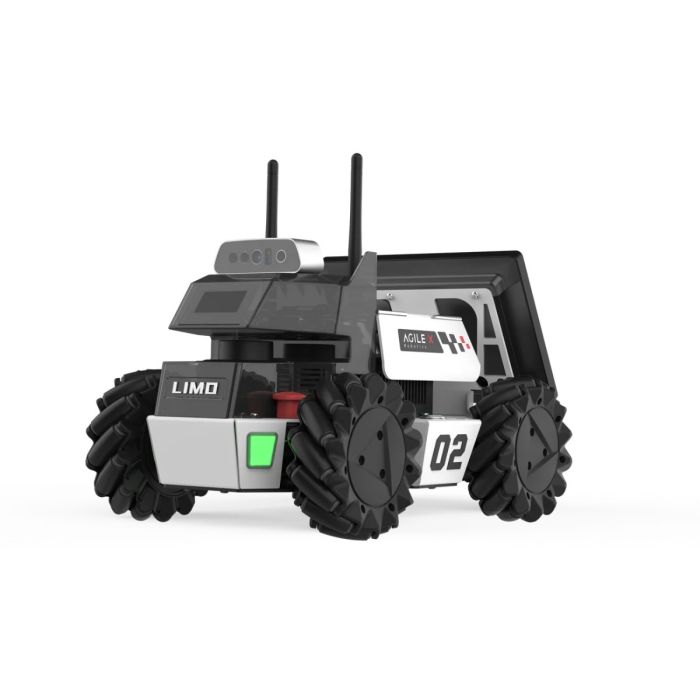
A typical university laboratory session lasts an afternoon, not a weekend, so the robot on the bench must be ready when the students arrive and still working when they leave. The Agilex LIMO PRO is sized for that timetable. It is a compact ROS mobile robot with an NVIDIA Jetson Orin Nano, an EAI T-mini Pro LiDAR and an Orbbec Dabai depth camera already on board, a 10000mAh battery behind a 2.5 h runtime, and a chassis small enough to carry between rooms. A group can spend the session writing and testing navigation code instead of wiring sensors to a computer.
Robots Middle East sells and supplies the Agilex LIMO PRO to universities, schools, research centres and engineering teams across the Middle East. Robots Middle East prepares each quotation, arranges delivery to the customer's site and supports the robot after it arrives, so a department deals with one regional partner from first enquiry to the first autonomous run.
Background
AgileX and the LIMO series
AgileX builds mobile robot platforms for research, education and industrial development. Its range runs from compact teaching robots to larger field chassis and manipulation kits, all of which can be browsed in the AgileX category. The LIMO series is the smallest member of that family. It is designed so that the robotics concepts taught in lectures, including mapping, localisation, path planning and perception, can be tried on real hardware at desk scale. The series comprises three versions: LIMO, LIMO PRO and LIMO ROS2. This page covers the LIMO PRO alone, and every figure below belongs to that version.
An edge-AI computer at the centre
The LIMO PRO is built around the NVIDIA Jetson Orin Nano, an embedded module that brings GPU-accelerated computing to small robots. On this platform the module pairs a 6-core Arm Cortex-A78AE CPU with a GPU of 1024 CUDA cores. That gives the robot room to run perception workloads, such as processing depth images or running vision models, on the robot itself rather than streaming data to an external workstation. The computer is integrated with the EAI T-mini Pro LiDAR, the Orbbec Dabai depth camera and an HI226 inertial measurement unit. The combination delivers robust environmental perception for autonomous navigation, obstacle avoidance and visual recognition applications.
Technical Specifications
| Specification | Value |
|---|---|
| Onboard computer | NVIDIA Jetson Orin Nano |
| CPU | 6-core Arm Cortex-A78AE |
| GPU | 1024 CUDA cores |
| LiDAR | EAI T-mini Pro |
| Depth camera | Orbbec Dabai |
| IMU | HI226 |
| Dimensions | 322 × 220 × 251 mm |
| Weight | 4.8 kg |
| Payload | 4 kg |
| Maximum speed | 1 m/s |
| Minimum ground clearance | 24 mm |
| Steering mode | Four-Wheel Differential Steering Mode |
| Battery capacity | 10000mAh |
| Runtime | 2.5 h |
| Standby time | 4 h |
| Operating temperature | -10 °C to +40 °C |
| Connectivity | Wi-Fi, Bluetooth |
| ROS compatibility | ROS1 Noetic and ROS2 Foxy |
| Software support | ROS and Gazebo; Python and C++ |
| Package contents | 1 LIMO Pro mobile robot, 1 battery, 1 charger, 4 Mecanum wheels, 2 tracks, mounting accessories and hardware |
Specifications as published by the manufacturer; they are confirmed against the datasheet at quotation.
The manufacturer has not published the IP rating, the maximum climbing angle, the charging time, the RAM and storage capacity or the motor power rating; Robots Middle East confirms these at quotation.
What does the LIMO PRO bring to a robotics programme?
The LIMO PRO's main contribution is integration. Many teaching and research robots arrive as a chassis that the customer must fit with a computer, a LiDAR and a camera, then calibrate and connect before any useful work can start. The LIMO PRO is supplied with the computing unit and the sensors in place. A programme can therefore begin with the subject it actually teaches, whether that is SLAM, motion planning or computer vision, rather than with an integration exercise.
The choice of the Jetson Orin Nano is important for perception work. Its 1024 CUDA cores let students and researchers run GPU-accelerated vision on the robot, so depth data from the Orbbec Dabai camera and scans from the EAI T-mini Pro LiDAR can be processed where they are captured. The HI226 IMU adds inertial data for sensor fusion, which is the usual starting point for reliable localisation.
Endurance is the second strength. The battery capacity has been increased to 10000mAh, which greatly enhances power and operational stability. On the LIMO PRO this translates into a 2.5 h runtime and a 4 h standby time, enough for a full practical session or a sustained test run without a mid-session battery change. At 4.8 kg and 322 × 220 × 251 mm, the robot is easy to lift onto a table, move between laboratories or store in a cabinet. Its 4 kg payload leaves room for additional sensors or experimental fittings.
The package also includes 4 Mecanum wheels and 2 tracks alongside the mounting accessories and hardware. This gives a department alternative running gear to experiment with beyond the robot's Four-Wheel Differential Steering Mode, which makes driving on any surface easy.
Which software can I run on the Agilex LIMO PRO?
The LIMO PRO is compatible with ROS1 Noetic and ROS2 Foxy. A laboratory can keep existing ROS1 material for established courses while moving new projects to ROS2. The platform supports ROS and Gazebo, so algorithms can be developed and tested in simulation before they run on the physical robot. It works with mainstream programming languages, including Python and C++. Python suits introductory teaching and rapid experimentation, while C++ suits performance-sensitive research code. With Wi-Fi and Bluetooth on board, the robot can be monitored and commanded from a workstation during a session, and several robots can share one laboratory network.
LIMO comes with a specially designed simulation table, which gives practical sessions a defined course to map and navigate. The Robots Middle East quotation lists exactly what each LIMO PRO order contains.
Who is the Agilex LIMO PRO for?
Universities are the most natural buyers. Departments of mechanical, electrical and computer engineering need a platform that carries a complete autonomy stack and can be shared between student groups term after term. The LIMO PRO's compact footprint and integrated sensors suit practical courses in robotics, control and artificial intelligence, as well as final-year and postgraduate projects.
Research groups working on SLAM, sensor fusion or embedded vision will value the onboard Jetson Orin Nano. It lets them evaluate algorithms on realistic embedded hardware rather than on a desktop GPU. Technical schools and STEM programmes that are building their first robotics laboratory gain a platform their students can grow into, starting in Python and moving on to ROS2 and C++. Corporate innovation teams and start-ups can use the LIMO PRO to prototype navigation or perception concepts at small scale before committing to larger hardware.
The series also includes LIMO and LIMO ROS2, and Robots Middle East advises on which version best fits a given programme. Larger AgileX platforms are listed in the AgileX category.
What is the Agilex LIMO PRO used for?
- Autonomous navigation: building maps and planning paths through rooms and corridors with LiDAR and depth data.
- Obstacle avoidance: detecting and steering around static and moving obstacles in real time.
- Visual recognition: running vision models on the Jetson Orin Nano to identify objects, markers or people.
- SLAM teaching: demonstrating simultaneous localisation and mapping in practical sessions on real hardware.
- Simulation-to-hardware workflows: validating algorithms in Gazebo before deploying them on the robot through ROS.
- Sensor fusion research: combining LiDAR, depth camera and HI226 IMU data for more reliable localisation.
Pricing and Availability
Robots Middle East supplies the Agilex LIMO PRO on quotation. Each offer is prepared for the specific institution, quantity and configuration, so a laboratory equipping several workstations receives a proposal that reflects its programme. Delivery, customs and support are arranged with the quotation. A tailored quotation for the Agilex LIMO PRO is available on this page.
Frequently Asked Questions
Which computer does the Agilex LIMO PRO use?
The LIMO PRO uses an NVIDIA Jetson Orin Nano with a 6-core Arm Cortex-A78AE CPU and a GPU of 1024 CUDA cores. This lets GPU-accelerated perception run on the robot itself.
Which sensors are fitted to the robot?
The robot carries an EAI T-mini Pro LiDAR, an Orbbec Dabai depth camera and an HI226 IMU. Together they support autonomous navigation, obstacle avoidance and visual recognition.
Does the LIMO PRO support ROS2?
Yes. It is compatible with ROS1 Noetic and ROS2 Foxy, and it supports Gazebo simulation with programming in Python and C++.
How long does the robot run on one charge?
The 10000mAh battery gives a runtime of 2.5 h and a standby time of 4 h, enough for a full practical session.
Can the Agilex LIMO PRO operate in a warm climate?
Its operating temperature range is -10 °C to +40 °C, which suits indoor laboratories and teaching spaces. Robots Middle East advises on use in any other environment before ordering.
What is included in the package?
The package contains 1 LIMO Pro mobile robot, 1 battery, 1 charger, 4 Mecanum wheels, 2 tracks, and mounting accessories and hardware.
Where can I buy the Agilex LIMO PRO and what does it cost?
Robots Middle East sells the Agilex LIMO PRO across the Middle East and prices it on quotation according to quantity and configuration. Requesting a quotation on this page is the quickest route to a firm offer.
Summary
A robot for teaching and research earns its place by being ready for the session and lasting through it. The Agilex LIMO PRO meets that test with a Jetson Orin Nano, an EAI T-mini Pro LiDAR, an Orbbec Dabai depth camera and an HI226 IMU integrated on a 4.8 kg chassis. Its 10000mAh battery delivers a 2.5 h runtime, and it supports ROS1 Noetic, ROS2 Foxy, Gazebo, Python and C++. Students reach working autonomy sooner, and researchers test their code on realistic embedded hardware. Robots Middle East quotes, delivers and supports it throughout the region. For any department planning its next robotics laboratory, this page is the starting point.