
Agilex Ranger Mini 3
In stock
- BRAND:
- AGILEX
- PART #:
- RANGER MINI 3
- ORIGIN:
- China
- AVAILABILITY:
- SUBJECT TO AVAILABILITY
- SKU:
- AgileX-RANGER-MINI-3
Agilex Ranger Mini 3
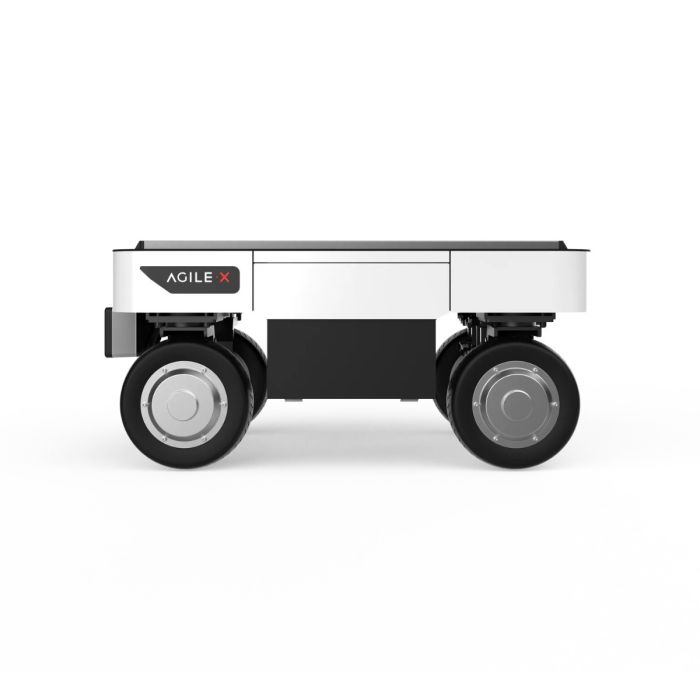
Many automation projects reach a moment the planning documents rarely mention. The robot arrives at the edge of the polished floor, the roller door lifts, and ahead lies a ramp, a gravel yard or a cracked service road. Plenty of platforms perform well on one side of that threshold and hesitate on the other. The Agilex Ranger Mini 3 is a small omnidirectional mobile robot designed specifically for industrial applications, and it is built to cross that line. It brings a four-wheel independent suspension for uneven ground, an omnidirectional base for tight aisles, and the mounting and software provisions an engineering team needs to make the platform its own.
Robots Middle East supplies the Agilex Ranger Mini 3 to companies, research institutions and system integrators across the Middle East. We prepare each quotation for the configuration you require and arrange delivery to your site. We also remain your point of contact for technical support once the platform is in service, so your project team deals with one accountable partner from the first enquiry to deployment.
Background
AgileX and its family of mobile platforms
AgileX builds mobile robot chassis that serve as foundations rather than finished applications. Each platform is a base on which customers mount their own sensors, computers and tools, and the development work then takes place on top of it. The Scout and Hunter series are two of the established families in this range, and the Ranger Mini line draws deliberately on both. The Ranger Mini 3 follows an earlier generation, the Ranger Mini 2.0, which is still named by some resellers. When you compare listings, please make sure that any figure you read belongs to the Ranger Mini 3.0 and not to its predecessor. You can find the wider range in the AgileX category.
Between agility and robustness
AgileX positions the Ranger Mini as a combination of the agility of the Scout series and the robustness of the Hunter series. The aim is flexibility and performance in both indoor and outdoor environments. In practice, this addresses a familiar compromise in mobile robotics. A chassis tuned for manoeuvring in confined spaces often struggles on broken ground, while a chassis built for rough terrain can feel cumbersome between shelving and workstations. The Ranger Mini 3 answers this with an omnidirectional drive base carried on four-wheel independent suspension. Each wheel can follow the ground beneath it, which supports manoeuvrability, passability and safety on terrain with slopes exceeding 15°.
Technical Specifications
| Specification | Value |
|---|---|
| Robot type | Small omnidirectional mobile robot |
| Intended use | Industrial applications, indoor and outdoor |
| Dimensions | 720mm×500mm×345mm |
| Weight | 75 kg |
| Ground clearance | 105 mm |
| Load capacity | 120 kg |
| Terrain | Manoeuvrability and safety on slopes exceeding 15° |
| Suspension | Four-wheel independent suspension |
| Battery | 48V24AH |
| Battery replacement | Hot-swapping in a running system |
| Maximum mileage | 35 km |
| Protection level | IP54 |
| Communication interface | Standard CAN (CAN bus protocol) |
| Software | Open-source SDK and software resources |
| Mounting | Aluminium T-slot rails for external sensors or kits |
Specifications are as published by the manufacturer and are confirmed against the datasheet at quotation. The manufacturer has not published an exact payload rating beyond the stated load capacity, the runtime, the operating temperature range, the charging time or the package contents, and its own product page does not give the weight; we confirm all of these at quotation.
What makes the Agilex Ranger Mini 3 different from the Scout and Hunter series?
The difference lies in the balance it strikes rather than in any single extreme. The Scout series is associated with agility and the Hunter series with robustness. AgileX describes the Ranger Mini as uniting the two, so that one platform can serve both an indoor workshop and an outdoor site. Several engineering choices support this. The four-wheel independent suspension lets the chassis keep its wheels in contact with uneven surfaces. The ground clearance of 105 mm and the IP54 protection level suit environments that are dusty or exposed to splashing water. The omnidirectional base allows precise positioning where space is limited.
The Ranger Mini 3 also stands apart in how it treats the time between missions. Hot-swapping lets an operator replace the battery while the system keeps running, so a mission does not have to end for a pack change. Maintenance becomes simpler, and the robot does not have to be shut down and restarted each time energy runs low. For a team that relies on a robot through a long shift, this changes the rhythm of operations as much as any drive specification does.
How easily can the Agilex Ranger Mini 3 be integrated into an existing system?
Integration is where many mobile robot projects lose time, and the Ranger Mini 3 addresses it on two levels. Mechanically, aluminium T-slot rails give secure mounting points for external sensors or complete kits. A lidar, a camera mast, a compute enclosure or a manipulator can therefore be fixed without custom brackets drilled into the chassis. Electrically and in software, the robot communicates over the CAN bus protocol through a standard CAN interface, a robust and widely understood standard in industrial and vehicle electronics. AgileX also provides an open-source SDK and software resources for expanded capabilities, so developers can work from documented foundations rather than reverse-engineering the drive system.
For integrators, this means the chassis behaves as a component rather than a closed product. You can design the autonomy stack, the payload and the user interface to suit the application, and leave the work of moving reliably across mixed terrain to the Ranger Mini 3.
Who is the Agilex Ranger Mini 3 for?
The first group is system integrators who deliver complete robotic solutions to industrial clients. For them, a dependable, open base with standard interfaces shortens development and keeps attention on the customer's actual problem. The second group is university laboratories and corporate research teams working on navigation, perception and mobile manipulation. They benefit from the open-source SDK and from a chassis that can carry real equipment outdoors as well as in the laboratory. The third group is operators of industrial sites, campuses and facilities who want to prototype inspection or transport tasks across areas that combine smooth floors with ramps and open ground.
Buyers whose priorities lie elsewhere may find a closer match in another platform from the AgileX range, and Robots Middle East will gladly compare the options with you.
What is the Agilex Ranger Mini 3 used for?
- Site inspection: carrying cameras and sensors on routine rounds through plant rooms, yards and perimeters.
- Mapping and navigation research: serving as a mobile base for developing and testing localisation and path-planning software.
- Mobile manipulation: providing a moving foundation for a robotic arm mounted on the T-slot rails.
- Intralogistics prototyping: moving materials between workstations and across thresholds between indoor and outdoor areas.
- Outdoor data collection: transporting measurement equipment across uneven ground for surveying or environmental monitoring.
- Education and training: giving engineering students a practical, open platform for robotics coursework and projects.
Pricing and Availability
Robots Middle East supplies the Agilex Ranger Mini 3 by quotation, so that the offer reflects your configuration, intended application and delivery location. Delivery, customs clearance and technical support are arranged together with your quotation. If you have questions about integration, sensors or configuration, our team will address them in the same conversation. A quotation request for the Agilex Ranger Mini 3 is available on this page.
Frequently Asked Questions
Is the Agilex Ranger Mini 3 suitable for outdoor use?
Yes. AgileX designed the Ranger Mini for both indoor and outdoor environments. It has a four-wheel independent suspension, a ground clearance of 105 mm and an IP54 protection level.
How much can the Agilex Ranger Mini 3 carry?
The Ranger Mini 3 has a load capacity of 120 kg, carried on its four-wheel independent suspension.
Can the battery be changed without switching the robot off?
Yes. Hot-swapping allows the battery to be replaced in a running system, which makes maintenance easier and battery changes quicker.
How far can the robot travel?
The Ranger Mini 3.0 has a maximum mileage of 35 km, and its battery is rated at 48V24AH. Hot-swapping lets an operator exchange the battery without shutting the system down.
How do I connect my own sensors and software?
Sensors and kits mount on the aluminium T-slot rails. The robot communicates over the CAN bus protocol, and AgileX provides an open-source SDK and software resources for development.
What is the difference between the Ranger Mini 3.0 and the Ranger Mini 2.0?
The Ranger Mini 2.0 is the earlier generation; the Ranger Mini 3.0 described on this page is the current one, designed specifically for industrial applications. Robots Middle East will gladly discuss both generations with you.
Where can I buy the Agilex Ranger Mini 3 and what does it cost?
You can buy the Agilex Ranger Mini 3 from Robots Middle East, which supplies it across the Middle East. The cost depends on configuration and delivery, so please request a quotation on this page.
Summary
The threshold between the factory floor and the world outside is where many mobile robots show their limits, and it is the ground the Agilex Ranger Mini 3 was designed to cover. Its omnidirectional base handles confined spaces, and its four-wheel independent suspension, 105 mm ground clearance and IP54 protection prepare it for the yard beyond. A 120 kg load capacity, hot-swappable batteries, aluminium T-slot rails, CAN bus communication and an open-source SDK turn the chassis into a foundation on which integrators and researchers can build. Robots Middle East quotes, delivers and supports the platform across the region. For a project that must work on both sides of the door, this page is the starting point.