
Agilex Piper Lightweight Robotic Arm
In stock
- BRAND:
- AGILEX
- PART #:
- PiPER
- ORIGIN:
- China
- AVAILABILITY:
- SUBJECT TO AVAILABILITY
- SKU:
- AgileX-PiPER
Agilex Piper Lightweight Robotic Arm
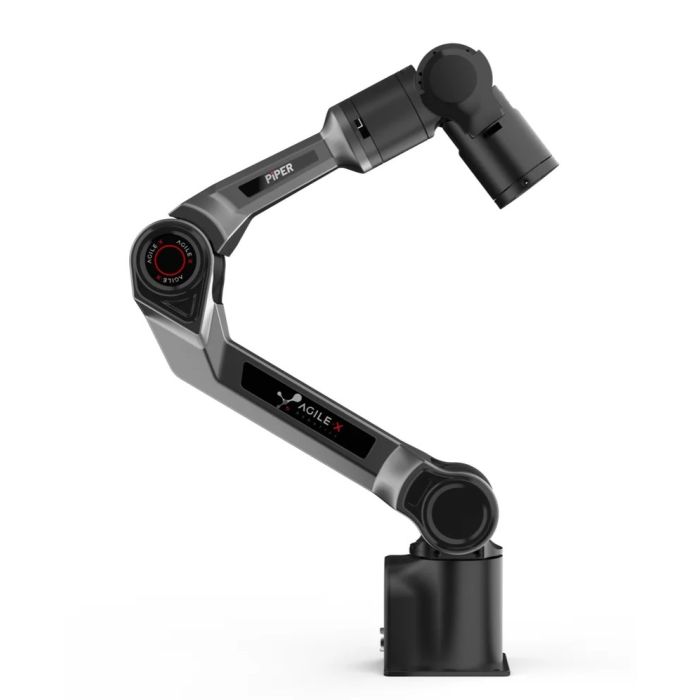
Turn the base of most industrial manipulators over and you find a tangle of cabling: motor leads, encoder lines, safety circuits and a fat umbilical running to a cabinet on the floor. Turn over the Agilex Piper Lightweight Robotic Arm and you find two sockets, one for power and one for CAN. Everything that would normally sit in that cabinet has been folded into the arm itself, and that one design decision explains most of what the PiPER is good at: it can be bolted to a bench, a trolley or a mobile robot, and it can be programmed from a laptop the same afternoon.
Robots Middle East supplies the Agilex Piper Lightweight Robotic Arm to universities, research centres, integrators and product development teams across the Middle East. We prepare the quotation, arrange delivery to your site and remain your point of contact for technical support once the arm is in service, so that a laboratory in the Gulf or the Levant deals with one regional partner rather than a chain of overseas intermediaries.
Background
AgileX and its robotics lineage
AgileX Robotics is best known for mobile robot platforms used in research, education and field development, and its catalogue has grown to include manipulators and complete mobile manipulation kits. The PiPER sits within that wider family, which you can explore in our AgileX category. For buyers this lineage matters because the arm was conceived by a company whose customers already work with ROS, CAN buses and Python, and it speaks the same languages as the platforms it is likely to be mounted on.
Integrated joints and an integrated controller
The PiPER is a lightweight robotic arm with six integrated joint motors for smooth, precise control, and its controller is integrated into the arm. Rather than routing each axis back to a separate drive cabinet, the arm accepts DC24V power and a single CAN connection. The body is an aluminium alloy structure enclosed in a polymer shell, which keeps the arm light enough to be moved by hand while retaining the stiffness a manipulator needs. The result is a machine positioned between the hobby arm and the industrial cobot: compact and approachable, yet built around a genuine six-axis architecture.
Technical Specifications
| Specification | Value |
|---|---|
| Degrees of freedom | 6 |
| Payload | 1.5kg |
| Weight | 4.2kg |
| Reach | 626 mm |
| Repeatability | ± 0.1 mm |
| Operating temperature | -20℃ to 50℃ |
| Input voltage | DC24V |
| Material | Aluminum Alloy Body, Polymer Shell |
| Controller | Integrated |
| Communication | CAN |
| External interface | Power*1, CAN*1 |
| Programming | Drag Teaching / Offline Trajectory / API / PC |
| Software support | Python API; ROS1 and ROS2 |
| User interface | Tablet-based interface for building and controlling applications |
| Base installation dimensions | 70mm*70mm*M5*4 |
Specifications are as published by the manufacturer and are confirmed against the datasheet at quotation.
The manufacturer has not published the IP rating, the maximum joint speed, the joint range of motion, the power consumption, the overall dimensions, whether a gripper is included or the full contents of the box; we confirm each of these with you at quotation.
How is the Agilex Piper Lightweight Robotic Arm programmed?
The PiPER offers four programming routes, and the choice between them usually reflects who is working with the arm rather than what the task is. Drag teaching lets an operator guide the arm by hand through a movement and record it, which is the quickest way for a student or a process engineer to demonstrate a motion without writing code. Offline trajectory programming suits teams who plan paths in advance and want the arm to execute them as prepared. PC-based control and the API serve developers who want the arm to respond to sensors, vision systems or higher-level planners.
On the software side, the PiPER can be controlled via a Python API and supports both ROS1 and ROS2. This matters in practice: many research groups maintain legacy ROS1 code while new projects are started in ROS2, and an arm that accepts both avoids forcing a migration simply to bring a manipulator into the workflow. For those who prefer not to work at code level at all, the modern tablet-based interface is intended for building and controlling applications directly.
What does the integrated design change for an integrator?
With the controller inside the arm and an external interface limited to one power and one CAN connection, the PiPER removes much of the electrical planning that accompanies a conventional arm. Mounting is equally direct: the base installation pattern is 70mm*70mm*M5*4, a compact footprint that suits a bench plate, an aluminium profile frame or the deck of a mobile platform. At 4.2kg, the arm adds little mass to a robot that must carry it, and its 1.5kg payload is sufficient for small grippers, cameras and light tooling.
The operating temperature range of -20℃ to 50℃ is also relevant in this region, where equipment may be demonstrated outdoors, carried in vehicles or installed in buildings where climate control is not guaranteed. A manipulator intended for mobile use needs to tolerate those conditions, and the published range gives integrators a clear basis for planning field trials.
Who is the Agilex Piper Lightweight Robotic Arm for?
University departments teaching robotics, mechatronics and control engineering form a natural audience. The arm offers students a real six-axis kinematic chain, a standard communication bus and a choice between hands-on drag teaching and code, so it can serve both introductory laboratory sessions and postgraduate research.
Research laboratories working in mobile manipulation and embodied AI are a second group. The light weight, compact base pattern and CAN interface make the PiPER a candidate for mounting on a wheeled or tracked platform, while ROS1 and ROS2 support allows it to sit within an existing software stack.
Product development teams and integrators building demonstrators, test rigs or small automated cells will value the integrated controller and the short path from unpacking to first motion. Those comparing the PiPER with other collaborative arms can browse our Cobots category.
The sources name three versions of the PiPER: Basic, Gripper and Pendant. They do not publish what distinguishes each version or which accessories accompany it, so we recommend that you tell us how you intend to use the arm and we will confirm the appropriate configuration and its contents in the quotation.
What is the Agilex Piper Lightweight Robotic Arm used for?
- Robotics teaching: giving students a genuine six-axis arm to programme by hand, in Python or through ROS.
- Mobile manipulation research: mounting a light arm on a mobile base to study reaching and grasping on the move.
- Embodied AI and data collection: recording demonstrations through drag teaching to build datasets for learning-based control.
- Algorithm development: testing motion planning, inverse kinematics and control strategies on real hardware rather than in simulation alone.
- Bench-top prototyping: building proof-of-concept handling tasks for light objects before committing to larger equipment.
- Demonstrations and exhibitions: presenting automation concepts with an arm that is easy to transport and set up.
Pricing and Availability
Robots Middle East supplies the Agilex Piper Lightweight Robotic Arm on a quotation basis, so that the configuration, accessories and documentation match your project precisely. Delivery, customs clearance and technical support are arranged together with your quotation. To begin, please share your intended application, preferred version and delivery location; a request for a quotation is available on this page.
Frequently Asked Questions
What payload can the PiPER carry?
The PiPER supports a payload of 1.5kg. This is suited to small grippers, cameras and light tools rather than heavy industrial handling.
Does the arm work with ROS?
Yes. The PiPER supports both ROS1 and ROS2 and can also be controlled through a Python API.
How does the arm communicate with a computer or robot?
Communication is via CAN, and the external interface consists of one power connection and one CAN connection. The controller is integrated into the arm.
Can I programme it without writing code?
Yes. Drag teaching allows you to guide the arm by hand and record the movement, and a tablet-based interface is provided for building and controlling applications.
Is the PiPER suitable for warm climates?
The published operating temperature range is -20℃ to 50℃. The IP rating has not been published, so please discuss dust and moisture exposure with us before deployment.
Is a gripper included?
The sources name Basic, Gripper and Pendant versions but do not state what each includes. Robots Middle East confirms the contents of your chosen version in the quotation.
Where can I buy the Agilex Piper Lightweight Robotic Arm and what does it cost?
You can obtain it from Robots Middle East, which supplies it across the Middle East. The cost depends on the version and accessories you choose, so we provide it in a tailored quotation that you can request on this page.
Summary
Two sockets on the base tell the story of the Agilex Piper Lightweight Robotic Arm. By building its six joint motors and its controller into the arm, AgileX has produced a manipulator that weighs 4.2kg, reaches 626 mm, repeats to ± 0.1 mm and connects through power and CAN alone. That simplicity translates into flexibility: drag teaching for the classroom, Python and ROS for the laboratory, and a compact base pattern for the mobile robot. For institutions and teams across the Middle East looking to put real manipulation within reach of their students and engineers, this page is the starting point.