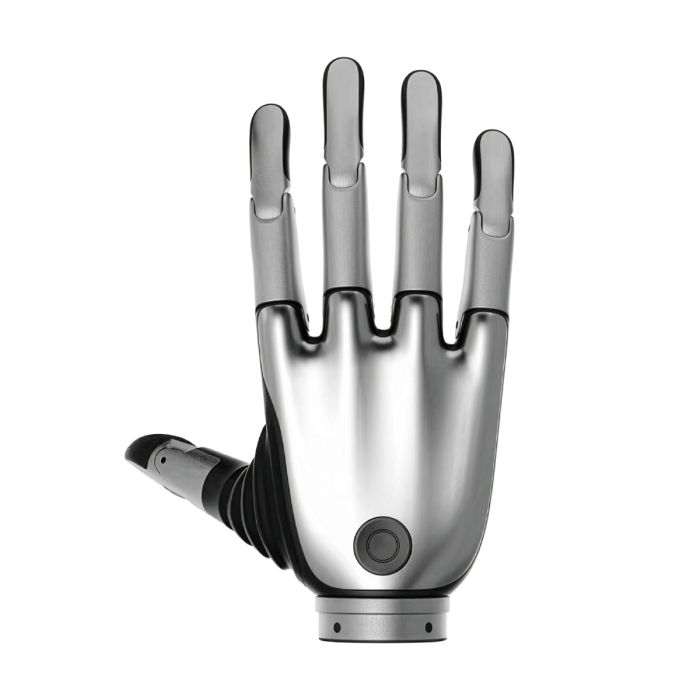
BrainCo Revo 2 Pro Dexterous Left Hand (XEL)
In stock
- BRAND:
- BRAINCO
- MODEL:
- REVO 2 PRO
- PART #:
- XEL
- ORIGIN:
- China
- AVAILABILITY:
- SUBJECT TO AVAILABILITY
- SKU:
- BrainCo-Revo-2-Pro-Left
Two-handed manipulation fails quietly when one hand is an afterthought. A robot that can only work with its right side cannot hold a part steady while the other hand acts on it, and so the left hand deserves the same engineering as the right. The BrainCo Revo 2 Pro Dexterous Left Hand (XEL) is the left-hand unit of the Pro tier in the Revo 2 series: a human-scaled hand that, per the published specification, combines 11 degrees of freedom with fieldbus connectivity suited to serious integration work.
Robots Middle East supplies this hand to research institutions, universities, integrators and robotics developers across the Middle East. We quote the unit on request, arrange delivery to the customer's site and support the project from enquiry onwards.
Background
The company and its lineage
BrainCo is a company working on brain-computer interfaces and bionic limbs, and the Revo 2 series descends from that prosthetic and bionic heritage. A hand designed for the human body must be light, quiet and safe near people, and those priorities carry over into a hand intended for robots. The result is a product family built around human proportions rather than around the convenience of an industrial gripper.
The Revo 2 family is offered in three versions. The BASIC version is coded XRL/XRR, the PRO version XEL/XER, and the TOUCH version XTL/XTR. In each case the first code is the left hand and the second the right. This article concerns the Pro left hand, coded XEL. Buyers comparing tiers may also wish to browse the BrainCo Revo 2 category, where the related versions are grouped.
Positioning and key technology
The Pro tier sits between the Basic and Touch versions. According to the published specification, the whole series shares the same mechanical basics: 11 degrees of freedom driven by 6 active joints, a mass of 383 g and a height of 160 mm measured from the base of the palm to the tip of the middle finger. What separates the Pro from the Basic is mainly electrical and communication-related. The Pro lists a wider supply voltage range and adds EtherCAT to the 485 and CANfd interfaces that the Basic also lists.
The control layer is equally relevant. The published specification describes position, velocity and current feedback control, together with cascaded control and compliance control. Compliance matters when a hand meets an object whose position is not known to the millimetre, because the hand can yield rather than force the contact. The series also lists current protection, stall protection, high-temperature protection and anti-collision protection. For teams that must leave a hand running through long test sessions, such protective behaviour reduces the risk of damage during development.
Technical Specifications
| Specification | Value |
|---|---|
| Version code | XEL (left) / XER (right) |
| Degrees of freedom | 11 (6 active) |
| Weight | 383 g |
| Height (palm base to middle fingertip) | 160 mm |
| Full fist grip force | ≥50N |
| Pinch force | ≥15N |
| Max payload | ≥20kg |
| Operating noise (at 50cm) | ≤50dB |
| Flexion/extension speed | ≤0.65s |
| Maximum opening and closing distance | 100mm (from thumb to index finger) |
| Communication interface (Pro) | 485, CANfd, EtherCAT |
| Supply voltage (Pro) | 12-64V |
| Static current (Pro) | 115 mA @24V |
| Maximum current (Pro) | 4.65A @24V |
| Repetitive control precision (Pro) | 0.1° |
| Operating temperature | -10 to 40℃ / 90%RH |
| Smart control | Position, velocity and current feedback control; cascaded control; compliance control |
| Smart protection | Current, stall, high-temperature and anti-collision protection |
| SDK integration | Python/C; compatible with Linux, Windows and ROS |
| Online upgrade | OTA online upgrades supported |
| Default device ID (left hand) | 126 |
| Standard colours | Space Gray, Silver (bulk colour customisation supported) |
Specifications as published; they are confirmed against the datasheet at quotation. The manufacturer has not published the hand width, the materials, the ingress protection rating, the cable length, the box contents or the tactile sensing detail for the Pro version; these are confirmed at quotation.
What makes the Pro different from the Basic version?
On the mechanical side, very little changes. The series-wide figures for weight, height, grip force and speed are printed once for the whole family, so the Pro should not be presented as a stronger or faster hand than the Basic. The difference lies in how the hand is powered and connected.
The published specification lists the Basic with a supply range of 12-28V, a static current of 65 mA @24V and a maximum current of 4.6 A @24V, and with 485 and CANfd interfaces. The Pro is listed with 12-64V, 115 mA @24V, 4.65A @24V and the addition of EtherCAT. A wider voltage window can simplify matters when a platform runs a higher-voltage bus, and EtherCAT is a natural fit where a cell already uses it for deterministic, synchronised communication. If your project needs only the lower voltage range and the simpler interfaces, the BrainCo Revo 2 Basic Left Dexterous Bionic Hand (XRL) may be the more economical match. Buyers should confirm each figure against the datasheet when requesting a quotation.
How does the Pro compare with the Touch version?
The Touch version, coded XTL/XTR, is listed in the same table with the same communication interface, supply voltage, current and precision figures as the Pro. The name suggests that its distinction concerns tactile sensing, but the fact sheet for this product does not carry tactile details, and the manufacturer has not published tactile sensing detail for the Pro version. Anyone whose application depends on touch feedback should therefore ask about it explicitly and consider the Brainco Revo 2 Touch Biomimetic Dexterous Left Hand (XTL) alongside this unit. Our team will confirm the differences in writing during quotation.
Who is the BrainCo Revo 2 Pro Dexterous Left Hand (XEL) for?
Research laboratories are the clearest segment. A hand with an open SDK, support for Python and C, and compatibility with Linux, Windows and ROS can be brought into an existing software stack without a rewrite. Universities running humanoid or manipulation programmes will value the OTA upgrade facility, which lets firmware be updated without dismantling the hand.
Humanoid developers form a second segment. A hand of human scale and modest mass suits an arm designed to work in human environments, and the left-hand code means a matched pair can be built with the right-hand unit. For the other side of the pair, see the BrainCo Revo 2 Pro Dexterous Right Hand (XER).
Automation integrators make up a third segment, particularly those who already work with EtherCAT or with higher-voltage supplies. Teams that are still choosing a platform may also review the wider Hands category to compare options before committing.
What is the BrainCo Revo 2 Pro Dexterous Left Hand (XEL) used for?
- Bimanual research. Paired with a right-hand unit, it allows one hand to steady an object while the other acts on it.
- Humanoid robot development. Its human-scaled form suits platforms intended to handle everyday objects and tools.
- Compliant grasping studies. The compliance and current feedback control modes support work on gentle, adaptive contact.
- Teaching and demonstration. Quiet operation, listed at no more than 50dB at 50cm, suits classrooms and exhibitions.
- Fieldbus integration trials. The 485, CANfd and EtherCAT interfaces allow control architectures to be tested in a realistic setting.
- Teleoperation experiments. Position and velocity control, combined with an open SDK, help operators drive the hand remotely and record the results.
Pricing and Availability
Robots Middle East does not print prices for this product. Please request a quotation, stating your quantity, your intended application and your delivery location. Delivery, customs and support are arranged together with the quotation, so that the whole project is settled in one conversation. Current availability and the terms of supply are confirmed in that quotation and are not shown on this page, and the quotation request is available on this page.
Frequently Asked Questions
Is this the left hand or the right hand?
This product is the left hand, coded XEL. The matching right hand in the Pro version is coded XER.
How many degrees of freedom does it have?
Per the published specification, the Revo 2 series has 11 degrees of freedom with 6 active joints. The same figure applies to the whole series, not only to the Pro.
Which communication interfaces does the Pro version support?
The published specification lists 485, CANfd and EtherCAT for the Pro version. The Basic version is listed with 485 and CANfd only.
What software can I use to control it?
The SDK is reported to support Python and C and to be compatible with Linux, Windows and ROS systems. OTA online upgrades are also listed.
What supply voltage does it need?
The Pro version is listed with a supply voltage of 12-64V. The published current figures are given at 24V, and they are confirmed against the datasheet at quotation.
Does it include tactile sensing, and what is in the box?
The manufacturer has not published tactile sensing detail for the Pro version, nor the box contents, the materials, the cable length or an ingress protection rating. All of these are confirmed at quotation.
Where can I buy the BrainCo Revo 2 Pro Dexterous Left Hand (XEL) and what does it cost?
You can buy it from Robots Middle East, which quotes, delivers and supports the unit across the Middle East. No price is shown here; the cost is given in a written quotation after you submit your requirements.
Summary
A capable left hand turns a one-handed robot into one that can work with two. The BrainCo Revo 2 Pro Dexterous Left Hand (XEL) offers human scale, 11 degrees of freedom, compliance-oriented control, protective behaviours and an open SDK. Its distinguishing features within the series are the 12-64V supply range and EtherCAT, while the Basic and Touch versions remain open options for other needs. Specifications are as published and are confirmed at quotation, and Robots Middle East handles supply, delivery and support. When you are ready to plan your project, this page is the starting point.
Specifications
General
Physical
Mobility
Performance
Connectivity
Software
Hand
Feature
1. High quality and stability – five years of product iteration and professional production lines.
2. Lightweight (383 grams), with 5 kg active grip force, 20 kg single-hand load capacity, and a grip-to-weight ratio of 53.
3. Ergonomic Bionic Design – supports curved surface grasping with anti- collision finger design.
4. Multi-dimensional tactile perception – pressure, friction, direction, proximity, and surface texture.
5. High Sensitivity Tactile Perception – max resolution of 0.01N.
6. Wide voltage support – 64V.
7. Universal Interfaces – RS485 & CAN-FD, and EtherCAT.
8. Standard Protocols and SDKs – Modbus & Protobuf protocols, SDKs for Python / C / ROS.