
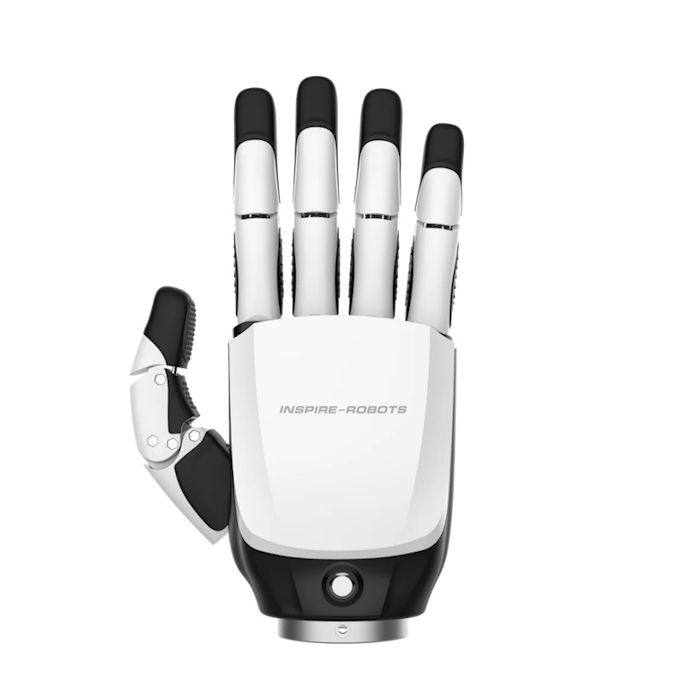
Inspire Robots Dexterous Robot Hand (RH56DFX)
In stock
- BRAND:
- INSPIRE ROBOTS
- PART #:
- RH56DFX
- ORIGIN:
- China
- AVAILABILITY:
- SUBJECT TO AVAILABILITY
- SKU:
- Inspire-RH56DFX
Inspire Robots Dexterous Robot Hand (RH56DFX)
A human hand is never generic. It is either a left or a right, and it ends at a wrist that decides where the fingers point before they close. Robot hands intended for human spaces are increasingly specified in the same way, and the Inspire Robots Dexterous Robot Hand (RH56DFX) makes the point explicit. It is offered as a left or a right hand, each with or without an integrated wrist, so the first decision a buyer faces concerns the body the hand will join rather than the grip alone. Behind that choice sits one shared hand: twelve joints, position and force sensing, RS485 control and a thumb that rotates across the palm. The useful question is therefore not whether the hand can grasp, but which of its four configurations suits the project in hand.
Robots Middle East supplies the RH56DFX to research laboratories, universities, system integrators and robotics developers throughout the Middle East. Robots Middle East prepares the quotation for the exact configuration you require, arranges delivery to your site and supports the hand after installation, from the first wiring of the RS485 interface to the questions that arise during integration with your arm, humanoid platform or test bench.
Background
Inspire Robots and its dexterous hand range
Inspire Robots develops compact actuators and multi-fingered robot hands for humanoid robots, service robots and manipulation research. Its range, gathered on our Inspire Robots page, includes several dexterous hands that share an anthropomorphic layout but differ in sensing and configuration. The RH56DFX belongs to the DFX series, which combines strength and speed, with a thumb active output force of 1.5KG and a four finger fingertip output force of 1KG. Within that series the hand is built as mirrored left and right units, RH56DFX‑2L and RH56DFX‑2R, and as wrist-equipped counterparts, RH56DFXW‑2L and RH56DFXW‑2R.
Sensing and self-locking
The hand integrates absolute position sensors and force sensors, and it provides real-time force feedback to the controller. Absolute position sensing means the controller knows where each finger stands from the moment the hand is switched on, while the force sensors allow a grasp to be regulated rather than simply commanded, with a force resolution of 0.50N. The hand is also self-locking when power is removed, so it holds its pose and needs no change of position when power returns. It should be noted that the RH56DFX is supplied without tactile sensors: its feedback comes from the integrated force and position sensing, not from a sensitive skin on the fingertips.
Technical Specifications
| Specification | RH56DFX‑2L / RH56DFX‑2R (without wrist) | RH56DFXW‑2L / RH56DFXW‑2R (with wrist) |
|---|---|---|
| Weight | 540g | 650g |
| Degrees of freedom | 6 | 6+2 |
| Number of joints | 12 | 12 |
| Control interface | RS485 | RS485 |
| Operating voltage | DC12V‑48V | DC12V‑48V |
| Peak current | 2A@24V | — |
| Repeatability | ±0.20mm | ±0.20mm |
| Thumb fingertip strength | 15N | 15N |
| Fingertip strength | 10N | 10N |
| Force resolution | 0.50N | 0.50N |
| Lateral rotation range of thumb | >65° | >65° |
| Lateral rotation speed of thumb | 107°/s | 107°/s |
| Flexion speed of thumb | 70°/s | 70°/s |
| Flexion speed of four fingers | 260°/s | 260°/s |
| Wrist yaw movement | — | ±27° |
| Wrist pitch movement | — | ±22° |
| Wrist load torque | — | 2NM (Excluding hand weight) |
Specifications are as published by the manufacturer and are confirmed against the datasheet at quotation.
The manufacturer has not published the dimensions, the IP rating, the communication baud rate, the service life, the operating temperature or the package contents, nor a clear peak current figure for the wrist versions; these details are confirmed at quotation.
What does the wrist version of the RH56DFX add?
The RH56DFXW‑2L and RH56DFXW‑2R keep the full hand of the standard models and add two further degrees of freedom at the wrist, giving 6+2 degrees of freedom in total. The wrist offers yaw movement of ±27° and pitch movement of ±22°, with a wrist load torque of 2NM, a figure that excludes the weight of the hand itself. In practical terms, the hand can tilt and turn its palm towards an object without asking the arm to reposition, which simplifies motion planning for approach angles and small corrections during a grasp.
That capability carries a weight consideration: the wrist versions weigh 650g against 540g for the RH56DFX‑2L and RH56DFX‑2R. For a humanoid forearm or a lightweight arm that lacks its own wrist articulation, the integrated wrist is often the cleaner solution. Where the host arm already provides full wrist motion, the standard hand avoids duplicating joints and keeps the mass at the end of the arm lower. The choice is therefore less about the hand than about the kinematic chain it completes.
How does the RH56DFX differ from a hand with tactile sensors?
Every RH56DFX configuration senses force and position, but none carries tactile sensors. Force feedback tells the controller how hard the fingers are pressing; a tactile array would additionally describe where on the finger contact occurs and how it is distributed. For many grasping, teleoperation and learning tasks, force and position feedback are sufficient, and a hand without tactile skin is simpler to integrate and to maintain. Projects that study contact itself, such as slip detection or texture recognition, are better served by a hand built with tactile sensing, for example the Inspire Dexterous Left Hand With Tactile Sensors (RH56F1-E2L-T1) or the Inspire Dexterous Right Hand With Tactile Sensors (RH56F1-E2R-T1). Robots Middle East can quote both families side by side when the decision is still open.
Who is the Inspire Robots Dexterous Robot Hand (RH56DFX) for?
Humanoid developers are the most natural buyers. A humanoid needs a matched pair of hands, and the left and right models allow a symmetrical build; the wrist-equipped RH56DFXW‑2L and RH56DFXW‑2R suit forearms that would otherwise end in a fixed mount. Integrators fitting a dexterous hand to a collaborative or industrial arm will usually find the RH56DFX‑2L or RH56DFX‑2R sufficient, since the arm supplies its own wrist motion.
University and corporate research groups working on grasp planning, imitation learning or teleoperation form a further segment. For them, the combination of absolute position sensing, real-time force feedback and a standard RS485 interface makes the hand straightforward to place inside a control loop and to log for training data. Teaching laboratories benefit from the self-locking behaviour, which keeps the hand in a predictable pose between sessions. Teams whose research depends on contact sensing should look instead at the tactile-sensor hands mentioned above, and those comparing several anthropomorphic hands can browse the full Robot Hands category.
What is the Inspire Robots Dexterous Robot Hand (RH56DFX) used for?
- Humanoid manipulation: completing a humanoid's arms with matched left and right hands for picking, holding and handing over objects.
- Teleoperation: mirroring an operator's hand movements on a remote robot, with force feedback available to the control software.
- Imitation and reinforcement learning: collecting joint-position and force data as training input for learned manipulation policies.
- Grasp research: comparing pinch, lateral and power grasps using the thumb's lateral rotation across the palm.
- Bimanual tasks: pairing a left and a right hand on a dual-arm platform for tasks that need two coordinated hands.
- Education and demonstration: giving students and visitors a dexterous hand that holds its pose safely when power is removed.
Pricing and Availability
Robots Middle East quotes each RH56DFX configuration on request, so that the quotation reflects the handedness, the choice of wrist and the quantity your project requires, whether a single hand or a matched pair. Delivery, customs and support are arranged with the quotation. To receive a quotation for the RH56DFX in the configuration your application needs, please use the enquiry form available on this page.
Frequently Asked Questions
Does the RH56DFX have tactile sensors?
No. The RH56DFX is supplied without tactile sensors; it integrates absolute position sensors and force sensors that provide real-time force feedback.
What is the difference between the RH56DFX‑2L and the RH56DFX‑2R?
The RH56DFX‑2L is the left hand and the RH56DFX‑2R is the right hand. The RH56DFXW‑2L and RH56DFXW‑2R are the corresponding versions with an integrated wrist.
How is the hand controlled and powered?
The hand uses an RS485 control interface and operates on DC12V‑48V. The peak current of the versions without wrist is 2A@24V.
What happens to the hand when power is lost?
The RH56DFX is self-locking when power is removed, so it holds its position. When power returns, there is no need to change its position before resuming work.
How precise is the RH56DFX?
The RH56DFX has a repeatability of ±0.20mm and a force resolution of 0.50N. The thumb fingertip strength is 15N and the fingertip strength of the other fingers is 10N.
Which version suits an arm that already has its own wrist?
Where the host arm already provides wrist motion, the RH56DFX‑2L or RH56DFX‑2R without wrist is usually the better fit. It weighs 540g, against 650g for the wrist versions.
Where can I buy the Inspire Robots Dexterous Robot Hand (RH56DFX) and what does it cost?
You can buy the RH56DFX from Robots Middle East, which supplies customers throughout the Middle East. The cost depends on the configuration and quantity, and Robots Middle East provides it in a formal quotation on request.
Summary
Choosing the RH56DFX begins as choosing a hand for a person would: left or right, and whether it should end at a wrist. Once that is settled, the hand itself is common to all four configurations, with twelve joints, absolute position and force sensing, RS485 control, a thumb that rotates across the palm and the reassurance of self-locking when power fails. The wrist versions add yaw and pitch for platforms that need them, and the standard versions keep the arm lighter where the wrist already exists. For teams that need tactile sensing, the Inspire range offers alternatives. For everyone else matching a dexterous hand to a specific robot body, this page is the starting point.