
MagicLab MagicBot G1 Standard Edition Humanoid Robot
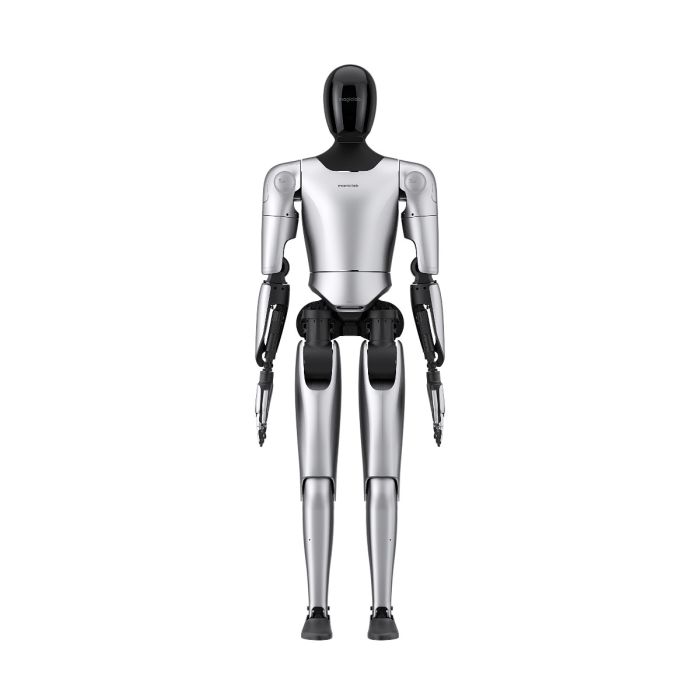
In stock
- BRAND:
- MAGICLAB
- MODEL:
- MAGICBOT Z1 STANDARD EDITION
- ORIGIN:
- China
- Warranty:
- 12 MONTHS
- AVAILABILITY:
- SUBJECT TO AVAILABILITY
- SKU:
- MagicLab-MagicBot-G1
MagicLab MagicBot G1 Standard Edition Humanoid Robot
A demonstration video shows what a humanoid robot can do once; a specification sheet shows what it can do every working day. Buyers who have watched bipedal machines walk, wave and pick up boxes increasingly ask harder questions: how much can it carry, how much thinking can it do on board, and how much energy does it bring to the task? The MagicLab MagicBot G1 Standard Edition Humanoid Robot answers those questions with stated figures rather than impressions. Its manufacturer lists a load rating for each arm and for the whole body, a named computing module and a stated battery capacity. That makes the G1 a platform you can plan around, not merely admire.
Robots Middle East supplies the MagicBot G1 Standard Edition to companies, universities, research centres and public institutions across the Middle East. Robots Middle East prepares each quotation, arranges delivery to your site and provides support after installation, so that the conversation about a humanoid project begins with your requirements and continues well beyond the day the robot arrives.
Background
Magiclab Robotics Technology (Wuxi) Co., Ltd.
The MagicBot G1 is made by Magiclab Robotics Technology (Wuxi) Co., Ltd., a Chinese robotics company that develops both humanoid and quadruped platforms. Its catalogue spans several bipedal humanoids alongside the MagicDog family of four-legged robots, which places the G1 within a broader engineering programme rather than presenting it as a one-off design. For buyers, a manufacturer with several related products typically means shared know-how in actuation, control software and system integration across the range. Those comparing options can browse our Humanoids category to see where the G1 sits among other machines of its kind.
A platform defined by load, compute and energy
Humanoid robots exist because most workplaces were laid out for people. A machine with legs, a torso and two arms can, in principle, use the same aisles, workbenches and tools as a human worker, without a facility being rebuilt around it. What separates one humanoid from another is how well that body is backed by strength, processing power and stored energy. The MagicBot G1 is described by its maker in exactly those terms: a high number of degrees of freedom for articulated movement, defined arm and body load ratings, an onboard computing module that pairs a multi-core CPU with a dedicated AI processor, and a battery whose capacity is stated in both ampere-hours and kilowatt-hours. MagicLab lists these figures under the MagicBot Gen1 designation, and they are set out in the table below.
Technical Specifications
| Specification | MagicBot Gen1 |
|---|---|
| Standing dimensions | 1740*580*280 mm |
| Degrees of freedom | 42 |
| Single-arm load | Up to 7.5 kg |
| Total body static load | Up to 40 kg |
| High-performance computing module | 8-Core CPU + 100 TOPS AI Processor |
| Battery capacity | 25 Ah (1.35 kWh) |
| Manufacturer | Magiclab Robotics Technology (Wuxi) Co., Ltd. |
Specifications are as published by the manufacturer and are confirmed against the datasheet at quotation.
MagicLab has not published the ingress protection rating, the maximum slope climbing angle, the operating temperature range or the power consumption; these are confirmed at quotation.
What can the MagicBot G1 actually lift and carry?
Two load figures describe the G1, and they measure different things. The single-arm load of up to 7.5 kg indicates what one arm can handle on its own, which is the figure that matters for picking a part from a bin, holding a tool or presenting an object to a person. The total body static load of up to 40 kg describes what the robot's structure can bear while holding position, which is relevant when a task involves supporting a load with both arms or carrying weight close to the body.
Reading the two together helps a buyer frame realistic tasks. Handling individual components, trays, cartons of moderate weight or laboratory equipment falls naturally within the single-arm rating, while the higher static figure gives room for two-handed holds and stable positioning. A static rating is not a dynamic one, so an application that involves walking while carrying, or repeated lifting over a shift, is worth describing to our team in detail. The 42 degrees of freedom give the arms, hands and legs the articulation to approach objects from different angles, which in practice often matters as much as raw load capacity.
The computing module supports the same goal. An 8-Core CPU combined with a 100 TOPS AI Processor gives the robot capacity to run perception and control workloads on board, which is the foundation for recognising objects, planning grasps and adjusting balance while handling a load.
Is the MagicBot G1 suited to conditions in the Gulf region?
This is a fair question for any buyer in the Middle East, and it deserves a direct answer: the deployment environment should be part of the specification discussion from the outset. Heat, dust and humidity all place demands on actuators, electronics and batteries, and the right answer depends on where the robot will actually work.
In practice, most humanoid deployments take place indoors, in air-conditioned factories, warehouses, laboratories, exhibition halls and offices. These are the settings the G1's human-scale body is designed for, and they are also the settings where climate is controlled. Where a project involves semi-outdoor areas, loading bays or spaces with significant dust, Robots Middle East will take those conditions into account when preparing your proposal.
Who is the MagicBot G1 for?
The G1 Standard Edition suits organisations that want a full-size bipedal humanoid with clearly stated load, compute and battery figures to plan against. Industrial and logistics companies evaluating humanoid automation will find the arm and body load ratings a useful starting point for pilot tasks such as material handling and station tending. Universities and research institutes working on locomotion, manipulation or embodied AI can make use of the onboard AI processor and the high count of degrees of freedom as a research platform. Innovation centres, museums and corporate visitor halls in the region may also value a human-height robot as a demonstrator of advanced technology.
MagicLab's sources also name a G1 Pro; please ask us about it if you are weighing the two. Buyers whose priorities differ may wish to compare the MagicLab MagicBot X1 Full-Size Humanoid Robot, the MagicLab MagicBot Z1 Standard Edition Humanoid Robot and the MagicLab MagicBot Z1 Development Edition Humanoid Robot, or review the wider Bipedal Humanoids category.
What is the MagicBot G1 used for?
- Material handling: moving parts, trays and moderate loads between stations within the single-arm rating.
- Production line assistance: tending workstations designed for human operators without rebuilding the line.
- Logistics pilots: testing humanoid picking and placing in warehouses and distribution centres.
- Embodied AI research: running perception and control models on the onboard AI processor.
- Education and training: giving engineering students hands-on experience with a full-size bipedal platform.
- Visitor engagement: demonstrating advanced robotics in exhibition halls, innovation centres and corporate lobbies.
Pricing and Availability
Robots Middle East supplies the MagicBot G1 Standard Edition on a quotation basis, so that the configuration, accessories and support match your project. Delivery, customs clearance and after-sales support are arranged together with the quotation. Tell us about your intended application and site conditions, and we will shape the proposal around them. A quotation request for the MagicLab MagicBot G1 Standard Edition Humanoid Robot is available on this page.
Frequently Asked Questions
How many degrees of freedom does the MagicBot G1 have?
MagicLab lists 42 degrees of freedom for the MagicBot Gen1. This articulation allows the arms, hands and legs to adopt a wide range of postures for manipulation and walking.
How much weight can the MagicBot G1 handle?
Each arm handles loads of up to 7.5 kg, and the whole body supports static loads of up to 40 kg.
What computing hardware does it carry?
The robot carries a high-performance computing module combining an 8-Core CPU with a 100 TOPS AI Processor, intended for running perception and control workloads on board.
What is the battery capacity?
The battery capacity is 25 Ah (1.35 kWh). Operating time varies with the task the robot performs.
How tall is the MagicBot G1?
Its standing dimensions are 1740*580*280 mm, a human-scale footprint suited to environments designed for people.
Who manufactures the MagicBot G1?
The robot is manufactured by Magiclab Robotics Technology (Wuxi) Co., Ltd., which also produces other humanoid and quadruped platforms. Robots Middle East supplies and supports it in the region.
Where can I buy the MagicBot G1 and what does it cost?
You can buy the MagicLab MagicBot G1 Standard Edition Humanoid Robot from Robots Middle East, which supplies customers across the Middle East. Pricing is provided by quotation, tailored to your configuration, delivery and support requirements.
Summary
A humanoid robot proves its worth not in a single impressive clip but in the figures that govern daily work. The MagicLab MagicBot G1 Standard Edition Humanoid Robot comes with those figures stated: 42 degrees of freedom, defined arm and whole-body load ratings, an 8-Core CPU paired with a 100 TOPS AI Processor, and a 25 Ah (1.35 kWh) battery, all within a human-scale body. Robots Middle East pairs that platform with quotation, delivery and support arranged for your site. For organisations in the region ready to move from watching humanoids to planning with one, this page is the starting point.