
MagicLab MagicDog Quadruped Robot
In stock
- BRAND:
- MAGICLAB
- MODEL:
- MAGICDOG
- ORIGIN:
- China
- Warranty:
- 12 MONTHS
- AVAILABILITY:
- SUBJECT TO AVAILABILITY
- SKU:
- MagicLab-MagicDog
MagicLab MagicDog Quadruped Robot
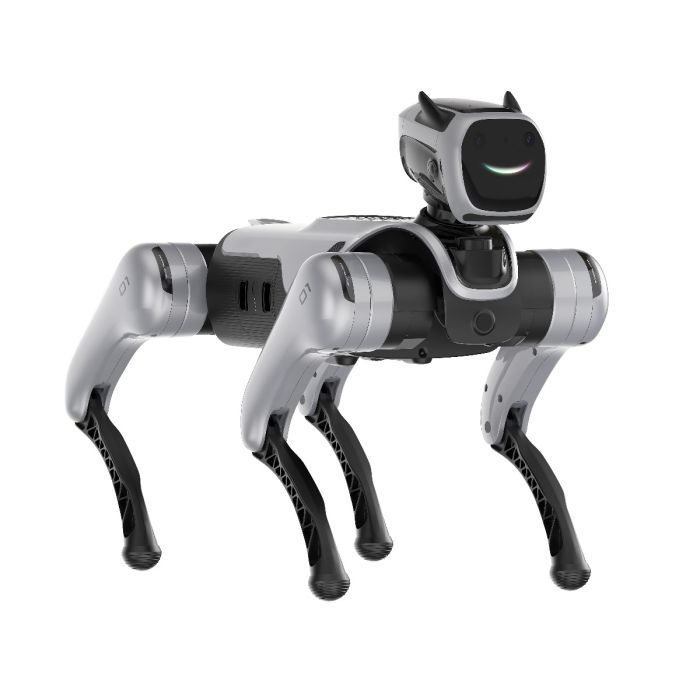
Folded down, it rests just 290mm high, a low and unassuming shape on the floor of a classroom or an exhibition stand. Brought to its feet, the same machine can launch into a backflip, moonwalk across the room or offer a paw for a handshake. The MagicLab MagicDog Quadruped Robot lives between those two states: at rest an object that hardly draws the eye, in motion a performer with 13 degrees of freedom and a sensor suite worthy of a research platform. It is the first quadruped robot dog that can express emotions autonomously, and it carries that personality on a chassis built for uneven ground, carried loads and serious programming work.
Robots Middle East supplies the MagicLab MagicDog Quadruped Robot to schools, universities, research centres, exhibition operators and businesses across the Middle East. Our team prepares each quotation, advises on the choice between the PRO and EDU versions, and arranges delivery and after-sales support within the region, so that the robot arrives ready for the work you have planned for it.
Background
MagicLab Robotics: a young company with a broad remit
MagicLab Robotics was founded in 2024 and is headquartered in Suzhou. The company develops general-purpose humanoid and quadruped robots as part of its work in embodied AI, the field concerned with intelligence that acts through a physical body rather than on a screen. Its humanoid line includes machines such as the MagicLab MagicBot X1 Full-Size Humanoid Robot, while the MagicDog belongs to its four-legged range, which Robots Middle East lists among its Standard Quadrupeds. For a buyer, the significance of this lineage is that the MagicDog comes from a developer whose whole focus is robots that move, sense and respond in the real world.
A robot dog built around expression
Where many legged robots are designed purely as carriers for sensors, the MagicDog places behaviour at the centre of its design. It expresses emotions autonomously and can perform over 30 high-difficulty poses, among them backflips, moonwalks, handshakes and stretching. Behind that performance sits an 8-core high-performance CPU and a sensor array combining a 2D LiDAR, a dual camera, a depth camera, a 4K HD camera, a fisheye camera and an ultrasonic sensor. Graphical programming, simple and intuitive, lets users compose new behaviours without writing code line by line, and over-the-air (OTA) upgrades allow the robot's software to be updated after delivery.
Technical Specifications
| Specification | MagicDog PRO | MagicDog EDU |
|---|---|---|
| Dimensions (standing, L x W x H) | 670*350*560mm | 670*350*560mm |
| Dimensions (lying down, L x W x H) | 720*440*290mm | 720*440*290mm |
| Net weight (excluding battery) | 15.8kg | 15.8kg |
| Maximum joint torque | Approx. 37.5N·m | Approx. 37.5N·m |
| Degrees of freedom (DOF) | 13 | 13 |
| Maximum speed | 3.0m/s | 3.0m/s |
| Payload | ≈5kg (Max. ≈10kg) | ≈5kg (Max. ≈10kg) |
| Maximum obstacle height | 15cm | 15cm |
| Maximum climbing angle | 40° | 40° |
| Maximum power | 3200W | 3200W |
| Voltage | 22V-36V | 22V-36V |
| Basic computing power | 8-Core High-Performance CPU | 8-Core High-Performance CPU |
| Sensors | 2D LiDAR + Dual Camera + Depth Camera + 4K HD Camera + Fisheye Camera + Ultrasonic Sensor | 2D LiDAR + Dual Camera + Depth Camera + 4K HD Camera + Fisheye Camera + Ultrasonic Sensor |
| Battery | 29.6V 8200mAh 240.7W Fast Release | 29.6V 8200mAh 240.7W Fast Release |
| Battery life | 1.5-3.0h | 1.5-3.0h |
| Adapter | 33.6V 3.5A 149W | 33.6V 3.5A 149W |
| SDK support | ○ | ● |
| OTA upgrade | Support | Support |
Specifications as published by the manufacturer; they are confirmed against the datasheet at quotation.
The manufacturer has not published the ingress protection rating, the operating temperature range, the wireless connectivity, the noise level, the charging time or the contents of the box; each of these is confirmed at quotation.
What does the MagicDog EDU offer that the MagicDog PRO does not?
On almost every line of the datasheet, the two versions are the same robot. They share the same frame, the same 15.8kg net weight, the same 13 degrees of freedom, the same 3.0m/s maximum speed and the same sensor suite, battery and adapter. The choice between them therefore rests on one line: SDK support. The manufacturer marks the EDU version with a filled symbol (●) and the PRO version with an open symbol (○).
In practice, this makes the EDU the version for organisations that intend to treat the MagicDog as a development platform: writing their own software, connecting it to research projects or teaching students to program a legged robot beyond the graphical interface. The PRO suits buyers whose interest lies in the robot as it ships, with its autonomous emotional expression, its library of poses and its graphical programming.
Can the MagicDog handle obstacles, slopes and a carried load?
The performance figures suggest a robot designed to leave the smooth floor of a showroom. It steps over obstacles up to 15cm high and climbs inclines of up to 40°, while a maximum joint torque of approximately 37.5N·m and a maximum power of 3200W give its legs the strength for dynamic manoeuvres such as the backflip. Its payload is ≈5kg, with a maximum of ≈10kg, enough to carry a small sensor module, a demonstration prop or educational equipment.
Endurance is stated as 1.5-3.0h from a 29.6V 8200mAh 240.7W battery, with the range depending on how hard the robot is worked. Because the battery is a fast-release design, a session need not end when the pack runs down: with a spare battery to hand, the robot can return to work after a quick exchange. With the battery fitted, the total weight is approximately 17kg.
Who is the MagicLab MagicDog Quadruped Robot for?
Schools and STEM programmes form a natural audience. Graphical programming gives younger learners an immediate way to make a four-legged robot move and perform, and the emotional expression holds attention in a way a static kit seldom does. Institutions that want students to progress from graphical blocks to their own code should look at the EDU version, given its SDK support.
Universities and research laboratories will value the sensor combination of LiDAR, depth, stereo, fisheye and 4K imaging on a compact legged platform, together with the 8-core processor. For this group, too, the EDU version is the sensible choice; buyers comparing platforms may also find our wider selection of Research Robots useful.
Exhibition organisers, museums, retail spaces and corporate showrooms form a third group. Here the robot's capacity to perform over 30 high-difficulty poses and to express emotions autonomously is the main attraction, and the PRO version covers that need without the development features. Finally, technology companies exploring human-robot interaction will find in the MagicDog a platform where personality and perception meet.
What is the MagicLab MagicDog Quadruped Robot used for?
- STEM education: teaching robotics, motion and sensing through graphical programming that students grasp quickly.
- Software development: building and testing custom behaviours on the EDU version with its SDK support.
- Perception research: studying mapping and vision with the LiDAR, depth camera and multi-camera array.
- Human-robot interaction studies: examining how people respond to a robot that expresses emotions autonomously.
- Exhibitions and brand events: drawing visitors with backflips, moonwalks and handshakes on a show floor.
- Light carrying tasks: moving a small payload across uneven ground and modest slopes during demonstrations or trials.
Pricing and Availability
Robots Middle East supplies the MagicLab MagicDog Quadruped Robot on a quotation basis, so that each offer reflects the version you choose, the quantity required and the intended use. Delivery, customs clearance and after-sales support are arranged together with your quotation. To begin, please tell us whether the PRO or the EDU version suits your project and where the robot will be used; the quotation request form is available on this page.
Frequently Asked Questions
Does the MagicDog really express emotions on its own?
Yes. It is the first quadruped robot dog that can express emotions autonomously, which sets it apart from robots that simply wait for commands.
How fast can the MagicDog move?
Both the PRO and the EDU versions reach a maximum speed of 3.0m/s.
Which sensors does the MagicDog carry?
It combines a 2D LiDAR, a dual camera, a depth camera, a 4K HD camera, a fisheye camera and an ultrasonic sensor, processed by an 8-core high-performance CPU.
How long does the battery last, and can it be swapped?
Battery life is 1.5-3.0h depending on use. The 29.6V 8200mAh battery is a fast-release design, so a charged spare can be fitted quickly.
Can the MagicDog climb kerbs and slopes?
Yes. It steps over obstacles up to 15cm high and climbs inclines of up to 40°, in both the PRO and the EDU versions.
Can the robot's software be updated after purchase?
Yes. Both versions support OTA upgrades, so new software can be installed over the air.
Where can I buy the MagicLab MagicDog Quadruped Robot and what does it cost?
You can buy it from Robots Middle East, which supplies it across the Middle East. The cost depends on the version and your requirements, so please request a quotation and our team will prepare an offer including delivery and support.
Summary
The MagicLab MagicDog Quadruped Robot is defined by the distance between its two postures: a low, quiet form when lying down and an agile performer when standing. Between those states sit 13 degrees of freedom, a 3.0m/s top speed, a six-part sensor suite and a personality that expresses itself autonomously. The PRO version serves those who want that performance as it ships; the EDU version adds SDK support for those who want to write the next behaviour themselves. Whichever path suits your classroom, laboratory or exhibition hall, Robots Middle East will advise, quote, deliver and support the robot, and this page is the starting point.