
MagicLab MagicDog-W Wheeled Quadruped Robot Dog
In stock
- BRAND:
- MAGICLAB
- MODEL:
- MAGICDOG-W
- ORIGIN:
- China
- Warranty:
- 12 MONTHS
- AVAILABILITY:
- SUBJECT TO AVAILABILITY
- SKU:
- MagicLab-MagicDog-W
MagicLab MagicDog-W Wheeled Quadruped Robot Dog
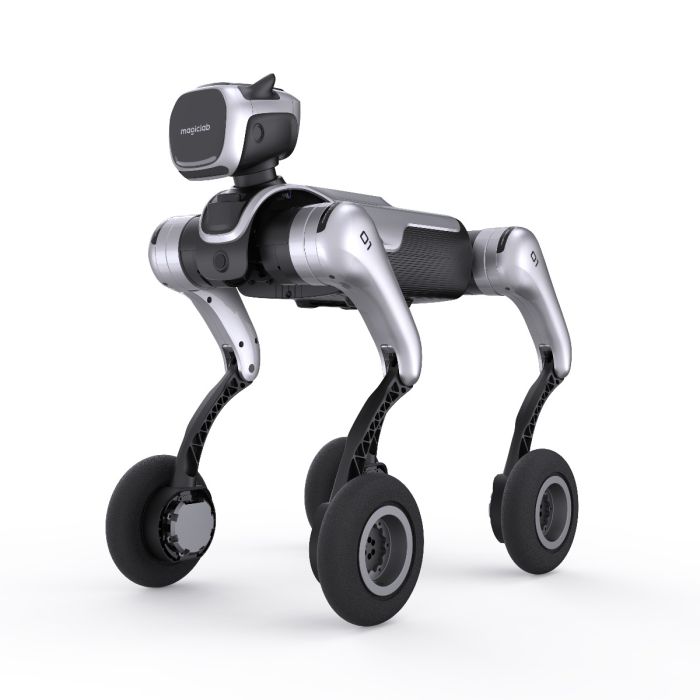
Most of a quadruped's motors are spent on two things: staying upright and getting somewhere. The MagicLab MagicDog-W Wheeled Quadruped Robot Dog spends sixteen on those tasks and one more on its head, so that it can turn and look at the people it works alongside. That detail captures the whole machine. It is a serious mobile platform, with LiDAR, depth sensing, onboard computing and a backplate built for extra equipment, and it is also a robot designed to be met face to face, with an expressive display where a plain sensor housing might otherwise be. Few robots in this class are asked to be both a working tool and a presence in a room, and the MagicDog-W is built on the assumption that many buyers need exactly that combination.
Robots Middle East sells the MagicDog-W and supplies it to universities, research institutes, integrators, venues and corporate clients across the Middle East. Robots Middle East prepares each quotation, arranges delivery to the customer's site and remains the point of contact for support after the robot is in service, so that a project team deals with one partner from the first enquiry to everyday operation.
Background
MagicLab and its robot family
MagicLab develops both humanoid and quadruped robots. Its MagicBot line covers humanoid platforms in several editions, whilst the MagicDog line covers four-legged robots for research, education and applied work. The MagicDog-W sits within that quadruped family as the wheeled member: the variant intended for customers whose robot must cover ground efficiently as well as negotiate uneven surfaces. Because MagicLab works across both humanoids and quadrupeds, the MagicDog-W reflects a company that treats perception, interaction and mobility as parts of a single engineering problem rather than as separate products.
A wheel-leg body with a sensing head
The defining feature of the MagicDog-W is its 7-inch pneumatic tyres, fitted to a four-limbed body built from aluminium alloy and high-strength engineering plastic. Wheel-leg robots of this kind are generally used where a route mixes smooth, open floors with obstacles and gradients; the wheels carry the robot efficiently across the former, while the articulated legs manage posture and balance on the latter. The MagicDog-W is rated for slopes of up to 40°, with a maximum joint torque of 37.5 N·m. Above the body sits a perception package that combines a 2D LiDAR, a dual camera, a depth camera, a 4K HD camera, a fisheye camera and ultrasonic sensors, all processed by 6TOPS of onboard computing power. The head, driven by its own motor, carries a display capable of 24 facial expressions, which gives the robot a readable character in public-facing settings.
Technical Specifications
| Specification | Value |
|---|---|
| Standing dimensions | 670*350*650mm |
| Prone dimensions | 720*500*290mm |
| Total weight | 22.5 kg (with battery) |
| Payload | Maximum 10 kg |
| Motion speed | 0-3 m/s |
| Material | Aluminium alloy + high-strength engineering plastic |
| Tyre type and size | 7-inch pneumatic tyre |
| Motor number | 16+1 (Head Motor) |
| Maximum joint torque | 37.5 N·m |
| Maximum slope angle | ≤ 40° |
| Onboard computing power | 6TOPS |
| Sensors | 2D LiDAR + Dual Camera + Depth Camera + 4K HD Camera + Fisheye Camera + Ultrasonic Sensors |
| Communication | WiFi 5, 4G Module, BT 5.0 |
| Battery | Capacity: 8200 mAh, Rated Voltage: 29.6 V |
| Battery life | 2-4 h |
| Operating temperature range | -5° ~ 40° |
| Facial expression display | 24 |
| Expansion | Versatile backplate compatible with expansion docks for mounting peripherals such as LiDAR and gimbals |
Specifications are as published by the manufacturer and are confirmed against the datasheet at quotation. The manufacturer has not published the IP rating, the charging time, whether the battery can be swapped, the maximum runtime per charge under load or the noise level; these points are confirmed at quotation.
What makes the MagicDog-W different from a conventional robot dog?
A conventional quadruped moves by stepping, which suits broken ground but tends to be a slow and energy-hungry way to cross a long, flat floor. A purely wheeled robot has the opposite profile. The MagicDog-W combines the two approaches in a single chassis: pneumatic tyres at the end of articulated limbs, giving a motion speed of 0-3 m/s while retaining the leg structure that lets it hold posture on a slope of up to 40°. Pneumatic tyres also absorb some of the shock from rough surfaces, which matters for a robot carrying cameras and a LiDAR.
The second difference lies in what the robot carries and how it communicates. Many quadrupeds are sold as bare locomotion platforms to which customers must add their own perception. The MagicDog-W arrives with a layered sensor suite and 6TOPS of onboard computing, and it connects over WiFi 5, a 4G module and BT 5.0. The 4G module is particularly relevant to outdoor deployments across large campuses, industrial sites or venues where WiFi coverage is incomplete. The third difference is the head: a dedicated motor and a display with 24 facial expressions turn the robot from an anonymous machine into something visitors, students and staff can read at a glance. For a robot that will spend time among people, that legibility is a practical feature, not merely a decorative one.
What is the difference between the MagicDog-W and the MagicDog-W Pro?
The sources name two versions: the MagicDog-W in its Standard version and the MagicDog-W Pro. The specifications above are not broken down by version, and no separate figures exist for the Pro. Robots Middle East therefore sets out the exact configuration, and any difference in equipment between the two, in the quotation, so that each figure a customer relies on is tied to the version actually being supplied.
Who is the MagicDog-W for?
The first group is research teams in robotics, autonomy and human–robot interaction. A platform that combines wheel-leg locomotion, a 2D LiDAR, depth and fisheye cameras and onboard computing gives such teams a great deal to work with from the first day, and the expansion backplate leaves room for their own sensors or gimbals.
The second group is educators. Universities and advanced technical schools can use the MagicDog-W to teach perception, navigation and control on a single machine that students find engaging, not least because of its expressive head.
The third group is system integrators and facility operators who are exploring patrol, inspection or guidance tasks across mixed indoor and outdoor ground. For these customers, the payload of up to 10 kg, the 4G connectivity and the expansion docks are the specifications that tend to decide a project. Buyers in the region should note the operating temperature range of -5° ~ 40° when planning outdoor use during the hottest months.
The fourth group is venues, exhibitions and corporate showrooms, where a robot that greets visitors with an expression is more memorable than one that simply rolls past. Customers whose priority is a legged quadruped without wheels may also wish to compare the MagicLab MagicDog Quadruped Robot and the MagicLab MagicDog Y1 Quadruped Robot Dog; Robots Middle East can advise on which member of the family fits a given brief.
What is the MagicDog-W used for?
- Site patrol: covering long routes across campuses, compounds and facilities, with cameras recording what the robot passes.
- Routine inspection: carrying its sensor suite, or additional instruments mounted on the backplate, along regular inspection paths.
- Robotics research: serving as a test platform for locomotion, mapping, autonomy and human–robot interaction studies.
- Teaching and STEM programmes: giving students hands-on experience of perception, control and navigation on one machine.
- Visitor engagement: welcoming and guiding guests at exhibitions, showrooms and events, using its expressive head display.
- Light carrying tasks: transporting tools, samples or equipment within its payload limit.
Pricing and Availability
The MagicDog-W is supplied by quotation, which allows Robots Middle East to agree the version, the configuration and any expansion equipment with the customer against the intended application before an order is placed. Delivery, customs clearance and after-sales support are arranged together with the quotation. To begin the process for your organisation, the quotation request is available on this page.
Frequently Asked Questions
How fast can the MagicDog-W move?
The MagicDog-W has a motion speed of 0-3 m/s. Its wheel-leg design lets it use that speed on open ground while keeping the leg structure for balance on slopes.
How much can the MagicDog-W carry?
The robot has a maximum payload of 10 kg. The backplate and expansion docks allow peripherals such as LiDAR units and gimbals to be mounted.
How long does the battery last?
Battery life is 2-4 h, from a battery with a capacity of 8200 mAh and a rated voltage of 29.6 V.
Can additional sensors or equipment be fitted?
Yes. The MagicDog-W has a versatile backplate that is compatible with expansion docks for mounting peripherals such as LiDAR and gimbals.
How does the MagicDog-W connect to a network?
It offers WiFi 5, a 4G module and BT 5.0. The 4G module is useful where a site has no continuous WiFi coverage.
Is the MagicDog-W suitable for outdoor use in the Middle East?
The operating temperature range is -5° ~ 40°, which should be taken into account when scheduling outdoor work in hot conditions. For protection against dust and water, please raise the question with Robots Middle East when requesting your quotation.
Where can I buy the MagicDog-W and what does it cost?
Robots Middle East supplies the MagicDog-W across the Middle East. The cost depends on the version and configuration chosen and is set out in a tailored quotation, which you can request on this page.
Summary
The MagicDog-W is defined by the balance it strikes between work and presence. Its sixteen locomotion motors, pneumatic tyres and articulated legs make it an efficient wheel-leg platform that can carry up to 10 kg and hold its footing on gradients of up to 40°, while its LiDAR, cameras, ultrasonic sensors and 6TOPS of onboard computing give it the perception that autonomous tasks require. Its seventeenth motor and expressive display make it a robot that people can read and approach with ease. For research groups, educators, integrators and venues that need both qualities in one machine, supplied, delivered and supported by Robots Middle East, this page is the starting point.