DISCONTINUED - Unitree Go1 Quadruped Robot Dog
Out of stock
- BRAND:
- UNITREE ROBOTICS
- MODEL:
- GO1
- ORIGIN:
- China
- AVAILABILITY:
- DISCONTINUED
- SKU:
- Unitree-Go1
DISCONTINUED - Unitree Go1 Quadruped Robot Dog
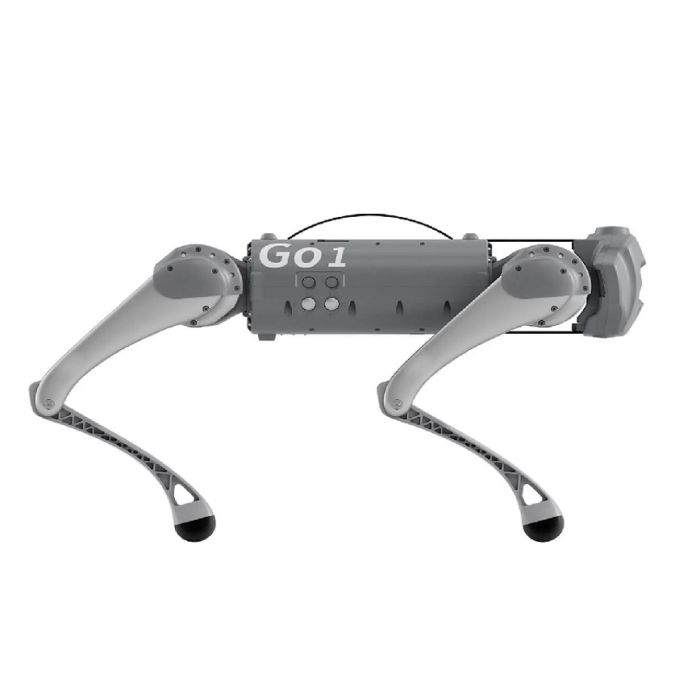
Under one name and on one chassis, the Go1 offers three quite different robots: a companion that trots beside its owner, a showpiece that watches the room from every side, and an open platform that researchers can program for themselves. The DISCONTINUED - Unitree Go1 Quadruped Robot Dog is the machine Unitree Robotics described as the world's first consumer-grade accompanied bionic quadruped, and it brought legged robotics within reach of buyers who had never owned a laboratory robot. Choosing well means looking past the shared body to the sensors, interfaces and speeds that separate the Go1 Air, the Go1 Pro and the Go1 Edu.
Robots Middle East sells the Go1 to universities, research groups, system integrators and private buyers across the Middle East, and it quotes, delivers and supports every order it supplies. As the manufacturer has discontinued the Go1, Robots Middle East sets out in each quotation which version can still be supplied and in what condition, so that you can weigh it fairly against current Unitree models before you commit.
Background
Unitree Robotics and the Go1 line
Unitree Robotics is a Chinese manufacturer that built its reputation on legged robots, moving over the years from research-grade quadrupeds towards machines that individuals, schools and smaller laboratories could realistically own. The Go1 was the model in which the company addressed consumers directly: lightweight, foldable for transport and designed to be taken wherever you go. Newer models have since taken its place in the range, yet the Go1 remains a useful point of reference for anyone studying how compact quadrupeds are designed, controlled and taught. Related platforms can be browsed in the Unitree Go1 category and across the wider Quadrupeds range.
Super-perception and intelligent accompaniment
Two systems define the Go1. The SSS super-sensing system relies on fisheye binocular depth cameras, each set covering a sensing angle of ≈ 150 x 170°; the Go1 Air carries one pair, while the Go1 Pro and Go1 Edu carry five pairs, giving the upper versions a far more complete view of their surroundings. The ISS intelligent accompaniment system lets the robot keep to its owner's side, using Unitree's patented wireless vector positioning and control technology rather than relying on the cameras alone. Beneath the shell, twelve silver alloy precision joint motors drive the legs, and a patented heat pipe-assisted heat dissipation system sits near the knee joint motors, where sustained effort produces the most heat. Processing is handled by a 16-core CPU paired with a 384-core GPU rated at 1.5TFLOPS.
Technical Specifications
| Specification | Go1 Air | Go1 Pro | Go1 Edu |
|---|---|---|---|
| Motion speed | 0 ~ 2.5m/s | 0 ~ 3.5m/s | 0 ~ 3.7m/s (limit ~ 5m/s) |
| Load | ≈4kg (limit ~ 10kg) | ≈4kg (limit ~ 10kg) | ≈6kg (limit ~ 10kg) |
| SSS super-sensing system (camera pairs) | 1 pair | 5 pair | 5 pair |
| Silver alloy precision joint motors | 12 piece | 12 piece | 12 piece |
| Charger | 24V,4A | 24V,6A | 24V,6A |
| Python programming interface | Not included | Not included | Included |
| Foot-end physical force sensor | Not included | Not included | Included |
| Radar | Not included | Not included | 2D or 3D optional |
| Weight | 12 kg | 12 kg | 12 kg |
| Dimensions (L x W x H, folded) | 0.588 x 0.22 x 0.29 m | 0.588 x 0.22 x 0.29 m | 0.588 x 0.22 x 0.29 m |
| Adaptive load capacity | ≈ 3-5 kg | ≈ 3-5 kg | ≈ 3-5 kg |
| Maximum speed | ≈4.7m/s (17km/h) | ≈4.7m/s (17km/h) | ≈4.7m/s (17km/h) |
| Fisheye binocular depth sensing angle (per set) | ≈ 150 x 170° | ≈ 150 x 170° | ≈ 150 x 170° |
| Body/thigh joint motor | C1-8: 520g 23.70N.m (MAX) | C1-8: 520g 23.70N.m (MAX) | C1-8: 520g 23.70N.m (MAX) |
| Knee joint | C1-8×1.5 ratio 35.55N.m (MAX) | C1-8×1.5 ratio 35.55N.m (MAX) | C1-8×1.5 ratio 35.55N.m (MAX) |
| Battery runtime (alternating no-load standing and running) | About 1 -2.5hours | About 1 -2.5hours | About 1 -2.5hours |
| Remote control module | Joystick and mobile phone | Joystick and mobile phone | Joystick and mobile phone |
Specifications are as published by the manufacturer and are confirmed against the datasheet at quotation.
The manufacturer has not published the IP rating, the operating temperature range, the Wi-Fi standard, the climbing slope angle, the battery capacity, the noise level or the exact package contents; all of these are confirmed at quotation.
What does the Go1 Edu add over the Air and the Pro?
The three versions share the same frame, the same twelve joint motors and the same knee-joint cooling, so the differences lie in what each version can sense, how quickly it moves and how far it can be opened up. The Go1 Air is the entry point, with a single camera pair and a motion speed of 0 ~ 2.5m/s. The Go1 Pro raises the camera count to five pairs and the motion speed to 0 ~ 3.5m/s, and pairs it with a 24V,6A charger in place of the Air's 24V,4A unit.
The Go1 Edu is where the platform becomes a research tool. It is the only version with a Python programming interface, which allows your own code to command the robot rather than leaving you limited to the supplied control modes. It is also the only version with foot-end physical force sensors, which tell a controller how hard each foot is pressing on the ground, and the only one that accepts an optional 2D or 3D radar for mapping and obstacle work. Its motion speed reaches 0 ~ 3.7m/s with a limit of ~ 5m/s, and its load rises to ≈6kg against ≈4kg for the Air and the Pro. For anyone intending to write software, gather contact data or experiment with navigation, the Edu is the version to request.
Is a discontinued quadruped still a sensible purchase?
A discontinued model is not automatically the wrong choice. The Go1's architecture is settled and well understood, its version structure is clear, and for teaching the basics of legged locomotion, perception and following behaviour it remains a complete, capable platform. The questions worth asking are practical ones: which version is available, what condition it is in, and what spare parts and support can accompany it. Robots Middle East addresses each of these in the quotation. If you need a current model with a longer service horizon, the Unitree Go2 PRO Robot Dog DEMO is worth comparing side by side with the Go1.
Who is the Go1 for?
The Go1 Air suits enthusiasts and early adopters who want a responsive companion robot that follows them and walks confidently around the home or office, without needing the full camera array. The Go1 Pro suits exhibitors, marketing teams and innovation centres that want a robot able to read its surroundings convincingly in front of an audience. The Go1 Edu is the version for universities, research laboratories and technical colleges, where the Python interface, foot-end force sensing and optional radar turn the robot into a teaching and experimentation platform.
Some buyers will be better served elsewhere in the range. Organisations planning site inspection or outdoor industrial patrols should look at the Unitree AS2 Air Industrial Quadruped Robot Dog, while research groups wanting a larger dedicated research quadruped can consider the Unitree Aliengo Quadruped Robot. Robots Middle East can set out the comparison in a single quotation.
What is the Go1 used for?
- Teaching legged locomotion: students observe gait, balance and recovery on a real machine rather than in simulation alone.
- Programmable research: the Go1 Edu's Python interface lets researchers test their own control and behaviour code.
- Perception and mapping experiments: the stereo fisheye cameras, and the optional radar on the Edu, support work on depth sensing and navigation.
- Exhibitions and public demonstrations: a quadruped that follows its handler draws attention at events, museums and showrooms.
- Companion and following studies: the ISS accompaniment system offers a ready basis for exploring how robots keep pace with people.
- Light payload trials: teams can test small sensor or carrying attachments within the load figures in the table above.
Pricing and Availability
Robots Middle East supplies the Go1 on quotation, because version, condition and the accompanying accessories all shape the final offer for a discontinued model. Delivery, customs clearance and after-sales support are arranged together with the quotation. Tell us which version interests you and how you intend to use it, and the offer will be prepared to match your project. A quotation request is available on this page.
Frequently Asked Questions
What are the differences between the Go1 Air, Go1 Pro and Go1 Edu?
The Air has one camera pair and the lowest motion speed, the Pro has five camera pairs and a higher speed, and the Edu adds a Python programming interface, foot-end force sensors, optional 2D or 3D radar and a higher load.
How fast can the Go1 move?
Motion speed is 0 ~ 2.5m/s on the Air, 0 ~ 3.5m/s on the Pro and 0 ~ 3.7m/s on the Edu, with a limit of ~ 5m/s. The maximum speed is given as ≈4.7m/s (17km/h).
How long does the battery last?
With no-load static standing and upright running alternating, the rated life is about 1 -2.5hours.
Can the Go1 be programmed?
Yes, on the Go1 Edu, which is the only version with a Python programming interface. The Air and the Pro are operated through the supplied control modes.
How is the Go1 controlled?
The remote control module comprises a joystick and a mobile phone. The ISS accompaniment system also allows the robot to follow at its owner's side.
What do the foot-end force sensors on the Go1 Edu do?
They measure the force each foot exerts on the ground, giving a controller direct contact information for balance and gait research. They are fitted to the Go1 Edu only.
Where can I buy the Unitree Go1 and what does it cost?
You can buy the Go1 from Robots Middle East, which supplies it across the Middle East on quotation. The cost depends on version, condition and accessories, so request a quotation and the full offer, including delivery and support, will be prepared for you.
Summary
The Go1 is one body carrying three distinct propositions: a companion in the Air, a perceptive showpiece in the Pro and a programmable research platform in the Edu. Its twelve joint motors, fisheye depth cameras and patented following technology made it a landmark consumer quadruped, and even as a discontinued model it can still earn its place in a classroom, a laboratory or an exhibition hall, provided the version matches the task. Robots Middle East will set out availability, condition and version options before you order; for anyone weighing the Go1 against its successors, this page is the starting point.