
Unitree H1 Humanoid Robot - Fastest Robot In The World
In stock
- BRAND:
- UNITREE ROBOTICS
- MODEL:
- H1
- ORIGIN:
- China
- AVAILABILITY:
- SUBJECT TO AVAILABILITY
- SKU:
- Unitree-H1
Unitree H1 Humanoid Robot - Fastest Robot In The World
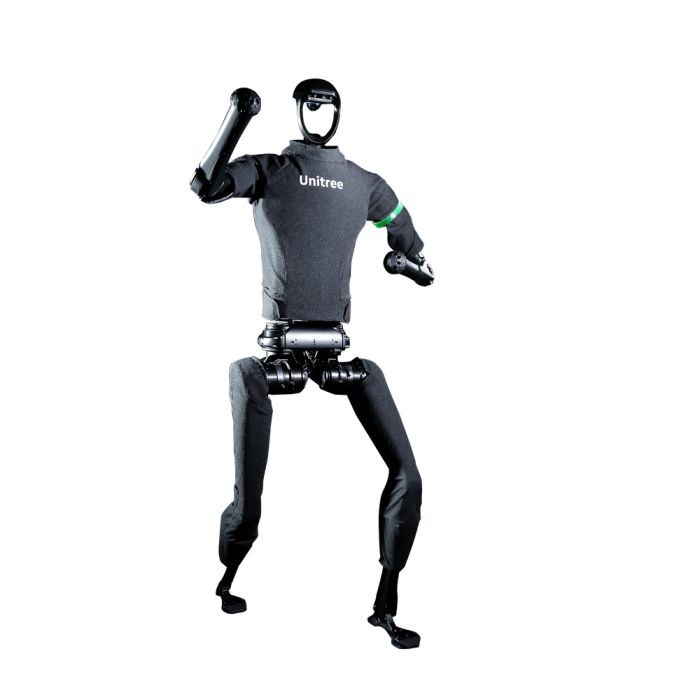
Height is the easy part of building a humanoid; carrying that height at a run is the hard part. A machine the size of a tall adult has long levers, a high centre of mass and very little margin for error once both feet leave the ground. The Unitree H1 Humanoid Robot - Fastest Robot in the World was designed around that problem. It stands about 180CM tall yet weighs about 47kg, and it ranks as the first full-size general-purpose humanoid robot that can run in China. The result is a platform that is light for its stature and powerful at the joints, aimed at teams that want to study and develop dynamic human-scale locomotion rather than merely watch it.
Robots Middle East sells the Unitree H1 and supplies it to universities, research institutes, innovation centres and corporate laboratories across the Middle East. Robots Middle East prepares each quotation for the configuration requested, arranges delivery to the buyer's site and remains the point of contact for support after the robot has been commissioned, so that a project has one accountable partner from the first enquiry onwards.
Background
Unitree Robotics and the road to a full-size humanoid
Unitree Robotics built its reputation on legged machines, developing the actuators, control software and manufacturing discipline that agile walking robots require. The H1 is Unitree's first universal humanoid robot, marking the point at which that experience in legged locomotion was scaled up to a two-legged body of adult proportions. Within the company's range it sits in the Unitree H1 / H1-2 family, which also includes the H1-2 version, and more broadly among the Bipedal Humanoids that serve research and development work.
Joint technology as the foundation
What allows a tall, slender robot to run is not its frame but its joints. The H1 reaches a peak torque density of 189N.m/Kg, meaning its actuators deliver a great deal of force relative to their own mass. Each joint output uses industrial grade crossed roller bearings, chosen for high precision and high load capacity, which matters when every footstep sends impact loads back through the leg. The legs are deliberately long, with thigh and calf lengths of 400mm each, giving the robot the stride geometry of a person. Perception comes from a 3D LiDAR and a depth camera that gather high-precision spatial data in real time for panoramic scanning, and continuous over-the-air software upgrades and updates let the platform improve after delivery.
Technical Specifications
| Specification | Value |
|---|---|
| Height | about 180CM |
| Weight | about 47kg |
| Key dimensions | (1520+285)mm × 570mm × 220mm |
| Peak torque density | 189N.m/Kg |
| Battery capacity | 864Wh, quickly replaceable |
| Battery | 15Ah (0.864KWh), Max Voltage 67.2V |
| DOF of each leg | 5 (Hip × 3 + Knee × 1 + Ankle × 1) |
| DOF of each arm | 4 (Expandable) |
| Thigh and calf length | 400mm × 2 |
| Total arm length | 338mm × 2 |
| Joint output bearing | Industrial grade crossed roller bearings (high precision, high load capacity) |
| Sensors | 3D LiDAR + Depth Camera |
| Computing (standard configuration) | Intel Core i5 (Platform Function), Intel Core i7 (User Development) |
| Dexterous hand | Optional |
| Software updates | Continuous OTA Software Upgrade and Update |
Specifications are as published by the manufacturer and are confirmed against the datasheet at quotation. The manufacturer has not published the battery runtime, the IP rating, the connectivity options, the operating temperature range, the charging time or the contents of the box; these are confirmed at quotation.
All figures in the table belong to the Unitree H1, not to the H1-2.
What sets the Unitree H1 apart from other humanoid platforms?
Many humanoid robots are built to walk carefully, keeping a foot on the ground at all times so that balance is never truly at risk. The H1 belongs to a different category: its defining capability is running, and running requires a phase in which the robot is airborne and must recover balance on landing. That demands actuators able to absorb and return large forces quickly, which is why the torque density figure of 189N.m/Kg sits at the centre of the design.
The second distinction is the relationship between size and mass. A robot of about 180CM that weighs about 47kg carries far less inertia through its limbs than a heavier machine of the same height, which makes dynamic motion easier to control and reduces the energy spent simply moving the body. The leg arrangement supports this, with five degrees of freedom per leg distributed as three at the hip, one at the knee and one at the ankle.
Third, the H1 separates the computing that keeps the robot functioning from the computing given to the user. In the standard configuration an Intel Core i5 handles platform functions while an Intel Core i7 is reserved for user development. For a research team this division is practical: experimental code can run on its own processor without competing with the controller that keeps the robot upright.
How does the Unitree H1 support long working sessions in the laboratory?
Development work on a humanoid is rarely continuous; it proceeds in cycles of testing, data collection and adjustment. The H1's battery is rated at 864Wh, with a capacity of 15Ah and a maximum voltage of 67.2V, and it is designed to be quickly replaceable. A team holding a spare pack can therefore exchange batteries between sessions instead of pausing the programme while a single pack recharges. Robots Middle East can advise on spare packs when preparing the quotation, so that a test schedule can be planned realistically.
Continuous over-the-air software upgrades also matter here. Locomotion and perception software improve over time, and a platform that receives updates remotely stays current without being returned for service. The arms, with four degrees of freedom each and described as expandable, together with the optional dexterous hand, give room to extend experiments from locomotion towards manipulation as a project matures.
Who is the Unitree H1 for?
The H1 suits university departments and research institutes studying bipedal locomotion, balance control and reinforcement learning, where a robot capable of running offers problems that a slow walker cannot. National and corporate innovation centres in the region will find it a credible platform for demonstrating human-scale robotics to visitors and partners while still supporting serious engineering work. Software and artificial intelligence teams developing perception or embodied intelligence can make use of the dedicated user-development processor and the LiDAR and depth camera data stream.
Teams whose work centres on manipulation should specify the optional dexterous hand when requesting a quotation, as the hand is not part of every configuration. Buyers comparing the H1 with the H1-2 can review both in the Unitree H1 / H1-2 category; Robots Middle East will set out the specifications of each version side by side so that the choice rests on the facts of the project.
What is the Unitree H1 used for?
- Locomotion research: studying dynamic walking and running on a full-size bipedal body.
- Control algorithm development: testing balance, gait and recovery controllers on demanding hardware.
- Embodied artificial intelligence: training and deploying learning-based policies on a human-scale robot.
- Perception and mapping: working with real-time 3D LiDAR and depth camera data for spatial understanding.
- Manipulation studies: extending research to grasping and handling with the optional dexterous hand.
- Demonstration and outreach: presenting advanced humanoid robotics at exhibitions, innovation centres and universities.
Pricing and Availability
The Unitree H1 is supplied on quotation, because the final configuration, including the computing package, the optional dexterous hand and any spare batteries, shapes the order. Delivery, customs and after-sales support are arranged together with the quotation from Robots Middle East. To begin, a formal quotation request for the Unitree H1 is available on this page.
Frequently Asked Questions
How tall and how heavy is the Unitree H1?
The Unitree H1 stands about 180CM tall and weighs about 47kg. Its key dimensions are (1520+285)mm × 570mm × 220mm.
Can the Unitree H1 really run?
Yes. The H1 is the first full-size general-purpose humanoid robot that can run in China.
What sensors does the Unitree H1 carry?
It is equipped with a 3D LiDAR and a depth camera, which acquire high-precision spatial data in real time for panoramic scanning.
Which processors are included?
The standard configuration includes an Intel Core i5 for platform functions and an Intel Core i7 for user development.
Is the battery replaceable?
Yes, the 864Wh battery is quickly replaceable, so a spare pack can be exchanged between working sessions.
Does the Unitree H1 come with hands?
A dexterous hand is available as an option. Please state whether you require it when requesting a quotation.
Where can I buy the Unitree H1 and what does it cost?
Robots Middle East sells and supplies the Unitree H1 across the Middle East. The cost depends on the configuration selected, so Robots Middle East provides it in a formal quotation requested through this page.
Summary
Building a humanoid as tall as a person is one achievement; making it light enough and strong enough at the joints to run is another. The Unitree H1 combines a stature of about 180CM with a weight of about 47kg, a peak torque density of 189N.m/Kg, crossed roller bearings at its joint outputs, 3D LiDAR and depth perception, a dedicated development processor and a quickly replaceable battery. Together these make it a serious platform for teams that intend to work on dynamic human-scale motion rather than observe it from a distance. For organisations in the Middle East ready to configure, quote and deploy a running humanoid with Robots Middle East, this page is the starting point.
Specifications
General
Physical
Performance
What's included
Related Products
Out of stock