
Unitree H2 EDU SMART G Humanoid Robot
In stock
- BRAND:
- UNITREE ROBOTICS
- MODEL:
- H2-EDU-SMART-G
- PART #:
- H2-EDU-SMART-G
- ORIGIN:
- China
- Warranty:
- 12 MONTHS
- AVAILABILITY:
- SUBJECT TO AVAILABILITY
- SKU:
- Unitree-H2-EDU-SMART-G
Unitree H2 EDU SMART G Humanoid Robot
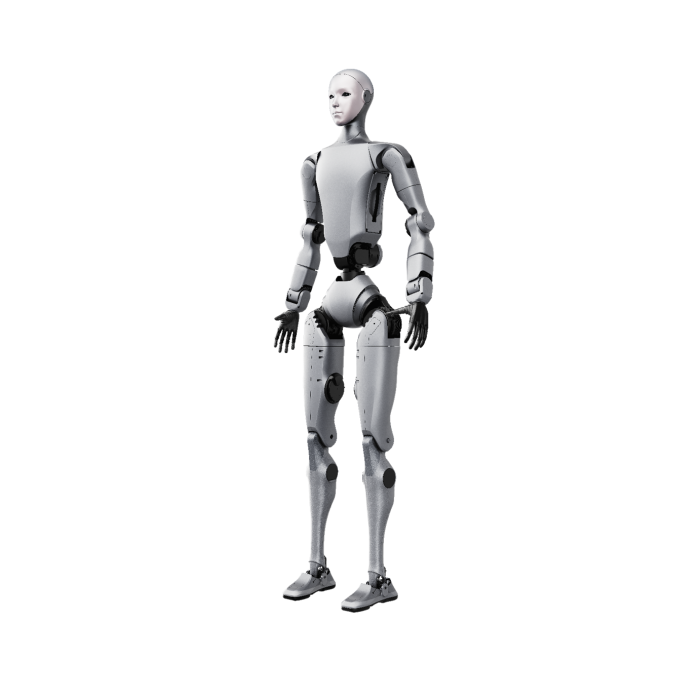
A person handling a fragile object gathers information at three distances: the eyes take in the scene, a glance follows the hand as it closes, and the fingertips report what no camera can see. Most humanoid platforms work only at the first of these distances. The Unitree H2 EDU SMART G Humanoid Robot works at all three. It combines a humanoid binocular camera with a wide field of view in the head, RGB cameras mounted at each wrist, and two five-finger BrainCo Revo 2 Touch hands that register pressure, friction, direction and proximity. Because it is built on the H2 EDU body, which is open to secondary development, research teams can study seeing and touching together in one full-size humanoid rather than in separate test rigs.
Robots Middle East sells the Unitree H2 EDU SMART G Humanoid Robot and supplies it to universities, research institutes, corporate innovation centres and system integrators across the Middle East. Robots Middle East prepares each quotation for the exact configuration requested, arranges delivery to the customer's site and remains the point of contact for technical support once the robot is in service.
Background
Unitree Robotics and the H2 family
Unitree Robotics made its name with legged machines, first with quadruped robots and then with a growing family of humanoids aimed at research, education and applied robotics. The H2 is the company's full-size humanoid, and it comes in several forms: the base H2, the H2 EDU development platform, the H2 EDU STANDARD package and a series of lettered H2 EDU SMART configurations. These are distinguished mainly by the dexterous hands they carry, including the DEX1-1 Plus, DEX3-1, DEX5-1, Inspire DFQ and, on the SMART G, the BrainCo Revo 2 Touch. The whole range is grouped under the Unitree H2 EDU category, where the configurations can be compared side by side.
All of these configurations share the same body. Its joints are driven by low-inertia, high-speed internal-rotor permanent magnet synchronous motors, a design chosen for fast response and effective heat dissipation. Its algorithms are not fixed at delivery either: they evolve continuously through over-the-air updates, so the platform a laboratory receives keeps developing during its working life.
Touch as the defining technology
What sets the SMART G apart within the family is its pair of BrainCo Revo 2 Touch hands. Each has five fingers and six degrees of freedom, and each provides tactile feedback across four modalities: pressure, friction, direction and proximity. Pressure tells a controller how firmly an object is held. Friction and direction show whether it is beginning to slide, and in which way. Proximity sensing lets the hand register an object before contact, which matters when a grasp has to be adjusted in the final moments of approach. Wrist-mounted RGB cameras complete the arrangement and give each hand its own close-range view of the object it is reaching for.
For manipulation research this combination is significant. Vision-only grasping depends on the head camera keeping the object in view, and that view is often blocked by the hand itself at the moment of contact. A wrist camera and tactile fingertips fill exactly that gap, giving researchers data streams in which visual and tactile signals can be recorded and aligned for the same action.
Technical Specifications
| Specification | Value |
|---|---|
| Hands (SMART G Revo 2 Touch) | 2 × five-finger BrainCo Revo 2 Touch hands with wrist-mounted RGB cameras |
| Hand degrees of freedom | 6 DoF per hand |
| Hand weight | 383 g |
| Tactile feedback | Pressure, friction, direction and proximity |
| Standing dimensions, H x W x D (H2 EDU body) | 1820 x 456 x 218mm |
| Weight with battery (H2 EDU body) | About 70kg |
| Total degrees of freedom (H2 EDU base body) | 31 |
| Maximum leg joint torque | 360N.m |
| Maximum arm joint torque | 120N.m |
| Arm maximum payload | Peak: ~15 kg; Rated: ~7 kg |
| Joint motor | Low inertia high-speed internal rotor PMSM |
| Battery capacity | 15Ah(0.972KWh) |
| Battery life | About 3h |
| Onboard computing | PC1: Intel Core i5 (Platform Capabilities); PC2: Intel Core i7 (Custom Development) |
| High-power computing module | Multiple brands and models available, such as Thor |
| Sensing | Humanoid Binocular Camera with Wide Field of View |
| Voice interaction | Array Microphone and High-Power Speaker |
| Wireless connectivity | WiFi 6, Bluetooth 5.2 |
| Secondary development | Supported |
| Software updates | Algorithms evolve continuously via OTA |
| Included accessories (H2 EDU) | Smart Battery (Quick Release), Charger, Manual Controller |
These specifications are as published by the manufacturer and are confirmed against the datasheet at quotation.
The manufacturer has not published the top walking speed, the IP rating, the operating temperature, the total weight of the SMART G configuration, the camera resolution or the charging time; Robots Middle East confirms each of these at quotation.
What does the SMART G configuration add to the H2 EDU?
The H2 EDU is designed to take a dexterous hand, with several models offered, and the lettered SMART configurations are the way that choice is made. The SMART G commits the platform to the BrainCo Revo 2 Touch, and with it to tactile sensing. A configuration chosen for its finger count alone treats the hand as an actuator. The SMART G treats it as a sensor as well, reporting how an object responds to being held as well as where the fingers are.
The wrist-mounted RGB cameras matter just as much. The H2 EDU already sees through its wide-field binocular head camera; the SMART G adds a viewpoint that travels with each hand. In practice an experiment can draw on three sources at once: the scene from the head, the approach from the wrist and the contact from the fingertips. That makes the configuration particularly suited to work on grasp planning, in-hand manipulation and the collection of multimodal demonstration data.
The body underneath stays the same. The SMART G keeps the H2 EDU's 31 degrees of freedom in the base body, its 120N.m arm joints and its rated arm payload of around 7 kg, so tactile research does not come at the cost of the platform's strength or reach.
Why choose the H2 EDU rather than the base H2?
The distinction is development access. Secondary development is supported on the H2 EDU and not on the base H2, and for any organisation that intends to write its own controllers, train its own policies or integrate its own perception stack, that difference is decisive. The EDU's computing reflects this purpose: PC1, an Intel Core i5, runs the platform's own capabilities, while PC2, an Intel Core i7, is reserved for custom development. Researchers can therefore run their own code without displacing the robot's core functions.
For heavier workloads such as large vision-language models or on-board learning, the H2 EDU can also take a high-power computing module, available in multiple brands and models such as Thor. Robots Middle East can advise on the module that best suits a particular research plan.
Who is the Unitree H2 EDU SMART G Humanoid Robot for?
The clearest fit is the university or institute laboratory working on dexterous manipulation, where tactile data is the subject of the research rather than an afterthought. Embodied-AI groups that collect demonstration data for learning-based control will find value in a humanoid that records head vision, wrist vision and touch from the same action. Engineering faculties that teach humanoid robotics can use the platform to show students the full chain from perception to contact, while corporate innovation centres can use it to evaluate whether humanoid hands are ready for the handling tasks in their own operations.
Not every programme needs tactile hands. Teams whose research centres on a different hand design, or on locomotion and whole-body control with simpler end effectors, may be better served by a sibling configuration. The Unitree H2 EDU SMART A Humanoid Robot carries the DEX1-1 Plus, the Unitree H2 EDU SMART B Humanoid Robot the DEX3-1 and the Unitree H2 EDU SMART D Humanoid Robot the DEX5-1. Robots Middle East can advise on which hand best matches a given research plan.
What is the Unitree H2 EDU SMART G Humanoid Robot used for?
- Tactile grasping research: studying how pressure, friction and direction feedback improve grip on fragile or irregular objects.
- Slip detection and recovery: developing controllers that sense an object starting to slide and correct the grasp before it falls.
- Multimodal data collection: recording aligned head-camera, wrist-camera and tactile data for imitation and reinforcement learning.
- Higher education: teaching humanoid control, perception and manipulation on a platform that students can programme.
- Human-robot interaction: exploring spoken dialogue through the array microphone and speaker alongside physical hand-over tasks.
- Industrial feasibility studies: testing whether humanoid hands can take on picking, sorting or assembly steps in a controlled setting.
Pricing and Availability
The Unitree H2 EDU SMART G Humanoid Robot is supplied on quotation, because the final package depends on the chosen computing module, the accessories and the support arrangements each organisation requires. Robots Middle East prepares a quotation that sets out the full configuration in detail. Delivery, customs clearance and after-sales support are arranged together with the quotation. To begin, please use the quotation request available on this page.
Frequently Asked Questions
What hands does the Unitree H2 EDU SMART G carry?
It carries two five-finger BrainCo Revo 2 Touch hands, each with six degrees of freedom and a wrist-mounted RGB camera. The hands provide tactile feedback on pressure, friction, direction and proximity.
Can our own team program the robot?
Yes. Secondary development is supported on the H2 EDU, and a dedicated Intel Core i7 computer (PC2) is provided for custom development alongside the Intel Core i5 that runs the platform's own functions.
How long does the battery last?
The H2 EDU's 15Ah(0.972KWh) battery gives a battery life of about 3h. It is a quick-release smart battery, so it can be exchanged without lengthy downtime.
How much can the arms lift?
The arm maximum payload is about 15 kg at peak and about 7 kg rated. The arm joints deliver a maximum torque of 120N.m.
What is included with the robot?
The H2 EDU comes with a quick-release smart battery, a charger and a manual controller, and the SMART G configuration adds the two BrainCo Revo 2 Touch hands. The full package is itemised in the Robots Middle East quotation.
Does the robot support voice interaction and wireless connectivity?
Yes. It has an array microphone and a high-power speaker for voice interaction, and it connects via WiFi 6 and Bluetooth 5.2.
Where can I buy the Unitree H2 EDU SMART G Humanoid Robot and what does it cost?
You can buy it from Robots Middle East, which supplies it across the Middle East. The cost depends on the configuration and services selected, so please request a tailored quotation through this page.
Summary
A humanoid that only sees has to guess at the moment of contact. The Unitree H2 EDU SMART G Humanoid Robot removes much of that guesswork by perceiving at three distances: the wide-field binocular camera in its head, the RGB camera at each wrist and the tactile sensing in each BrainCo Revo 2 Touch fingertip. Beneath those senses sits the H2 EDU body, with 31 degrees of freedom, 360N.m leg joints, a dedicated development computer and algorithms that keep improving through over-the-air updates. For laboratories, universities and innovation teams that want to study how a robot handles the physical world, rather than only how it looks at it, this is a well-equipped platform. Robots Middle East supplies, delivers and supports it across the region, and for any organisation ready to discuss a configuration, this page is the starting point.