
AgileX LIMO COBOT
In stock
- BRAND:
- AGILEX
- PART #:
- LIMO COBOT
- ORIGIN:
- China
- AVAILABILITY:
- SUBJECT TO AVAILABILITY
- SKU:
- AgileX-LIMO-COBOT
AgileX LIMO COBOT
Code that works in simulation has a habit of failing on a real floor. A grasp that closes neatly in a virtual world misses by a little once wheels slip, lighting changes and the object is not quite where the map says it should be. The AgileX LIMO COBOT is built to close that gap. It puts a mobile base, a robotic arm and an onboard computer into one platform, so that the same project can move from the simulator to the laboratory floor without a separate arm, a separate robot and a cable harness improvised between them.
Robots Middle East supplies the AgileX LIMO COBOT to universities, technical colleges, training centres and competition teams across the Middle East. We prepare the quotation, arrange delivery to your institution and remain your point of contact for support once the platform is in use.
Background
From mobile robot to mobile manipulator
A mobile robot that can only drive teaches half of robotics. It can map a room, plan a route and avoid obstacles, but it cannot act on what it finds. A fixed arm teaches the other half: it can pick and place with care, yet only within reach of the bench it is mounted on. A mobile manipulator joins the two, and the most instructive problems in robotics appear exactly where they meet: driving up to an object, recognising it, positioning the base and reaching for it.
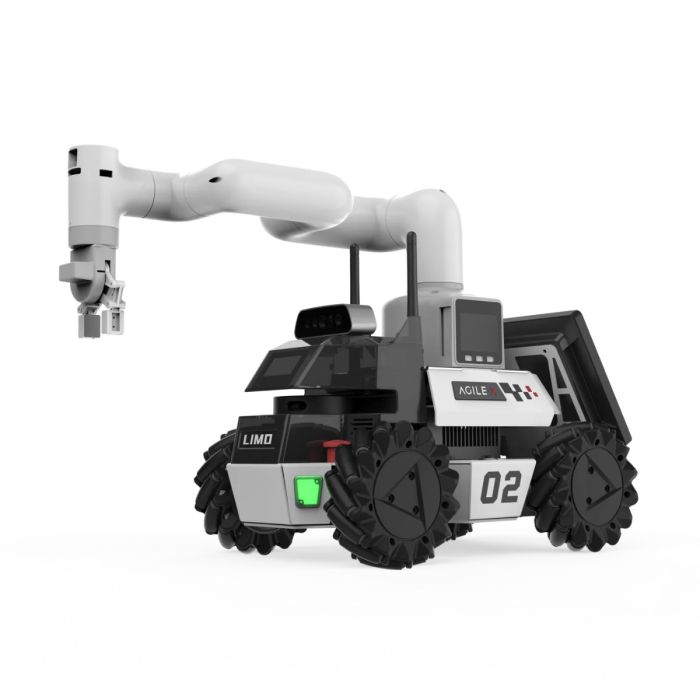
The LIMO COBOT is AgileX's answer to that combination. It integrates the Mycobot 280 M5 arm with an Nvidia Orin Nano computer on the LIMO mobile base, and it supports navigation, obstacle avoidance, mapping, mobile grasping and visual recognition. Rather than asking an institution to source and integrate each part, it arrives as a single system designed to be programmed.
The arm, the compute and the software stack
The arm is a 6-DoF robotic arm that supports various end-effectors, which allows precise mobile grasping across different task requirements. Six degrees of freedom give the arm the freedom to approach an object from a chosen angle rather than only from above, and the support for different end-effectors means that a course or a competition brief need not be shaped around a single gripper.
The Nvidia Orin Nano provides the onboard computing for the autonomous functions. On the software side, the platform supports ROS and Gazebo and is compatible with Python and C++. ROS is the framework most robotics courses already teach, and Gazebo is the simulator that is commonly used alongside it, so students can develop and test behaviour virtually before running it on the hardware. The base uses LIMO's Four-Wheel Differential Steering Mode, which AgileX describes as making driving on any surface easy.
Technical Specifications
| Specification | Value |
|---|---|
| Product | AgileX LIMO COBOT |
| Robotic arm | Mycobot 280 M5, 6-DoF, supports various end-effectors |
| Onboard computer | Nvidia Orin Nano |
| Steering mode | Four-Wheel Differential Steering Mode |
| Software platforms | ROS, Gazebo |
| Programming languages | Python, C++ |
| Functions | Navigation, obstacle avoidance, mapping, mobile grasping, visual recognition |
| Intended use | Education, competitions and training |
Specifications are as published by the manufacturer and are confirmed against the datasheet at quotation.
AgileX has not published the battery charging time, the IP rating, the operating temperature range, the wireless connectivity or the arm's payload at full extension; these are confirmed at quotation.
What makes the LIMO COBOT different from a separate arm and mobile robot?
An institution can, in principle, buy a small mobile robot and a desktop arm and join them. In practice the integration becomes the project: mounting, power, communication between two controllers and a software bridge that someone must maintain. Each semester begins with repairing what the last cohort changed, and the time intended for teaching autonomy is spent on wiring.
The LIMO COBOT removes that layer. The arm, the base and the Nvidia Orin Nano are integrated by the manufacturer, and the platform supports navigation, mapping, obstacle avoidance, visual recognition and mobile grasping as one system. Because it supports ROS and works with Python and C++, students write code in the languages and framework they are already learning rather than in a proprietary environment. The result is that the interesting question, how a robot should combine where it is with what it sees and what it reaches for, becomes the subject of the course rather than a distant goal at the end of it.
The integration also matters for assessment. When every group works on the same platform, results are comparable, faults are easier to diagnose and teaching material can be reused from one year to the next.
How does the LIMO COBOT support the move from simulation to hardware?
Support for both ROS and Gazebo is central to how the platform is meant to be used. A typical approach in robotics education is to build and test a behaviour in simulation, where mistakes cost nothing, and then to deploy it on a real robot, where the environment answers back. A platform that is supported in the simulator and runs the same framework on the hardware shortens that path considerably.
For a teaching programme, this allows a sensible rhythm: students first develop mapping, navigation or grasping logic in Gazebo, then take that work to the LIMO COBOT and discover how it behaves with real wheels, real lighting and real objects. The Four-Wheel Differential Steering Mode gives the base a manoeuvre that is straightforward to model, and the 6-DoF arm gives enough flexibility for grasping exercises to be meaningful rather than token. The gap between simulation and reality does not disappear, but it becomes something students can study and learn from, which is arguably the most valuable lesson the platform offers.
Who is the AgileX LIMO COBOT for?
The manufacturer positions the LIMO COBOT for education, competitions and training, and those three groups describe its natural buyers well.
Universities and engineering faculties are the first. Courses in robotics, mechatronics, computer vision and artificial intelligence benefit from a platform that combines mobility, perception and manipulation, and the ROS, Python and C++ support fits curricula that are already built around those tools.
Competition teams are the second. A mobile manipulator that arrives integrated allows a team to concentrate on strategy and software rather than hardware assembly, and to practise the full sequence of navigating, recognising and grasping on the same robot.
Training centres and vocational programmes are the third. Where the aim is to prepare technicians and engineers for work with autonomous systems, a single platform that demonstrates navigation, obstacle avoidance, mapping and grasping makes a compact and coherent training tool.
Buyers whose project calls for an arm without a mobile base may also consider the Agilex Piper Lightweight Robotic Arm, and the wider range can be compared in our AgileX and Cobots categories. Robots Middle East will advise on the most suitable platform when preparing your quotation.
What is the AgileX LIMO COBOT used for?
- Teaching autonomous navigation: students plan and follow routes on a real robot rather than only in simulation.
- Mapping exercises: groups build maps of a laboratory or corridor and use them for localisation and planning.
- Obstacle avoidance: learners test how a robot detects and reacts to objects in its path.
- Mobile grasping: the 6-DoF arm picks objects after the base has driven into position, joining motion and manipulation.
- Visual recognition: perception projects identify objects so that the robot can decide what to grasp.
- Competition preparation: teams rehearse complete tasks on an integrated platform before an event.
Pricing and Availability
Robots Middle East supplies the AgileX LIMO COBOT on quotation, so that the offer reflects your institution, the number of units and any accessories or end-effectors your programme requires. Delivery, customs clearance and after-sales support are arranged together with the quotation. To begin, please send us a short description of your intended use, and our team will respond with a tailored offer; the request form is available on this page.
Frequently Asked Questions
Which robotic arm does the AgileX LIMO COBOT use?
The LIMO COBOT integrates the Mycobot 280 M5, a 6-DoF robotic arm that supports various end-effectors for mobile grasping.
What computer runs the autonomous functions?
The platform integrates an Nvidia Orin Nano for its autonomous features, including navigation, mapping and visual recognition.
Can the LIMO COBOT be programmed with ROS?
Yes. It supports ROS and Gazebo and is compatible with Python and C++, which suits most university and training curricula.
How does the base steer?
The base uses LIMO's Four-Wheel Differential Steering Mode, which AgileX describes as making driving on any surface easy.
Is the LIMO COBOT suitable for robotics competitions?
The manufacturer presents it as a platform for education, competitions and training, and its integrated arm, base and computer allow teams to concentrate on software and strategy.
What is the battery charging time and the IP rating?
AgileX has not published the battery charging time or the IP rating. Robots Middle East confirms these details, together with the operating temperature, wireless connectivity and arm payload at full extension, when preparing your quotation.
Where can I buy the AgileX LIMO COBOT and what does it cost?
You can buy the AgileX LIMO COBOT from Robots Middle East, which supplies it across the Middle East. The cost depends on your configuration and is set out in a quotation prepared for your institution.
Summary
The AgileX LIMO COBOT addresses the moment when code written in simulation meets a real floor. By integrating the Mycobot 280 M5 arm and the Nvidia Orin Nano on the LIMO base, with support for ROS, Gazebo, Python and C++, it lets students and teams take navigation, mapping, obstacle avoidance, visual recognition and mobile grasping from the simulator to hardware on one platform. For universities, competition teams and training centres that want that transition to be part of the lesson rather than an obstacle to it, and that wish to work with Robots Middle East for supply and support, this page is the starting point.