
Agilex HUNTER 2.0
In stock
- BRAND:
- AGILEX
- PART #:
- HUNTER 2.0
- ORIGIN:
- China
- AVAILABILITY:
- SUBJECT TO AVAILABILITY
- SKU:
- AgileX-HUNTER-2.0
Agilex HUNTER 2.0
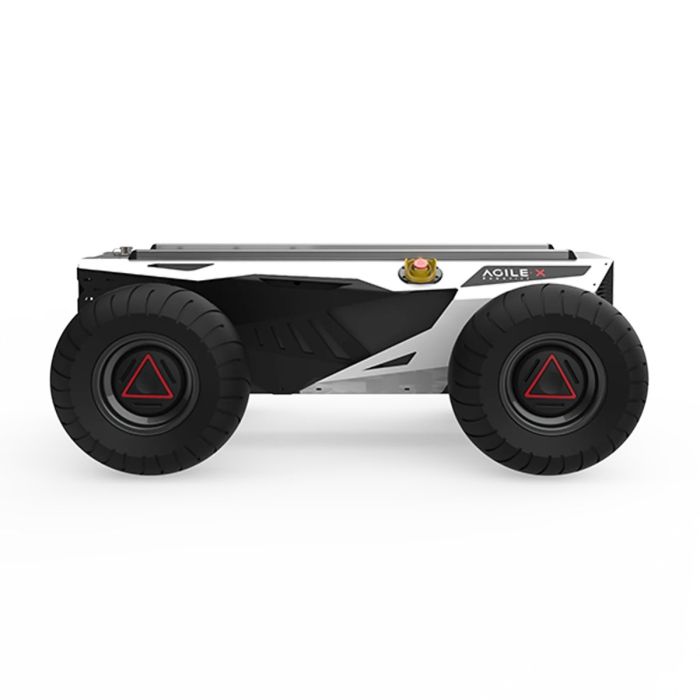
Between a simulator that never misses a lane and a service road where a kerb, a speed bump and a parked van appear in the same minute, every autonomous driving programme needs a vehicle it can afford to learn on. The Agilex HUNTER 2.0 is such a vehicle in compact form. It is a wheeled chassis developed for low-speed autonomous driving scenarios. It steers through its front wheels as a road car does, and it rides on rocker suspension that lets it negotiate the obstacles it meets on its path. It arrives as a foundation rather than a finished robot, and for the engineers who will build upon it, that is precisely the point.
Robots Middle East supplies the HUNTER 2.0 to universities, research institutes, system integrators and industrial development teams across the Middle East. We prepare each quotation around the configuration you require, including the optional FS RC transmitter and any custom IP protection. Once the platform is on site, Robots Middle East remains your point of contact for delivery, technical questions and after-sales support.
Background
AgileX and its family of mobile chassis
AgileX develops mobile robot platforms that are meant to be built upon. Its chassis supply locomotion, power and a control interface, while perception, planning and the application itself remain in the hands of the customer. The range spans wheeled and tracked designs for different terrains and research needs. Within it, the HUNTER line serves projects in which car-like motion matters more than anything else. You may compare the wider family in our AgileX category, where tracked, wheeled and manipulation platforms from the same manufacturer are listed.
Ackerman steering and rocker suspension
Two design decisions define the HUNTER 2.0. The first is front-wheel Ackerman steering, the geometry used in passenger vehicles. The rear wheels drive and the front wheels turn, so the chassis follows curved paths in the way a car does rather than rotating on the spot. The second is rocker suspension, which allows the wheels to follow uneven ground and helps the chassis negotiate obstacles in its way. Together they give a research team a platform whose motion can be described by the same vehicle models used in road-going autonomy. That kinematic fidelity is the reason the platform exists.
Technical Specifications
| Specification | Value |
|---|---|
| Intended use | Low-speed autonomous driving scenarios |
| Steering | Front-wheel Ackerman steering |
| Suspension | Rocker suspension |
| Maximum load | 150KG |
| Operating temperature | -10℃ to 45℃ |
| Water and dust protection (standard) | IP22 only, unless separate custom IP protection is configured |
| Communication standard | CAN2.0B, 500K baud rate, Motorola message format |
| Connectors | Two 4-pin aviation connectors and one DB9 (RS232) connector |
| Mounting | Aluminium T-slot rails for external sensors or kits |
| Software | Open-source SDK and software resources |
| Charger | 10A charger by default |
| Remote control | FS RC transmitter (optional) |
| Obstacle sensing | No automatic obstacle avoidance sensor fitted |
Specifications are as published by the manufacturer and are confirmed against the datasheet at quotation.
The manufacturer has not published the exact dimensions, the weight, the motor power or the top speed of the HUNTER 2.0; these details are confirmed at quotation.
What makes the HUNTER 2.0 different from a skid-steer research robot?
Many mobile research bases turn by driving the wheels on one side faster than the other, so the tyres scrub sideways across the ground. That approach is simple and manoeuvrable, but it does not resemble the way a car moves. Software written for skid-steer motion therefore transfers poorly to a road vehicle. The HUNTER 2.0 avoids this mismatch with front-wheel Ackerman steering. Path planners, trajectory controllers and motion models built on bicycle or vehicle kinematics can be tested on it without translating them into a different style of locomotion.
The trade-off is a turning circle rather than a pivot. Teams working in tight indoor spaces may find a skid-steer or tracked platform more convenient. Teams preparing software for vehicles, however, will find that this constraint is exactly the behaviour they need to rehearse. The rocker suspension adds a further degree of realism, because it lets the chassis meet the irregular surfaces of real paths instead of confining tests to perfectly flat floors. Combined with a maximum load of 150KG, the platform can carry a full sensor suite and onboard computing hardware of the kind that autonomous driving development demands.
What does the HUNTER 2.0 leave to the integrator?
The HUNTER 2.0 is not equipped with any automatic obstacle avoidance sensor. Out of the box it is a drivable chassis, not a self-driving robot. Perception is the integrator's responsibility: LiDAR, cameras, positioning equipment or any other sensor must be selected and fitted by the project team. The aluminium T-slot rails along the chassis provide secure mounting points for those sensors or for complete kits, so hardware can be repositioned as the sensor layout evolves.
Control is handled over the CAN bus. The chassis adopts the CAN2.0B communication standard at a 500K baud rate with Motorola message format. Two 4-pin aviation connectors and one DB9 (RS232) connector provide the physical interfaces. AgileX supplies an open-source SDK and software resources for expanded capabilities, which shortens the path from first connection to a working driver in your own software stack. For manual positioning, test runs and safe recovery, an FS RC transmitter is available as an option. A 10A charger is supplied by default for recharging between sessions.
Who is the Agilex HUNTER 2.0 for?
The clearest fit is the university laboratory or research institute working on autonomous driving. Such teams need to validate planning and control algorithms on hardware before moving to a full-size vehicle. For them, the Ackerman geometry is the deciding feature, because experiments carried out on this chassis remain relevant to road vehicles.
System integrators form the second group. A company developing a low-speed autonomous application, such as a service vehicle for a campus, an industrial site or a logistics yard, can use the HUNTER 2.0 as the mobile base of a prototype. The load capacity and T-slot rails accommodate the sensors, computing hardware and mission equipment that a demonstrator requires.
Technical education is the third. Engineering faculties teaching vehicle dynamics, sensor fusion or robot software can give students a platform that behaves like a vehicle and is fully open to programming through the SDK.
Buyers should weigh the operating environment carefully. The published operating temperature runs from -10℃ to 45℃, and the standard protection rating is IP22. Teams planning outdoor summer trials in the region should compare these values with expected site conditions and discuss custom IP protection with us. Where a project needs tracked locomotion, rough terrain or manipulation instead of car-like motion, other platforms in the AgileX range may be more suitable, and we will gladly advise on the choice.
What is the HUNTER 2.0 used for?
- Autonomous driving research – testing path planning, trajectory tracking and control algorithms on a car-like chassis at low speed.
- Perception and sensor fusion – carrying LiDAR, cameras and positioning sensors on the T-slot rails to develop and compare perception pipelines.
- Low-speed logistics prototypes – building demonstrators for goods movement on campuses, industrial sites and private roads.
- Inspection platform development – serving as the mobile base for inspection payloads on paved routes around facilities.
- Engineering education – giving students hands-on experience with vehicle kinematics, CAN bus communication and robot software.
- Simulation-to-reality validation – confirming that behaviour developed in a simulator holds up on a physical vehicle with real suspension and steering.
Pricing and Availability
Robots Middle East supplies the HUNTER 2.0 on quotation. Each offer is prepared for your configuration and includes options such as the FS RC transmitter and custom IP protection where required. Delivery, customs clearance and technical support are arranged together with the quotation, so that your team knows exactly what will arrive and who will support it. To begin, please share your project requirements and intended operating environment with us. The request form for a tailored quotation is available on this page.
Frequently Asked Questions
Does the HUNTER 2.0 avoid obstacles automatically?
No. The HUNTER 2.0 is not equipped with any automatic obstacle avoidance sensor, so perception sensors and the corresponding software must be added by the integrator, typically on the aluminium T-slot rails.
How much can the HUNTER 2.0 carry?
The maximum load of the HUNTER 2.0 is 150KG. This leaves room for sensors, onboard computing hardware and mission equipment on a development platform.
How do I control the HUNTER 2.0 from my own computer?
The chassis communicates over CAN2.0B at a 500K baud rate using Motorola message format. AgileX provides an open-source SDK and software resources to help you integrate it with your software stack.
Can the HUNTER 2.0 operate outdoors?
The operating temperature is -10℃ to 45℃. The standard water and dust protection is IP22 only, unless separate custom IP protection is configured. Please describe your site conditions when requesting a quotation so that we can recommend the appropriate configuration.
Is a remote control included?
An FS RC transmitter is offered as an option for the HUNTER 2.0. Your quotation will state clearly whether it is included.
What charger is supplied?
The HUNTER 2.0 is equipped with a 10A charger by default to meet ordinary recharging needs.
Where can I buy the Agilex HUNTER 2.0 and what does it cost?
You can buy the HUNTER 2.0 from Robots Middle East, which supplies it across the Middle East. The cost depends on configuration and options, so we provide it in a tailored quotation that also covers delivery, customs and support.
Summary
An autonomous driving stack proves itself only when it leaves the simulator and meets real ground. The HUNTER 2.0 gives it that ground at a manageable scale. Its front-wheel Ackerman steering reproduces the motion of a road vehicle, and its rocker suspension handles the obstacles of real paths. A 150KG maximum load, aluminium T-slot rails, CAN2.0B communication and an open-source SDK leave the perception, intelligence and application entirely in your hands. For research teams, integrators and educators in the region who want their next experiment to behave like a vehicle, this page is the starting point.