
Agilex TRACER 2.0
In stock
- BRAND:
- AGILEX
- PART #:
- TRACER 2.0
- ORIGIN:
- China
- AVAILABILITY:
- SUBJECT TO AVAILABILITY
- SKU:
- AgileX-TRACER-2.0
Agilex TRACER 2.0
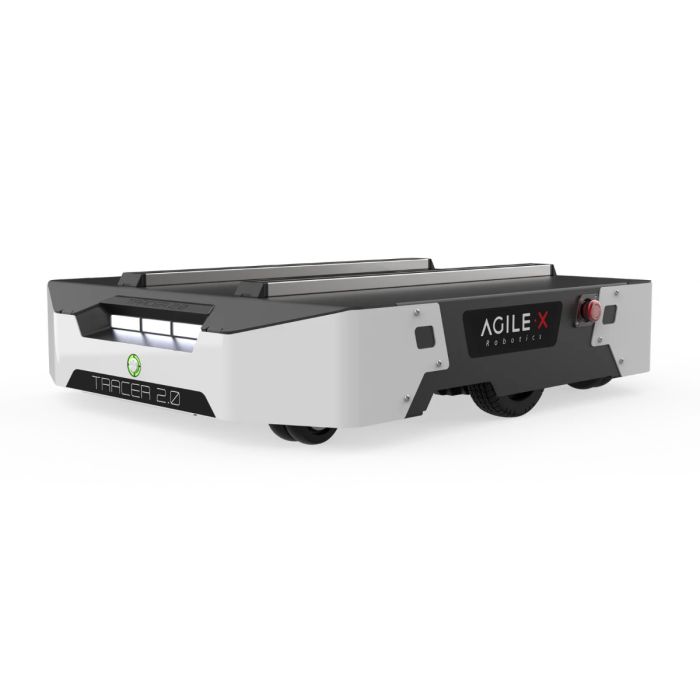
In many robotics projects the first machine built is a demonstration, and the second has to work a full shift. The step between the two is where chassis choices are tested. Batteries that looked adequate in a lab run out halfway through a logistics trial, wheels lose traction under a loaded tote, and a mounting plate drilled by hand becomes the weakest part of the build. The Agilex TRACER 2.0 is designed for the second machine. It is a compact two-wheel differential AGV built for smart indoor logistics and robotics R&D, with 400W motor power, a speed of 2 m/s and a 150KG payload. It gives a project a base it can keep using once the demonstration is over.
Robots Middle East supplies the Agilex TRACER 2.0 to universities, research centres, system integrators and logistics operators across the Middle East. Robots Middle East handles quotation, delivery and after-sales support for the platform. Our team can also help you match the chassis to the sensors, compute and payloads your application calls for.
Background
AgileX and its family of mobile bases
AgileX builds mobile robot chassis and kits for developers, laboratories and integrators. These are platforms that supply the drive, power and structure, while the customer adds perception, autonomy and the working payload. The range covers differential, Ackermann-steered and tracked bases as well as manipulation kits. Teams that standardise on one ecosystem can therefore carry their software habits from one vehicle to the next. TRACER 2.0 is the indoor, compact member of that family. It is aimed at smooth floors, corridors and shelving aisles rather than open terrain.
Positioning: more strength in the same footprint
The idea behind the second-generation TRACER is simple. It delivers more speed and strength in the same small footprint. The body measures 702mm x 610mm x 169mm, so it stays low enough to pass beneath many fixtures and to carry loads with a low centre of gravity. An enhanced triple-arm structure ensures precise movement under load. This matters for a differential-drive vehicle, because heading accuracy depends on both drive wheels keeping consistent contact with the floor. Swing arm non-independent suspension links the wheels so that small floor irregularities are absorbed without the chassis rocking off its track. The 30AH battery doubles runtime for high-demand operations, which addresses the shortfall that so often ends a long trial early.
Technical Specifications
| Specification | Value |
|---|---|
| Product type | Compact two-wheel differential AGV for smart indoor logistics and robotics R&D |
| Dimensions | 702mm x 610mm x 169mm |
| Weight | 54-56kg |
| Motor | 2×400W Brushless motor |
| Speed | 2 m/s |
| Payload | 150KG |
| Braking distance | 0.9m (Empty, deceleration 0.5) |
| Battery | 24V 30Ah Lithium battery |
| Suspension | Swing arm non-independent suspension |
| Structure | Enhanced triple-arm structure |
| Protection | IP22 |
| Operating temperature | -10~40°C |
| Obstacle handling | 10 mm steps, 25 mm gaps |
| Mounting | Aluminium T-slot rails for external sensors or kits |
| Communication | CAN bus protocol |
| Software | Open-source SDK and software resources; ROS 1 (Melodic, Noetic) and ROS 2 (Foxy, Humble) |
Specifications are as published by the manufacturer and are confirmed against the datasheet at quotation.
The manufacturer has not published the package contents, a full list of communication interfaces, whether a controller or remote is included, or any certifications; Robots Middle East confirms these points at quotation.
How does the TRACER 2.0 chassis behave under a full load?
Payload figures alone say little about how a chassis drives once it is loaded. On TRACER 2.0, the 150KG payload is supported by the enhanced triple-arm structure and the swing arm non-independent suspension. Together they keep the wheels planted, so the vehicle tracks where it is commanded to go. For mapping and localisation this is more than a mechanical detail. Wheel odometry that drifts under load adds error to every pose estimate built on it.
Indoor floors are rarely perfect, and the chassis is specified to handle 10 mm steps and 25 mm gaps with ease. That covers features such as lift thresholds, expansion joints and the edges of floor mats. The braking distance of 0.9m is stated for an empty vehicle at a deceleration of 0.5. An integrator planning stop zones for a loaded robot should treat that as the unloaded starting point and validate stopping behaviour with the real payload.
Environment matters too. IP22 protection is an indoor-class rating, suited to dry, sheltered interiors rather than washdown areas or outdoor exposure. The -10~40°C operating range covers most conditioned warehouses, laboratories and cold-store antechambers. Buyers in the region planning deployment near loading bays or in unconditioned buildings should compare that range with measured site temperatures.
How does TRACER 2.0 fit into a ROS development workflow?
The other half of the argument is software. TRACER 2.0 supports the CAN bus protocol for connections. It comes with an open-source SDK and software resources, including full SDK documentation and examples. It works with ROS 1 (Melodic, Noetic) and ROS 2 (Foxy, Humble). A laboratory can therefore keep a legacy ROS 1 stack running while it migrates to ROS 2, on the same hardware.
Physically, the aluminium T-slot rails give a repeatable, secure way to mount lidar, cameras, compute enclosures, shelving or a manipulator kit. Hardware can be moved along the rail during prototyping without re-drilling the deck. Once a layout is final, it can be reproduced exactly on a second or third vehicle. This combination of open software and modular mounting lets a research prototype grow into a fleet without a redesign.
Who is the Agilex TRACER 2.0 for?
The first group is university and corporate research laboratories working on navigation, SLAM, fleet coordination or human-robot interaction. They need a dependable indoor base that speaks ROS and leaves the research budget for the research. The second is system integrators building logistics solutions such as tote transport, line-side delivery and shelf replenishment. For them the payload, runtime and CAN bus control shorten the path from proof of concept to pilot. The third is product developers creating a branded service robot who want to place their own enclosure and payload on a proven drive base rather than engineering one from scratch. Technical colleges and training centres form a fourth group, because the open SDK and documented examples make the platform a teaching tool as well as a research one.
TRACER 2.0 is an indoor platform. Projects that need rough-terrain mobility, tracked drive or a ready-made manipulation setup should look across the wider AgileX range, and Robots Middle East can advise on which chassis matches the site and task.
What is the Agilex TRACER 2.0 used for?
- Indoor material transport moves totes, bins and parts between stations in warehouses and workshops.
- Navigation research provides a stable, ROS-ready base for SLAM, path planning and localisation experiments.
- Mobile manipulation carries a robot arm or kit mounted on the T-slot rails for pick-and-place studies.
- Inspection and data collection carries cameras and sensors along indoor routes in facilities and laboratories.
- Service robot development serves as the drive base beneath a custom enclosure for delivery or guidance robots.
- Teaching and training gives students hands-on experience of mobile robotics with open software and documentation.
Pricing and Availability
Robots Middle East supplies the Agilex TRACER 2.0 on a quotation basis. This lets us confirm the configuration, documentation and any accessories your project requires before you commit. Delivery, customs clearance and technical support are all arranged with the quotation. To begin, please share a brief outline of your application, payload and operating environment through the quotation request available on this page.
Frequently Asked Questions
What payload can the Agilex TRACER 2.0 carry?
TRACER 2.0 carries a payload of 150KG. It is supported by an enhanced triple-arm structure that keeps movement precise under load.
How fast does TRACER 2.0 travel?
The chassis reaches 2 m/s. Its braking distance is 0.9m when empty at a deceleration of 0.5.
Which ROS versions does it support?
TRACER 2.0 works with ROS 1 (Melodic, Noetic) and ROS 2 (Foxy, Humble). It comes with full SDK documentation and examples.
What battery does it use?
It uses a 24V 30Ah Lithium battery, and the 30AH battery doubles runtime for high-demand operations.
Can TRACER 2.0 be used outdoors?
TRACER 2.0 is built for indoor use, with IP22 protection and an operating range of -10~40°C. Outdoor or wet environments call for a different platform from the AgileX range.
Is a remote controller included?
The manufacturer has not published the package contents or whether a controller is supplied. Robots Middle East confirms what is included when it issues your quotation.
Where can I buy the Agilex TRACER 2.0 and what does it cost?
You can buy the Agilex TRACER 2.0 from Robots Middle East, which supplies it across the Middle East. Pricing is provided by quotation, together with delivery, customs and support arrangements, so please submit a request through this page.
Summary
A demonstration robot only has to impress once, whereas a working robot has to repeat its task every day. The Agilex TRACER 2.0 is built for the second role. It is a compact two-wheel differential AGV that combines 400W motor power, 2 m/s speed and a 150KG payload with a triple-arm structure for precise movement under load. A 30AH battery supports longer operations, and aluminium T-slot rails give hardware a secure home. CAN bus control, an open-source SDK and support for both ROS 1 and ROS 2 let a research stack grow into a deployable system without changing the base underneath it. For laboratories and integrators in the Middle East ready to move from prototype to pilot, this page is the starting point.