
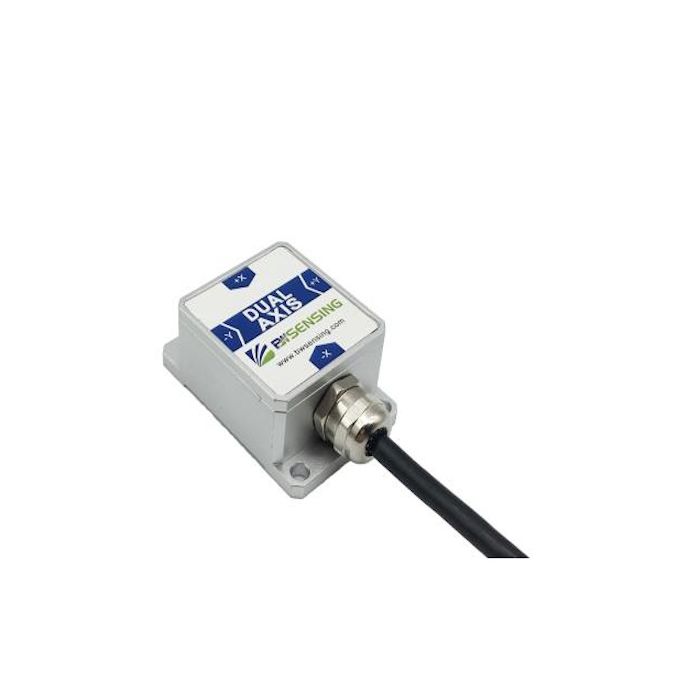
BWSENSING Low Cost Dual-Axis Digital Output With Modbus Inclinometer (BWL327S)
In stock
- BRAND:
- BWSENSING
- PART #:
- BWL327S
- ORIGIN:
- China
- AVAILABILITY:
- SUBJECT TO AVAILABILITY
- SKU:
- BWSENSING-BWL327S
BWSENSING Low Cost Dual-Axis Digital Output With Modbus Inclinometer (BWL327S)
A spirit level speaks to a person: the bubble drifts, an eye reads it and a hand makes the correction. Automated equipment has no eye, so the same question, how far has this tipped, must be answered in numbers, on a wire, continuously and for as long as the machine runs. The BWSENSING Low Cost Dual-Axis Digital Output With Modbus Inclinometer (BWL327S) gives that answer from a compact housing. It measures inclination on two axes across ±90°, resolves changes of 0.01° and delivers its readings over RS232, RS485 or TTL, so that a controller, a data logger or a monitoring platform can act on tilt without anyone needing to look.
Robots Middle East sells the BWL327S to system integrators, engineering contractors, research groups and operators of solar, telecom and industrial installations across the Middle East. Robots Middle East prepares each quotation around the specific project, arranges delivery and customs clearance to the destination, and supports the sensor once it is installed, from the first configuration questions through to integration with the customer's control system.
Background
BWSENSING and its inclinometer family
BWSENSING offers a broad family of tilt and inclination sensors, from single-axis instruments to dual-axis units, with CAN and serial digital interfaces among the outputs represented in the BWSensing range on this store. The sources for this product name several closely related versions, namely the BWL327S, BWL327, BWL326S and BWL325S. They share a common lineage but are separate models, and every figure on this page belongs to the BWL327S alone. Where a project specification refers to one of the other versions, Robots Middle East advises on the right model for the application.
Gravity as the reference, digits as the language
A static inclinometer of this class measures its orientation relative to the pull of gravity, a reference that is available everywhere and requires no external signal. A dual-axis instrument reports tilt about two perpendicular axes, usually described as X and Y, or pitch and roll, which matters whenever a structure or machine can lean in any direction rather than along a single hinge. What distinguishes the BWL327S within that class is its positioning: the product name states plainly that it is a low-cost device, yet it pairs that economy with IP67 protection, a published impact rating and a digital output that a modern controller can read directly, without an intermediate analogue-to-digital stage.
Technical Specifications
| Specification | Value |
|---|---|
| Axes | Dual-axis inclinometer measurement |
| Range | ±90° |
| Resolution | 0.01° |
| Highest accuracy | 0.1° |
| Output | RS232/RS485/TTL optional |
| Output frequency | 5-100Hz adjustable |
| Start-up time | <50ms |
| Voltage input | 9~35V |
| Protection level | IP67 |
| Impact resistance | 2000g, 0.5ms, 3 times/axis |
| Insulation resistance | ≥100 MΩ |
| Mean time between failures (MTBF) | ≥90000 h |
| Product size | L55mm×W37mm×H24mm (customizable) |
| Weight | 210 g (without outer packaging) |
Specifications are as published by the manufacturer and are confirmed against the datasheet at quotation.
The manufacturer has not published the package contents, the cable length, the baud rate options, the power consumption in watts, the operating temperature range or the mounting method; each of these is confirmed at quotation.
What does the choice of RS232, RS485 or TTL mean for integration?
The output of the BWL327S is specified as RS232, RS485 or TTL, and the choice is made to suit the system the sensor will join. Each interface serves a different kind of installation. RS485 is the usual preference in field automation: it is a differential bus that tolerates long cable runs and allows several devices to share one pair of wires, which suits a solar plant with many trackers or a structure monitored at several points. RS232 is a point-to-point link that remains common on industrial computers, test benches and older equipment. TTL-level serial is the natural match for a microcontroller or an embedded board mounted close to the sensor, as is often the case in robotics prototypes and compact instruments.
The product name places Modbus at the heart of the design. Modbus is one of the most widely supported protocols in industrial control, so a PLC, a SCADA system or a gateway can often poll the inclinometer with little bespoke software, and the integration team can work with tools it already knows.
The adjustable output frequency of 5-100Hz adds a further degree of flexibility. A slowly moving structure such as a tower can be reported at a low rate to reduce bus traffic, while a levelling platform or a tracker drive can request faster updates for tighter control.
How does a low-cost inclinometer stand up to field conditions?
Economy in a sensor often means compromise in its housing, but the published figures for the BWL327S point the other way. IP67 protection addresses dust and immersion, the two hazards that most often shorten the life of instruments mounted outdoors. The impact rating of 2000g, 0.5ms, 3 times/axis describes a tested tolerance to sharp shocks of the kind that occur during installation, transport or operation of heavy machinery. An insulation resistance of ≥100 MΩ and an MTBF of ≥90000 h complete a picture of a device intended to be installed and then left to work.
The voltage input of 9~35V is a wide window that accommodates the supply rails typically found in industrial cabinets, solar installations and vehicles, which simplifies wiring and reduces the need for dedicated regulators. A start-up time of <50ms means the sensor is reporting almost as soon as power is applied, a useful property for equipment that is switched on and off frequently or powered only when a measurement is required.
Who is the BWL327S for?
The BWL327S suits buyers who need dependable two-axis tilt data at scale and who prefer a digital interface over analogue wiring. Solar tracker manufacturers and photovoltaic engineering contractors are an obvious group, since a tracker must know its own angle in order to follow the sun, and a large plant multiplies the number of sensors involved. Telecom operators and structural engineers responsible for towers and masts form a second group, using the sensor to watch for gradual lean or sudden movement. Machine builders who design automatic levelling systems, and developers of medical instruments that must remain correctly oriented, make up a third.
University laboratories and robotics teams are also well served, particularly where TTL output allows the sensor to be connected directly to an embedded controller during development and the same model then carried into an RS485 field deployment.
Where only one axis matters, the BWSENSING Cost-Effective Single-Axis Digital Output With Modbus Inclinometer (BWM417) is a natural alternative, and for vehicles and machines built around a CAN network the BWSENSING Cost-Effective Single-Axis CAN Output Inclinometer (BWM415) matches that bus by name. The wider selection is available in the Sensors category, and Robots Middle East will advise on the most suitable model for a given specification.
What is the BWL327S used for?
- Photovoltaic automatic tracking – reporting the angle of each tracker so that the drive can keep the panels aligned with the sun.
- Tower tilt monitoring – watching telecom masts, transmission towers and similar structures for lean that develops over time.
- Industrial automatic leveling – providing feedback to platforms and machine beds that must hold a level position.
- Medical instruments – supplying orientation data to equipment whose function depends on correct positioning.
- Equipment attitude feedback – giving controllers on mobile or adjustable machinery a continuous record of pitch and roll.
- Robotics and research prototypes – adding two-axis tilt sensing to embedded systems through a direct serial connection.
Pricing and Availability
The BWL327S is supplied on quotation, so that the output option, the quantity and any customisation of the housing can be matched to the project before an order is placed. Delivery, customs and after-sales support are arranged with the quotation by Robots Middle East. To begin, please submit your requirements through the quotation request available on this page.
Frequently Asked Questions
What does the BWL327S measure?
It measures inclination on two axes, with a range of ±90°. This allows it to report tilt in any direction relative to gravity.
What is the difference between its resolution and its accuracy?
The resolution of 0.01° is the smallest change in angle the sensor can report, while the highest accuracy of 0.1° describes how closely a reading matches the true angle. Both matter, and they answer different questions.
Which outputs are available?
The output is specified as RS232, RS485 or TTL, selected to suit the system the sensor will join. The product name also identifies the unit as a Modbus inclinometer.
Can the BWL327S be installed outdoors?
The sensor carries IP67 protection, which addresses dust and immersion, the main hazards for instruments mounted outdoors.
What power supply does it need?
The voltage input is 9~35V, a wide window that suits the supply rails common in industrial and solar installations.
How quickly does it deliver readings?
The start-up time is <50ms, and the output frequency is adjustable between 5 and 100Hz to suit the application.
Where can I buy the BWL327S and what does it cost?
The BWL327S is available from Robots Middle East, which supplies it across the Middle East. The cost depends on the configuration and quantity, so please request a quotation on this page.
Summary
The spirit level will always have its place on a workbench, but a solar plant, a tower or a self-levelling machine needs a level that reports to a controller rather than to an eye. The BWL327S fills that role with two-axis measurement across ±90°, 0.01° resolution, a choice of RS232, RS485 or TTL output and a housing rated IP67, all within a design that BWSENSING presents as low-cost. Robots Middle East quotes, delivers and supports it across the region. For any project that needs tilt expressed in numbers rather than bubbles, this page is the starting point.